Three IP cameras may have enough battery energy for the night, yet one is denied PoE power. Before expanding storage, check the switch’s voltage-specific PoE budget and port limits.
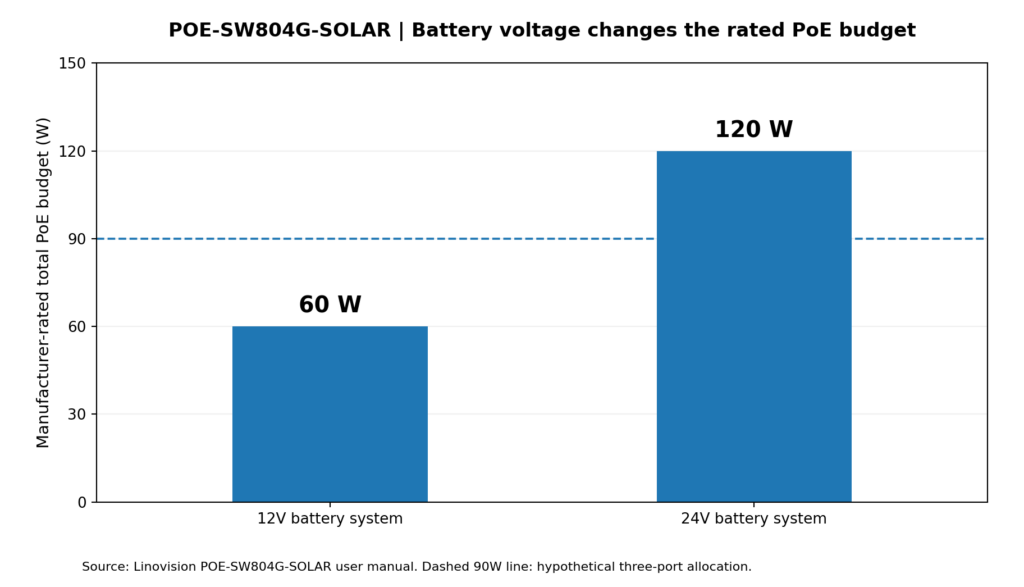
For example, Linovision rates its POE-SW804G-SOLAR at 60W total PoE on a 12V system and 120W on a 24V system. These ratings are model-specific. Parallel 12V batteries cannot unlock 120W mode. Check charging and startup separately.
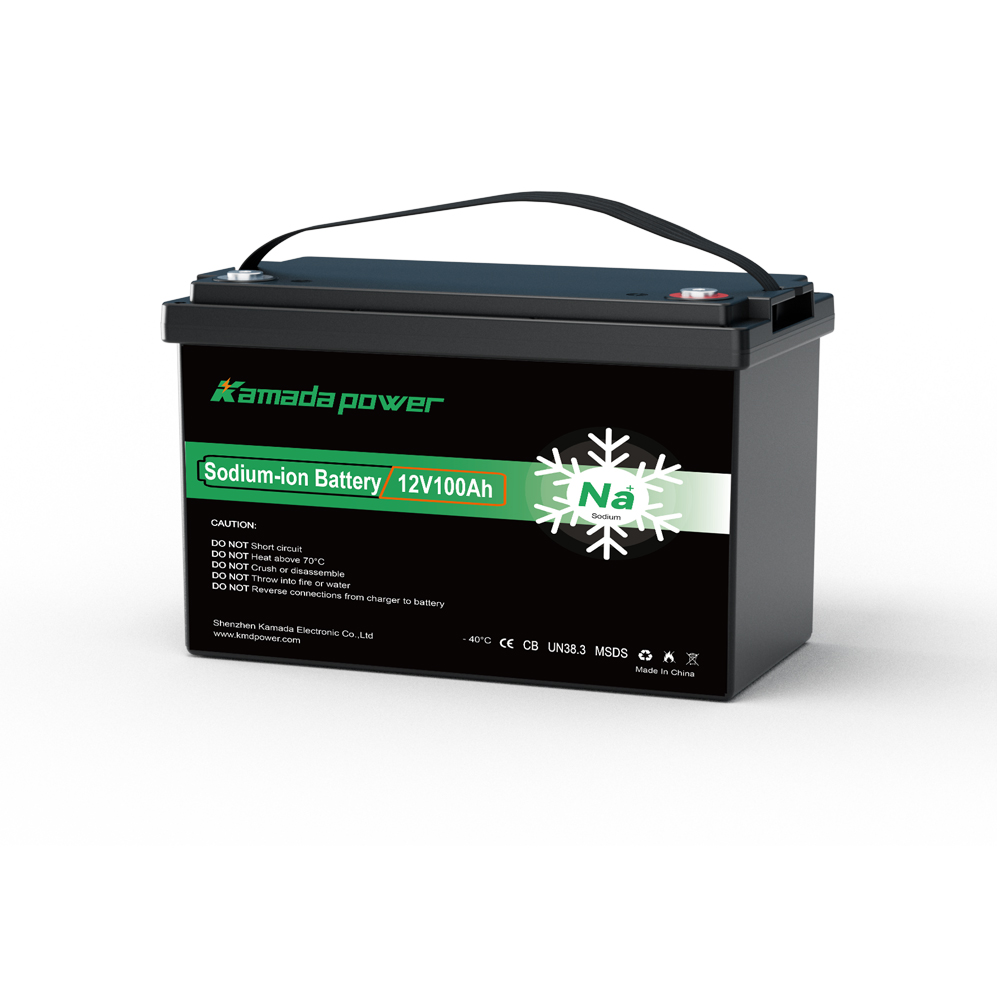
Kamada Power 12 V 100 Ah sodíkovo iónová batéria
Does the Same Solar PoE Switch Really Have a Different 12V and 24V Power Budget?
Yes. The Návod k obsluhe Linovision POE-SW804G-SOLAR specifies four IEEE 802.3af/at PoE ports and the following system-voltage-dependent ratings:
| Manufacturer-published specification | 12V battery system | 24V battery system |
|---|
| Total PoE power budget | 60W | 120W |
| Maximum PV panel power specified for the system | 170W | 340W |
| Maximum PV open-circuit voltage | 30V | 60V |
| Maximum charging current | 10A | 10A |
| PoE port standard | IEEE 802.3af/at | IEEE 802.3af/at |
Source: Linovision manual. The 10A limit is for battery charging, not PoE output or pack discharge. The separate auxiliary-load limit is not the PoE budget.
Figure 1. Rated total PoE output at 12V and 24V; the 90W reference is a hypothetical three-camera PSE allocation, not a Kamada Power Sodíkovo-iónová batéria test.
The 120W total is nie a per-port rating. Its IEEE 802.3af/at ports cannot supply a camera requiring an IEEE 802.3bt high-power port. The Ethernet Alliance’s PoE explanation distinguishes up to 30W at an 802.3at power-sourcing equipment (PSE) port from up to 25.5W delivered to a powered device (PD) under standard conditions. Both individual ports and aggregate budget must pass.
Why Can 24V Support More PoE Power Without Changing the Cameras?
At a given power and conversion efficiency, higher battery voltage means lower input current:
Battery-input current (A) ≈ total PoE output power (W) ÷ [battery voltage (V) × conversion efficiency].
Current and heat can limit power, but Linovision does not disclose the exact cause. These are calculations, not measurements.
At an assumed 85% efficiency, 60W from 12V needs about 5.9A of battery current; 120W from 24V also needs about 5.9A. Supplying 120W from 12V would need about 11.8A under the same assumption. Actual current changes with voltage and efficiency; the manufacturer’s 60W 12V rating remains binding.
How Much PoE Power Do the Cameras Need at the Same Time?
Typical camera consumption is not enough for power allocation. Axis’s December 2025 white paper explains why IR, heaters, motors and other functions change maximum consumption. Check the exact camera’s PoE standard, negotiated or reserved PSE power, maximum demand and operating modes.
| Proposed camera configuration | Illustrative PSE allocation | 60W budget at 12V | 120W budget at 24V |
|---|
| Two cameras, each allocated 15.4W | 30.8W | Potentially within budget | Potentially within budget |
| Three 802.3at cameras, each needing up to 30W at PSE | 90W | Exceeds budget | Within budget; verify ports and conditions |
| One camera needing an IEEE 802.3bt 60W-class port | 60W-class port needed | Incompatible port | Incompatible port |
Illustrative allocations, not equipment tests. Verify negotiation, firmware, port limits and cable losses.
Three cameras drawing about 20W each can exceed a 60W PSE allocation budget once classification, reservation and cable losses are considered.
If a third camera is denied power, inspect port allocation. For nighttime drops, log IR/heater peaks. If all cameras reboot, check the DC bus, BMS, undervoltage and temperature before blaming PoE budget.
Why Does a Larger 12V 100Ah Sodium-Ion Battery Not Fix This Limit?
Stored energy (Wh) is not the switch’s permitted output power (W). Stránka Kamada Power 12V 100Ah sodium-ion battery datasheet supplied for this review určuje 12V nominal, 1,200Wh nominal energy, 15.6V maximum charge voltage, 8V discharge cutoff and up to 100A continuous pack discharge. They neither raise the 60W rating nor prove usable Wh or loaded pack voltage.
Stránka 8V discharge cutoff is not a CCTV operating target. Verify the switch’s low-voltage disconnect, wiring drop and BMS recovery. Linovision re quires a 12V battery above 9V to start the controller. A low-voltage shutdown needs a validated recovery path; sunlight alone does not guarantee restart.
Linovision 4S LiFePO4 reference profile zoznamy 14.4V boost, 14.2V float, 15.0V overvoltage protection and 0.5A end current. The supplied Kamada Power datasheet describes 20A CC to 15.6V, then CV to 2A at 0–45°C. Ide o not matching approved charging profiles. The 14.4V target may undercharge this pack; the reference 15.0V protection point is below its standard charge target. Linovision’s 10A charger limit is below Kamada Power 20A standard rate but is not inherently unsafe or incompatible if the pack maker approves a lower charge current. Temperature restrictions still apply.
For a battery other than the default 12V LiFePO4, Linovision requires a separately sold RS485-to-USB cable and LINOVISION Tool Box to configure parameters after connecting the battery and before connecting PV. Confirm the exact firmware supports the pack maker’s approved voltage, charge termination, float behavior, temperature protection and recovery settings. Adjustable parameters do nie prove sodium-ion compatibility. Never bypass protection to force a match.
The separate Kamada Power 12V 100Ah sodíkovo iónová batéria uses a 12.8V model designation; do not combine unconfirmed revisions. Even manufacturer-approved parallel 12V packs increase possible reserve without changing nominal bank voltage or unlocking the switch’s 24V PoE budget.
Do not series-connect 12V packs without explicit approval. A 12-to-24V booster on an all-in-one MPPT battery port may disrupt charging or system detection. A separate 24V power path requires independent qualification.
What Other Limits Can Cause a Camera to Be Denied PoE Power?
Per-port capability. IEEE 802.3af/at is not 802.3bt. A 120W aggregate budget does not convert a 30W-class port into a 60W-class one. Verify each camera’s required PoE type.
Power allocation or negotiation. A PSE may reserve power by class or communicated request. Cisco’s PoE guidelines document budget-dependent allocation and denial, but do not establish Linovision’s firmware algorithm. Check this switch’s actual logs and LEDs.
Common input undervoltage. Controller LVD, converter input limits or BMS discharge interruption may take several cameras down at once. Log pack and switch-input voltage with protection status. The 8V pack cutoff is not an approved controller LVD.
Temperature and startup. Test simultaneous IR, PTZ, heaters and restarts. Determine which event failed first rather than assuming every outage is a PoE budget issue.
Output operating mode. Linovision documents manual, light-controlled and scheduled load modes. Verify which mode affects the PoE ports versus the auxiliary LOAD output, and confirm the selected configuration supports 24/7 CCTV, not nighttime-only lighting.
Charging compatibility. Passing the 60W output test does not approve the MPPT. Verify the pack’s 15.6V charging specification, current limits and controller settings independently.
How Should an OEM Qualify a 12V sodium-ion Battery and Solar PoE Switch?
Freeze the hardware BOM: exact switch and firmware, cameras, Ethernet runs, charger profile, Kamada Power Sodíkovo-iónová batéria pack/BMS revision, site temperatures and expected duty cycle.
1. Screen total power. Sum the camera maximum or negotiated PSE allocations. If the design requires 90W, it fails the present switch’s 60W 12V total regardless of battery Ah.
2. Check each port. Confirm IEEE 802.3af/at compatibility, per-port class, allocated power, wiring and cable losses; reject unsupported 802.3bt demands.
3. Verify battery and MPPT compatibility. Skontrolujte Cieľová hodnota nabíjania 15,6 V, current and temperature limits, 8V pack cutoff, LVD/LVR and >9V controller startup. Follow Linovision’s RS485-to-USB/Tool Box setup procedure for non-default chemistry before PV connection, then confirm that firmware can implement the manufacturer-approved settings. Hold approval if it cannot.
4. Run all cameras together. Include IR, heaters, PTZ and routers; log PoE allocations, battery V/I, input voltage, BMS events and temperature. Verify 24-hour PoE/LOAD output behavior under the selected manual, light or schedule mode, and check continuous recording.
5. Diagnose the first constraint. A denied third port suggests allocation or port limits; all cameras resetting suggests common-bus or protection events; regular timed shutdowns suggest output-mode settings. After low-voltage shutdown, verify automatic BMS/controller recovery. Confirm with logs.
6. Record power and procurement decisions. A constant 60W PoE output for 24h needs 1,440Wh at the PSE output, before conversion losses—more than this pack’s 1 200 Wh menovitej energie without daytime replenishment. Actual duty cycle, usable battery Wh and PV recharge determine autonomy. Choose keep 12V / change PoE device / engineer 24V / reject, recording outstanding tests.
Do not force BMS trips, exceed controller ratings or bypass the equipment’s safeguards.
Should the Project Keep 12V, Change PoE Hardware, or Move to 24V?
Keep the existing 12V arrangement when allocations fit 60W, each port and the approved battery/charger settings pass, the output mode supports required uptime, and recovery tests succeed. Approved parallel expansion adds reserve, not PoE output rating.
Keep 12V but change the PoE device when the project needs, for example, 90W of PSE allocation and a different switch can deliver that budget from an actual 12V input, with an approved charging architecture. This can avoid unnecessarily replacing the complete battery system.
Consider a properly engineered 24V architecture when camera demand and available equipment justify it. Requalify the 24V battery or bank, charger/MPPT, PV voltage, protection and startup. Do not assume two 12V sodium-ion packs can be connected in series.
Reject the combination if a camera needs an unsupported PoE port, the required power exceeds available hardware ratings without a viable redesign, or the battery charging and recovery requirements cannot be met safely.
Kamada Power existing security-system application guide covers battery use more broadly. Here the procurement decision is whether this particular PoE switch can supply the simultaneous cameras from the chosen 12V pack, without an incompatible charger or recovery path.
What Should a Surveillance OEM Send Before Selecting the Battery?
Send the switch firmware, camera maximum PoE allocations, port map, MPPT settings, output operating mode, pack revision, site temperatures and annual volume. State whether 12V and 24/7 unattended recovery are required.
Stránka Kamada Power 12V 100Ah sodíkovo iónová batéria does not prove this switch/pack pairing. Provide the exact datasheet and wiring schematic.
Často kladené otázky
Does a 120W PoE budget mean one camera can receive 120W?
No. Total budget and per-port capability are separate. This model uses IEEE 802.3af/at, not an IEEE 802.3bt high-power port.
Can a fully charged 12V sodium-ion battery make a 60W switch supply 90W?
No. Battery state of charge and 100Ah capacity cannot override the switch’s 60W total PoE rating at 12V.
Why do my cameras work individually but not all at once?
Their combined PoE allocations may exceed the budget, or a single port may be incompatible. Check port logs first; if all cameras reboot together, also measure common DC voltage, temperature and BMS/controller state.
Will two approved parallel 12V 100Ah packs unlock the 24V power rating?
No. Manufacturer-approved parallel packs remain a nominal 12V bank. They may extend runtime or reduce sag, but the same switch stays rated for 60W at 12V.
Can I use a 12-to-24V boost converter to obtain the 120W rating?
Not by feeding boosted voltage into the integrated MPPT battery input. A separate higher-voltage PoE power path might be engineered, but only with appropriate switch input ratings, isolation, protection and battery/charger approval.
Záver
The same solar PoE switch may have different total camera-power ratings at 12V and 24V. For Linovision’s POE-SW804G-SOLAR, these are 60W versus 120W, with unchanged IEEE 802.3af/at per-port limits. More 12V battery capacity cannot raise the 60W ceiling. Verify camera allocations, the Kamada power 15.6V charge profile, non-default battery configuration, >9V startup, continuous output mode and daily energy balance. Keep 12V with compatible PoE hardware, qualify a different 24V architecture, or reject the pairing. Kontaktujte spoločnosť Kamada Power with the camera list, firmware, charging settings, wiring and planned volume for a revision-specific review.