Off-grid CCTV cameras may use only a few dozen watts, yet the battery empties faster than predicted. An overlooked load is the inverter and its AC adapters. Before adding another 12V 100Ah sodium-ion battery, measure AC-path watt-hours and verify voltage compatibility. DC may save energy; some equipment still needs AC.
Inverters draw power even at no AC load; peak efficiency does not establish low-load performance. Compare AC and qualified DC designs delivering the same uninterrupted service using DC-input Wh. First check voltage: the supplied Kamada Power sodium ion battery pack 15.6V charging target exceeds the example SureSine Classic SI-300’s 15.5V input ceiling. Efficiency cannot justify an electrically incompatible pairing.
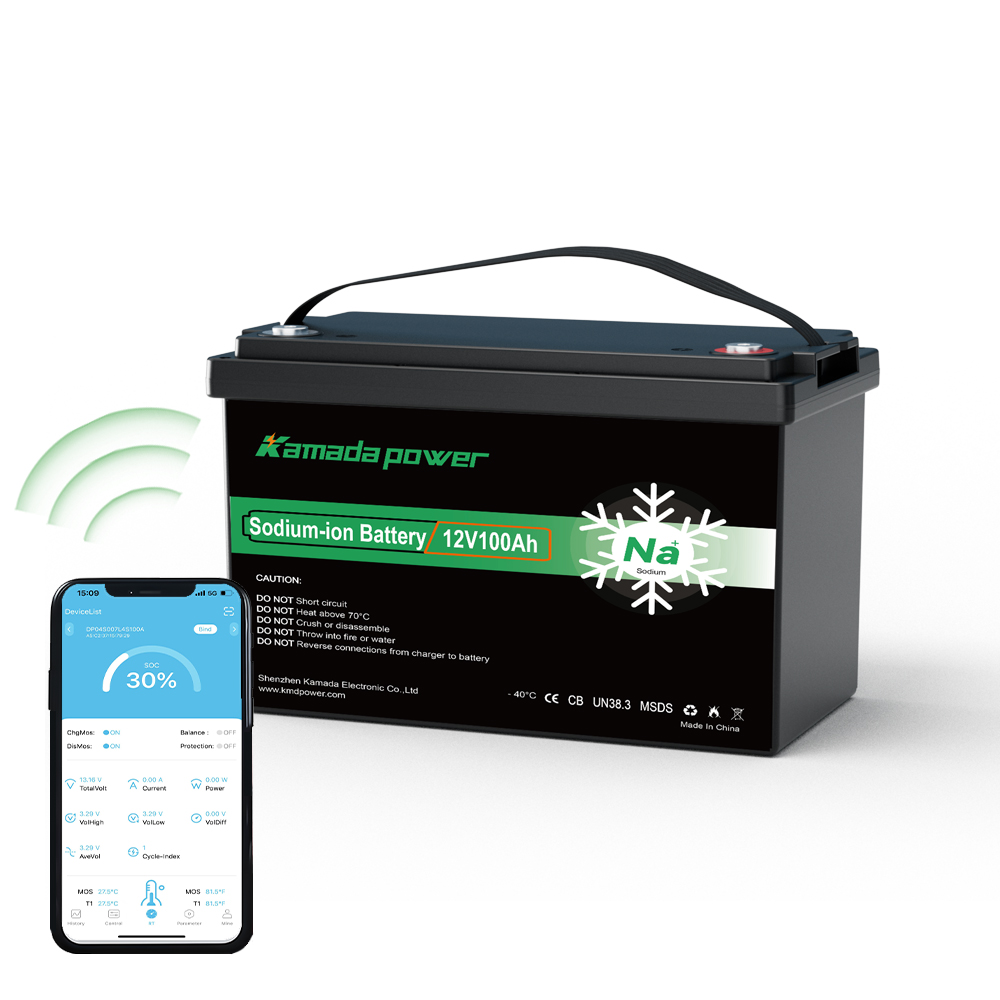
Kamada Power 12V 100Ah sodíkovo iónová batéria
How Much Energy Can an Inverter Consume with No Camera Load?
Morningstar’s SureSine Classic SI-300 is a 300W, 12V-input off-grid inverter. Its published self-consumption is 450mA ON with no AC load, 55mA standby a 25mA OFF, s 92% peak efficiency in the current datasheet. These model-specific figures are not Batéria Kamada Power test results. Morningstar Classic specifications.
At an assumed 12V input, no-load ON draw is 12V × 0.45A = 5.4W, alebo 129.6Wh in 24 hours—more than a 5W device running all day (120Wh). Actual draw varies with voltage, mode and load.
| SureSine Classic state | Published DC current | Illustrative power at 12V | 24h equivalent if continuously in this state |
|---|
| Inverter ON, no AC load | 450mA | 5.40W | 129.6Wh |
| Pohotovostný režim | 55mA | 0.66W | 15.8Wh |
| Inverter OFF | 25mA | 0.30W | 7.2Wh |
Figure 1. Published currents converted to Wh at assumed 12V; not measured energy. Standby and OFF do not represent continuous AC CCTV service.
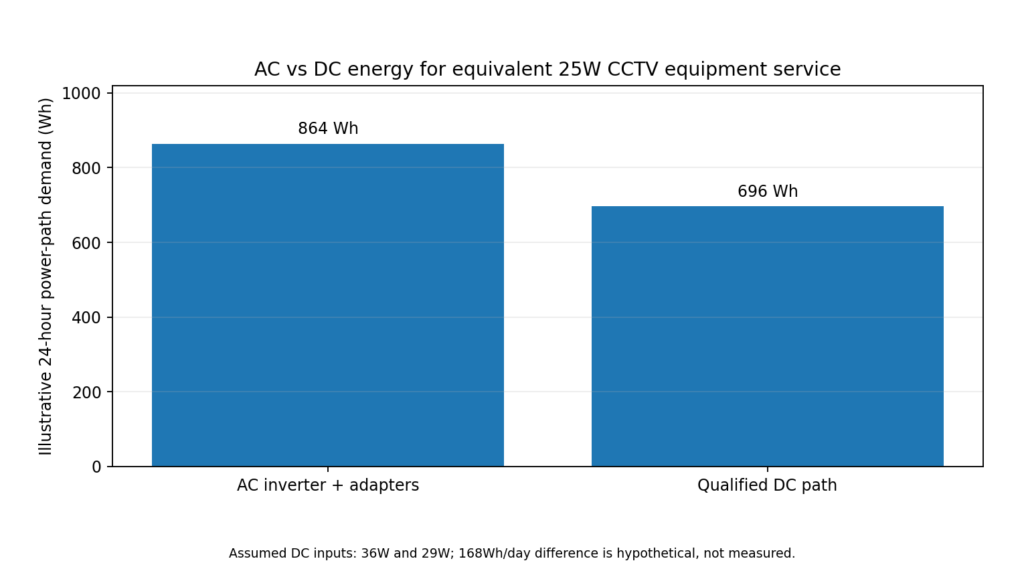
Na stránke Always ON mode, AC stays available unless a fault occurs. In standby, the current Classic data indicates about 8W to detect an AC load; the 2006 manual lists ~8W for SI-300-220V and ~10W for SI-300-115V. Confirm the actual model/revision before relying on standby: small CCTV loads may lose AC service. Always ON is the default. Morningstar Classic manual.
Do not add 5.4W idle power to measured loaded DC input: it already includes inverter overhead.
Why Does a Small CCTV Load Make Inverter Efficiency Important?
A 300W inverter supplying 25W runs at 8.3% of rated output. Morningstar’s Classic datasheet efficiency curve shows efficiency varies with load; do not read a precise 25W efficiency from that plot. Fixed consumption, switching and adapters matter. DOE/LBNL AC/DC research likewise uses load-dependent curves, but does not prove CCTV savings.
Camera loads also vary. Axis’s December 2025 white paper gives one example with 4.7W typical (heater/IR off) v porovnaní s 12.6W maximum. IR, heaters and motors change demand; those figures do not describe every camera.
An enclosure may also contain an NVR, router, PoE switch and adapters. Count the entire conversion chain, not only camera watts. The Classic manual lists 95°C heatsink shutdown and 80°C recovery; check enclosure heat and thermal events. Some equipment requires AC.
How Much Battery Energy Does the AC Power Path Actually Use in 24 Hours?
Miera DC branch watt-hours, not inverter nameplate watts or AC volt-amperes (VA).
During battery-only discharge:
Battery discharge energy (Wh) = ∫ battery-terminal voltage (V) × discharge current (A) dt, with time in hours; if in seconds, divide by 3,600.
Meter the inverter’s DC input and its AC real watts. With PV on the bus, separately log inverter/other branches, battery charge/discharge and solar input; PV may power loads directly. Compare 24-hour paths delivering the same recorded service, including night operation.
An illustrative AC-versus-DC comparison
Assume the same 25W useful CCTV load in two hypothetical architectures: 36W DC input for inverter-plus-adapters versus 29W for a qualified DC path. These are planning assumptions, not Morningstar or Kamada Power measurements.
| Comparable quantity | AC inverter + AC adapters | Qualified DC supply |
|---|
| Useful equipment power | 25W | 25W |
| Assumed battery-side path input | 36W | 29W |
| Path energy over 24 hours | 864Wh | 696Wh |
| Energy difference against AC design | - | 168Wh/day less |
Figure 2 — Illustrative 24-hour energy for equivalent CCTV service
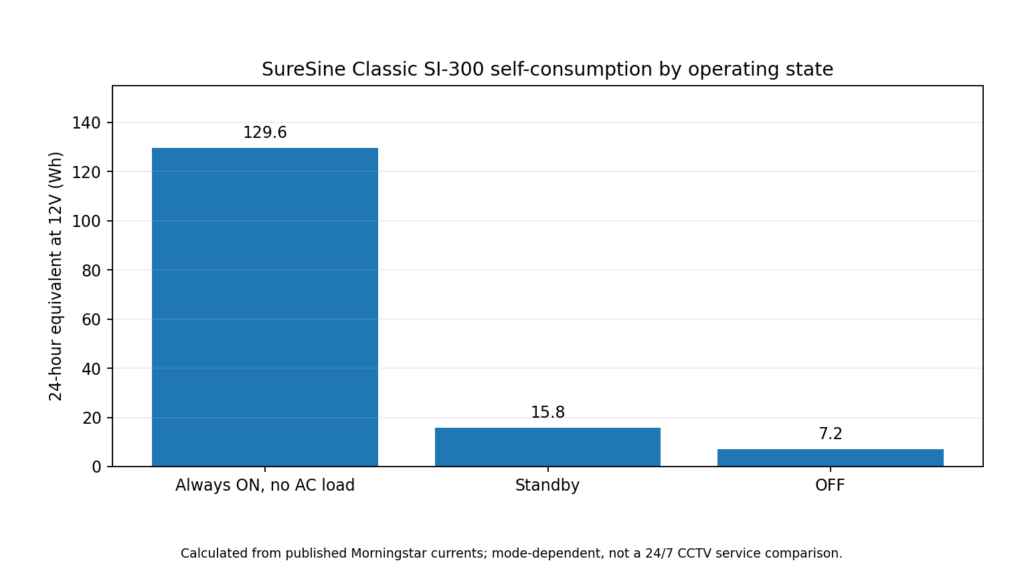
Illustrative inputs; 168Wh/day is not measured battery saving. No-load draw is not counted twice.
A 7W × 24h = 168Wh/day reduction in path demand may reduce battery or solar demand, but usable Wh, recharge, temperature and cutoff still determine runtime.
Which CCTV Loads Can Safely Move from AC to Direct DC?
Skontrolujte each device’s approved input, not just its wall plug. Cameras may use regulated DC or IEEE PoE, routers another voltage, and NVRs may require AC. Never bypass internal mains supplies or confuse passive and active PoE.
A DC redesign must cover the verified pack and charging voltage window, rail tolerance, startup/IR/heater peaks, protected wiring, grounding, cable loss, temperature and recovery. Meter DC-converter idle and loaded Wh too.
EXISTING AC PATH                   POSSIBLE APPROVED DC PATH
12V sodium-ion pack                 12V sodium-ion pack
        |                                    |
  DC-to-AC inverter                    Protected DC bus
        |                                    |
   AC adapter(s)                   Rated DC-DC / PoE supply
        |                                    |
 CCTV / router / NVR                CCTV / router / NVR
Concept only, not an approved wiring diagram. Preserve protection and the required recording service.
Is the Runtime Shortfall Actually the Inverter or the Battery?
Four causes can look alike: conversion overhead, insufficient usable Wh, a voltage-limit shutdown, or inadequate daily recharge.
Voltage compatibility is a veto, not an efficiency calculation. The SureSine Classic SI-300 určuje 10.0–15.5V DC, s 15.5V high-voltage disconnect a 14.5V reconnect. The supplied Kamada Power 12V 100Ah sodium ion battery datasheet určuje 12V nominal, 1,200Wh nominal, 15.6V maximum charging voltage and 8V discharge cutoff; its standard CC/CV procedure reaches 15.6V. If the Classic input sees that voltage, it exceeds the published limit and may disconnect AC. Reject a direct shared-bus pairing unless an approved design covers all operating states, tolerance and transients; cable drop is not overvoltage protection. The Kamada Power 12 V 100 Ah sodíkovo iónová batéria shows a separate 12.8V model designation; never merge unconfirmed revisions. Classic datasheet.
Classic low-voltage choices are 11.5V LVD / 12.6V reconnect (default) or 10.5V / 11.6V. The published LVD delay is four minutes; an older Classic manual also lists 10.0V instant LVD. Confirm the actual revision and capture both voltage and event timing, since startup sag and sustained undervoltage differ. Both selectable LVDs exceed the pack’s Ochranné vypnutie pri 8 V, not a normal service target. An inverter can stop early, but voltage thresholds alone cannot quantify remaining usable Wh. Check loaded voltage, temperature, BMS and restart; do not bypass protection.
Stránka 15.5V limit is Classic-specific. Morningstar’s newer SureSine 300W zoznamy 16.5V maximum for its 12V model, but needs separate qualification. Log daily charge/discharge; Ah alone cannot cure a persistent deficit.
How Should an OEM Test Inverter Losses Before Ordering More 100Ah Packs?
Use the actual battery, inverter, charger and CCTV BOM. Compare identical service and uptime.
- Map power branches. Include DC/AC, AC/DC, PoE and loads outside the inverter.
- Measure 24-hour energy. Separate inverter DC-input Wh, battery charge/discharge Wh and PV input; synchronize with recording logs.
- Check modes. Compare Always ON, standby and OFF; test the model-specific ~8–10W standby threshold with real loads. Sleeping is not continuous service.
- Check voltage limits. Log charge maximum, LVD/LVR, 4-minute delay, possible instant cutoff and transitions. Resolve the 15.6V/15.5V Classic conflict before approval.
- Test the DC design. Verify outputs, PoE, startup, peaks, isolation and heat. Compare matched duty cycles; require no local recording gaps, resets or loss of required remote video, and log thermal protection.
- Measure usable reserve. Use approved discharge limits, matched load/temperature and BMS recovery; consider approved parallel packs only after energy balance and interfaces pass.
Report path Wh, camera energy, usable pack Wh, voltage compatibility and recharge balance separately. Keep AC if DC fails safety or uptime requirements.
Should the OEM Change the Power Architecture or Buy Another Battery?
| Overený zistený fakt | Procurement decision |
|---|
| AC path draws materially more energy for equivalent service; approved DC/PoE interfaces pass | Qualify direct DC first, then reassess storage |
| AC must stay, but low-load or Always ON losses are excessive | Evaluate a better-matched inverter, with qualified input voltage and continuous AC |
| Proposed Classic inverter may see 15.6V above its 15.5V limit | Reject direct pairing or redesign the regulated input with manufacturer approval |
| Inverter LVD occurs before BMS cutoff | Coordinate authorized LVD/LVR, measure usable Wh and verify recovery |
| Compatible AC path is necessary but verified usable Wh cannot meet autonomy | Consider approved parallel capacity if charging can restore it |
| PV replenishes less energy than the system consumes | Correct daily energy deficit; more Ah postpones shutdown |
AC-only recorders or isolation requirements may justify an inverter. Compare uptime, efficiency, safety, maintenance and cost.
What Should a Surveillance OEM Send for an Energy-Loss Review?
Provide inverter model/settings, CCTV BOM, battery/PV Wh logs, charger, temperatures, uptime requirement and projected volume. Identify approved DC/PoE inputs.
Stránka Kamada Power 12V 100Ah sodium-ion product is a candidate, not a tested inverter pairing. Its security-system applications guide provides context; here the decision is avoidable AC-path Wh versus battery-voltage incompatibility.
Často kladené otázky
Can an inverter drain a 12V 100Ah CCTV battery when no cameras are drawing power?
Yes. Classic lists 450mA ON/no-load: 129.6Wh/day at assumed 12V. Standby/OFF draw less but cannot be treated as uninterrupted service.
Is a 92% peak-efficient inverter 92% efficient at a 20W camera load?
No. Use the manufacturer’s efficiency curve or meter DC input and AC real watts at that load. Do not double-count no-load draw.
Does switching to DC always extend CCTV runtime?
No. A qualified DC/PoE path must show lower measured Wh for identical uninterrupted service and satisfy input limits.
Will adding a second 12V 100Ah pack fix the inverter’s losses?
Approved parallel packs add reserve, but do not fix conversion losses, the Classic 15.6V/15.5V conflict, or a daily energy deficit.
Can inverter ECO mode maintain 24/7 CCTV?
Only if recording continues. Classic standby is approximately 8W or 10W depending on model/revision; verify the actual camera, router and NVR loads.
Záver
An inverter can be a hidden load in small solar CCTV Battery systems, but measured DC-input energy and uninterrupted service—not idle current alone—must guide procurement. The Classic’s 450mA no-load current is published; the 168Wh/day AC–DC difference is hypothetical. The supplied Kamada Power sodíkovo iónová batéria pack’s 15.6V charge target exceeds the SureSine Classic SI-300’s 15.5V ceiling. Resolve voltage compatibility, LVD timing and standby behavior before choosing direct DC, another inverter or more approved capacity. Kontaktujte spoločnosť Kamada Power with inverter settings, schematic, 24-hour Wh logs, temperature and projected annual volume for a revision-specific review.