Many 4×4 brands start a battery RFQ with one short message: “Please quote 12V 100Ah slimline lithium battery with our logo.” That may get a rough price, but it is not enough for a serious private label project.
A slimline lithium battery may need to fit behind a seat, inside a ute canopy, under a drawer system, or beside a DC-DC charger, fuse box, inverter, shunt, and solar controller. It may also carry your brand label, carton, manual, warranty promise, and market documents.
If you want an accurate quotation, send the supplier enough information to check fitment, current rating, charging compatibility, branding cost, shipping documents, and sample approval before pricing.
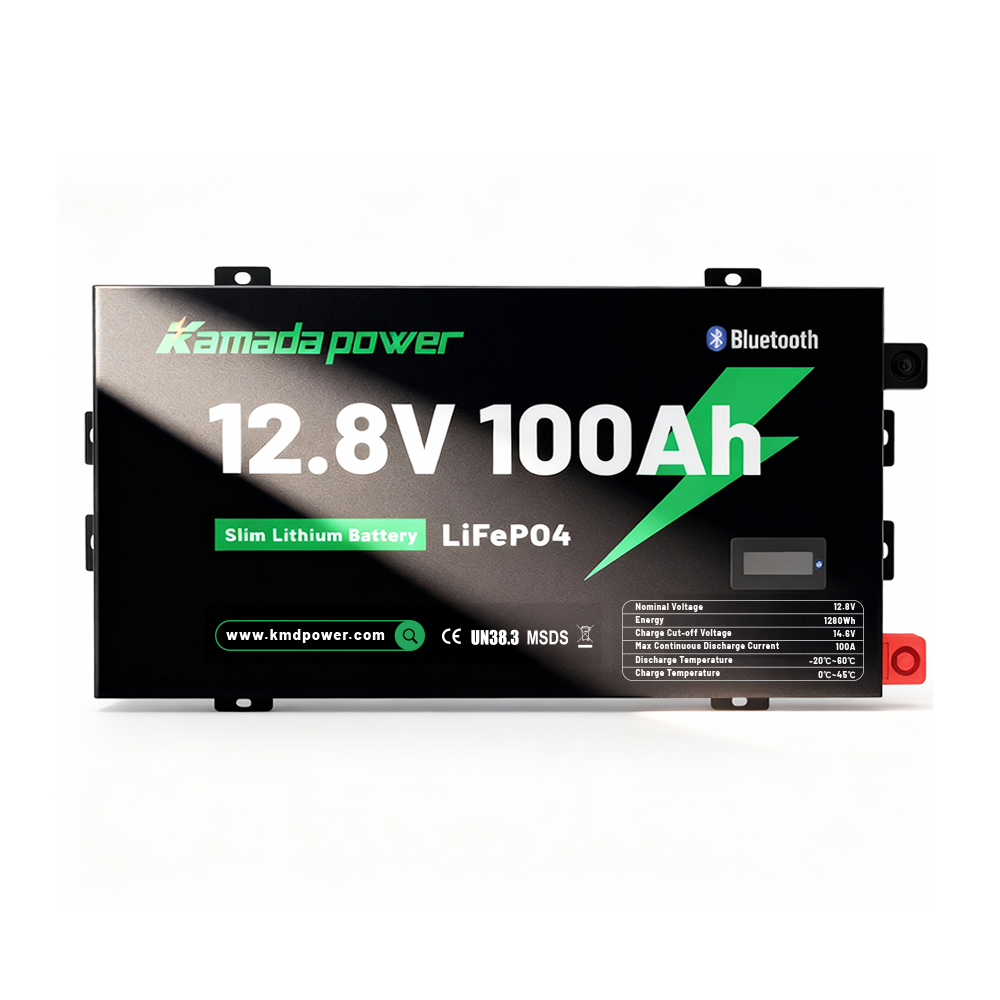
Kamada Power 12v 100Ah Slimline lithium battery
Quick Answer
Before asking for price, send the target voltage, capacity, maximum dimensions, installation position, mounting direction, terminal layout, load profile, charging system, BMS requirements, private label files, packaging needs, destination market, required documents, sample test plan, order quantity, and launch schedule.
| RFQ Item | What to Send | Why It Matters |
|---|
| Battery model | 12V 100Ah, 150Ah, 200Ah, or custom | Defines cells, BMS, case size, and cost |
| Installation space | Maximum L × W × H and cable clearance | Prevents sample fitment failure |
| Application | Behind-seat, canopy, drawer, camper, fleet ute | Helps select case and terminals |
| Load profile | Fridge, lights, inverter, compressor, Starlink | Defines capacity and discharge current |
| Charging system | DC-DC, solar MPPT, AC charger, alternator | Prevents charge mismatch |
| Branding | Logo, label, carton, manual, serial number | Affects MOQ, lead time, and approval |
| Documents | Destination market and required files | Affects shipment and selling readiness |
Why a Private Label RFQ Is Different
A standard battery inquiry focuses on price, capacity, and delivery time. A private label RFQ is different because the battery will be sold under your brand. Your customer will judge it by fitment, reliability, packaging, instructions, support, and warranty.
The supplier is not only quoting cells and a BMS. The quotation may include a slim enclosure, terminal layout, internal wiring, label design, carton printing, manual preparation, serial number tracking, compliance documents, and sample testing support.
1. Define the Target 4×4 Application
Start by telling the supplier where and how the battery will be used. “Slimline” can mean behind-seat, under-seat, canopy-mounted, drawer-mounted, camper trailer, service ute, overland kit, or removable canopy battery.
Also explain the end user. A weekend camper, mining service vehicle, touring customer, and fleet installer have different expectations. A fleet installer may care more about repeatable wiring, labels, serial numbers, and service access. A retail 4×4 brand may care more about carton design, manual quality, logo presentation, and warranty registration.
If the product is designed for specific vehicles, include the vehicle models. Fitment can affect bracket design, terminal direction, cable exit, and clearance.
2. Send Mechanical Requirements First
Mechanical information is often more important than capacity at the beginning of a slimline project. A battery can have the correct Ah rating but still fail if it does not fit the real installation space.
Send maximum length, width, height, required slim thickness, cable bending space, terminal clearance, mounting orientation, bracket or tray requirement, case color, surface finish, expected IP rating, and exposure to heat, dust, mud, salt, or vibration.
Tell the supplier whether the battery will be mounted flat, upright, side-mounted, or vertically against a panel. Do not assume every battery can be installed in every direction.
3. Confirm Terminal and Connector Layout
Terminal position is a common cause of sample failure. In a slimline installation, a few centimeters can decide whether the battery is easy to install or impossible to service.
Your RFQ should specify front terminal or top terminal, positive and negative terminal side, terminal type, cable exit direction, fuse location near the battery, service access after installation, and protective covers.
Common options include M8 or other stud terminals, touch-protected high-current connectors, automotive connectors, industrial circular connectors, and custom harnesses. Do not specify a vague “aviation connector.” Define the required DC voltage and current, cable size, ingress rating, vibration resistance, mating-cycle life, polarity keying, touch protection, and whether connection or disconnection under load is permitted. For kits, also define cables, fuses, brackets, switch panels, and labels.
4. Send Electrical Requirements and Load Profile
Voltage and capacity are necessary, but they are only the beginning. You also need to define current, loads, charging, and runtime.
A useful RFQ should include expected continuous discharge current and peak discharge current. This is especially important if customers use inverters, compressors, induction cookers, tool chargers, or other high-power loads.
| Load Type | Information to Send | Design Impact |
|---|
| Fridge | Rated watts and duty cycle | Runtime estimate |
| LED lights | Total watts and hours | Capacity sizing |
| Inverter | Rated and surge watts | BMS and cable rating |
| Compressor | Startup current | Peak current protection |
| Starlink/router | Continuous watts and hours | Overnight energy budget |
Do not ask the supplier to guess runtime without load data. If you know daily Wh or Ah consumption, send it. If not, list the devices and usage hours.
5. Send Charging System Details
Many battery problems are caused by charger mismatch, wrong voltage settings, excessive charging current, solar controller behavior, or low-temperature charging conditions.
Send the DC-DC charger brand and model, charging current, lithium charging voltage, solar MPPT controller model, solar panel wattage, AC charger model, alternator system if relevant, whether solar and alternator charging work together, and expected low-temperature operation.
For 4×4 use, the DC-DC charger is especially important. The supplier needs the charge current and voltage profile to confirm whether the BMS, cells, and thermal design are suitable.
If your market includes cold regions, discuss low-temperature charging protection or heating requirements early.
6. Define BMS and Monitoring Requirements
A private label slimline lithium battery should have a BMS matched to the real application, not only to nominal capacity.
At minimum, ask for overcharge, over-discharge, overcurrent, short circuit, cell balancing, high-temperature protection, and low-temperature charging protection.
Then decide whether the product needs Bluetooth app, SOC display, LED indicator, CAN or RS485 communication, sleep mode, wake-up function, heating control, or data logging for warranty support.
7. Send Private Label Requirements
Private label is not just putting a logo on the case. It includes the full customer-facing product identity.
Prepare your brand logo in vector format, battery label design or reference, model name, SKU, voltage and capacity wording, warning icons, safety text, certification marks if applicable, serial number position, QR code or warranty registration link, case color, carton design, user manual requirement, barcode, and pallet label format.
If you do not have a final label design, send a reference style. Packaging should also be defined because neutral cartons, branded cartons, retail boxes, and palletized shipments have different costs.
8. Clarify Documents and Market Requirements
Lithium batteries require transport evidence and may also require separate product, electrical, radio, chemical, labelling, or vehicle-installation compliance depending on the destination and how the product is sold. State the exact market, sales channel, installation method, and whether the battery is supplied alone or inside a complete power kit.
Ask for an exact-model document matrix rather than “certificates available.” It may include:
| Requirement Area | Examples to Confirm | Important Boundary |
|---|
| Dangerous-goods transport | UN38.3 test summary, SDS/MSDS, shipping classification and packing data | UN38.3 is a lithium-battery transport test requirement; it is not a complete product-safety approval |
| Product specification | Datasheet, BMS limits, label, manual, serial format | Values must match the sample and production model |
| Destination-market compliance | Required declarations, test reports, markings or importer information | Requirements depend on market, product configuration and claims |
| Wireless functions | Bluetooth or other radio documentation where fitted | A battery without radio and a battery with Bluetooth may have different obligations |
| Installation system | Charger, fuse, cable and vehicle-fitment instructions | Battery documents do not validate the complete canopy installation |
Confirm document ownership, model number, laboratory or issuer, revision date, validity, and whether private-label artwork can legally carry the proposed marks. Do not assume a report for a similar battery covers the quoted model.
Transport-document boundary: UN38.3 is contained in the United Nations Manual of Tests and Criteria for dangerous-goods classification and transport. Treat it as transport evidence, not as proof that the complete battery or vehicle installation meets every product-safety or destination-market requirement.
9. Send a Sample Test Plan
Many buyers order samples without defining what “pass” means. This creates slow feedback and unclear responsibility.
Before sample production, define whether the sample is for engineering testing, vehicle fitment, installer review, distributor approval, marketing photos, field trial, or certification pre-check.
| Test Area | What to Check | Example Pass Standard |
|---|
| Fitment | Battery fits the target space | No terminal or cable interference |
| Charging | DC-DC and solar compatibility | No unexpected BMS cutoff |
| Discharge | Fridge, inverter, lights, compressor | Stable operation under target loads |
| Temperature | Hot and cold behavior | Protection works as specified |
| Vibration | Off-road use and mounting strength | No loose terminal or case damage |
| Label | Branding and warning text | Correct model, rating, and logo |
| Packaging | Carton and pallet protection | No damage after sample shipment |
10. Send Commercial Information
A private label quotation also needs commercial context. Send the sample quantity, first trial order quantity, first bulk order quantity, annual forecast, number of SKUs, label versions, launch date, destination country or port, preferred Incoterm, sample shipping method, and required delivery date.
A target price range can help after the specification is clear. However, do not use target price to replace technical requirements.
11. Common RFQ Mistakes to Avoid
Avoid these common mistakes: asking only for “100Ah slimline battery price,” ignoring installation space, forgetting the DC-DC charger model, treating private label as only a logo change, and ordering samples without approval criteria. Capacity does not define the real product. Size, BMS, current, charger, enclosure, label, documents, and testing standards all matter.
12. RFQ Template for 4×4 Private Label Slimline Battery Projects
Use this structure when contacting a supplier:
Company and market: company name, website, target market, sales channel, current product line, and launch date.
Battery specification: voltage, capacity, maximum dimensions, continuous discharge current, peak current, BMS functions, Bluetooth or display, and low-temperature requirement.
Installation: vehicle or canopy type, installation location, mounting direction, bracket or tray requirement, terminal direction, cable plan, and fuse plan.
Charging system: DC-DC charger model, solar controller model, solar panel wattage, AC charger model, charge current, and charge voltage profile.
Private label: logo file, label design, case color, manual, carton, barcode, serial number, and warranty card.
Compliance and logistics: destination country, product configuration, required transport and market documents, Incoterm, sample delivery method, first order quantity, annual forecast, and required delivery date.
13. What a Professional Supplier Should Reply
A good supplier should not simply send a unit price. They should review your RFQ and confirm size feasibility, BMS rating, charger compatibility, terminal layout, mounting direction, private label MOQ, lead time, available documents, sample test process, and risks before mass production.
If the supplier does not ask any engineering questions, be careful. A fast quote is not always a reliable quote.
14. When a Slimline Lithium Battery May Not Be the Right Choice
A slimline lithium battery is not suitable for every project. It may not be the right choice if the installation space is extremely hot, fully sealed, and has no ventilation. It may also be unsuitable if the customer expects engine starting performance instead of auxiliary energy storage.
If the inverter load is too high for the requested slim case size, a larger battery bank or different layout may be safer. Do not rush private label mass production before fitment, charging, load, and packaging are validated.
Conclusion
A private label slimline lithium battery quotation is only accurate when the supplier understands the full product. For 4×4 brands, the most important RFQ details include installation space, vehicle application, load profile, charging system, BMS functions, private label files, packaging, compliance needs, sample test plan, quantity forecast, and destination market.
If you are developing a private label slimline lithium battery for 4×4, ute canopy, dual battery, overland, or fleet applications, Contact us. send your RFQ details to Kamada Power. Our engineering team can review the specification, check feasibility, prepare sample options, and support private label production for your target market.
FAQ
What information is needed for a private label slimline lithium battery quotation?
Send voltage, capacity, dimensions, installation location, load profile, charging system, BMS requirements, branding files, packaging needs, certification market, sample plan, quantity forecast, and destination country.
Why does the supplier need my DC-DC charger model?
The DC-DC charger model helps confirm charge voltage, charge current, lithium profile, solar input behavior, and compatibility with the battery BMS.
What is the biggest RFQ mistake?
The biggest mistake is asking for price with only capacity and quantity. A private label 4×4 battery RFQ should also include installation, charging, BMS, branding, packaging, compliance, and testing requirements.