Battery Cable Amperage Capacity Chart. The acrid scent of melting PVC is a haunting reminder that sizing cables for safety alone isn’t enough. I’ve seen world-class 12V DC systems fail simply because installers ignored voltage drop—a critical oversight in marine and industrial builds where standard AC wiring rules don’t apply. This guide provides accurate NEC and ABYC-compliant charts covering both essentials: Zmogljivost (preventing fires) and Padec napetosti (ensuring performance).
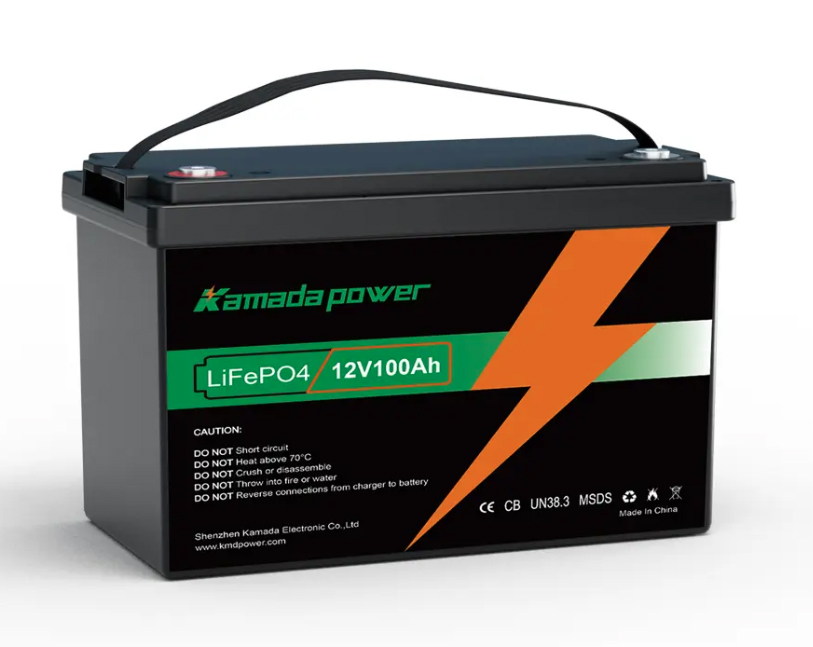
Kamada Power 12v 100Ah Lifepo4 baterija
12V Battery Cable Ampacity & Voltage Drop Charts (Cheat Sheet)
When sourcing cables for a fleet retrofit or a custom heavy-duty build, you need data that is scannable and accurate. We have broken this down into two charts because sizing for safety and sizing for performance are two different calculations.
Max Amperage Capacity Chart for 12V Battery Cables (Safety Limits)
Context: This chart tells you the absolute maximum current a copper cable can carry before the insulation begins to degrade or melt. This is your “do not exceed” limit.
Note: These figures assume high-grade copper cable with a 105°C insulation rating (typical of high-quality marine or welding battery cables) used in free air. If you are using standard automotive wire (often rated at 60°C or 80°C) or bundling wires in a hot engine conduit, you must derate these numbers significantly.
| Velikost AWG | Area (mm²) | Max Amperage (Continuous) | Max Amperage (Surge/Cranking 5 sec) |
|---|
| 6 AWG | 13.3 mm² | 120 Amps | ~200 Amps |
| 4 AWG | 21.2 mm² | 160 Amps | ~300 Amps |
| 2 AWG | 33.6 mm² | 210 Amps | ~450 Amps |
| 1/0 AWG | 53.5 mm² | 285 Amps | ~600 Amps |
| 2/0 AWG | 67.4 mm² | 330 Amps | ~750 Amps |
| 4/0 AWG | 107 mm² | 445 Amps | 1000+ Amps |
12V Battery Cable Size by Length for 3% Voltage Drop
Context: This is where most installations fail. Just because a 4 AWG wire can safely carry 100 amps doesn’t mean it can deliver that power efficiently over 20 feet. In 12V baterija systems, resistance is the enemy.
For critical electronics (inverters, navigation systems, medical fridges), you generally want a maximum of 3% voltage drop.
| Load (Amps) | 0-5 Feet | 5-10 Feet | 10-15 Feet | 15-20 Feet |
|---|
| 50A | 6 AWG | 4 AWG | 2 AWG | 2 AWG |
| 100A | 4 AWG | 2 AWG | 1/0 AWG | 2/0 AWG |
| 150A | 2 AWG | 1/0 AWG | 2/0 AWG | 3/0 AWG |
| 200A | 1/0 AWG | 2/0 AWG | 4/0 AWG | 4/0 AWG |
| 300A | 2/0 AWG | 4/0 AWG | Double Run | Double Run |
Note: 12V systems require exponentially thicker cables than 120V AC systems to move the same amount of power. Do not try to save money here.
Ampacity vs Voltage Drop for 12V Battery Cables: Explained
If you are a procurement officer or an engineer moving from AC grid systems to DC battery systems, the distinction between ampacity and voltage drop is where costly mistakes happen.
Ampacity (The “Fire” Limit for 12V Cables)
Opredelitev: Ampacity is strictly a thermal rating. It is the maximum current a wire can carry continuously before the internal heat generation causes the insulation to melt or catch fire.
Analogija: Think of the cable as a water pipe. Ampacity is the bursting point of that pipe. If you push too much water (current) through too small a pipe, the pressure builds until the pipe physically fails. In electrical terms, the wire acts like a toaster filament—it glows hot, melts the insulation, and you have a short circuit.
Opredelitev: Voltage drop is the amount of energy lost as heat as electricity fights its way down the length of the wire.
Formula:Voltage Drop = Current (I) × Resistance (R) × Length
(Where I is Current in Amps, R is Resistance of the wire per foot, and Dolžina is the total circuit length)
Zakaj je to pomembno:
Here is a real-world scenario we see often: A customer installs a 3000W inverter. They use a 4/0 cable because the ampacity chart says it’s safe for 300 amps. However, the cable run is 15 feet long.
- The Battery is pushing 12.8V.
- The Wire has too much resistance over that distance, losing 1.5V.
- The Inverter receives only 11.3V.
When the inverter sees 11.3V under load, its internal logic thinks the battery is dying. It triggers a “Low Voltage Alarm” and shuts down, even though the battery is actually full. The wire didn’t melt, but the system failed.
Factors Affecting 12V Battery Cable Ampacity & Voltage Drop
Not all copper is created equal. When specifying materials for a B2B order or a high-stakes project, three specs on the datasheet matter most.
Insulation Temperature Rating (75°C vs 105°C)
In the construction industry (NEC standards for houses), wire is typically rated at 75°C or 90°C. However, in automotive and marine environments, ambient temperatures are higher.
We always recommend 105°C rated cable (often designated as SGT, SGX, or Marine UL 1426). A cable with 105°C insulation can safely handle significantly more current than a 75°C cable of the same gauge because the insulation won’t melt as easily. This gives you a better safety margin if a system is momentarily overloaded.
Stranding Count (Flexibility vs Conductivity)
This is the difference between a stiff “building wire” and a supple “battery cable.”
- Building Wire (THHN): Uses a few thick strands of copper. It is stiff and prone to work-hardening. If used in a boat or vehicle, the constant vibration will eventually cause these thick strands to snap at the terminal lugs.
- Battery/Welding Cable: Uses hundreds (sometimes thousands) of ultra-fine copper strands (e.g., 0.2mm diameter). This high strand count acts like a shock absorber for vibration. It’s also much easier to route through tight corners in an engine bay or battery compartment.
OFC vs CCA (Copper Quality Matters)
This is the most critical warning in this guide: Avoid Copper-Clad Aluminum (CCA) at all costs for main battery interconnects.
CCA is aluminum wire with a thin coating of copper. It is cheaper and lighter, but aluminum has about 60% the conductivity of copper.
- OFC (Oxygen-Free Copper): The gold standard. Optimal conductivity and corrosion resistance.
- CCA Risks: To get the same current carrying capacity as a 1/0 OFC cable, you would need a 3/0 or 4/0 CCA cable. If you use an undersized CCA cable based on copper charts, you are creating a fire hazard. Furthermore, aluminum corrodes much faster than copper in marine environments, leading to increased resistance over time.
Step-by-Step 12V Battery Wire Size Calculator
Don’t guess. Use this simple workflow to size your cables correctly every time.
1.Determine Current (Amps)
Take your maximum continuous load wattage and divide by the system voltage (use the lowest operating voltage, usually 12V or even 10V, to be safe).
- Primer: 2000W Inverter ÷ 12V = 166.6 Amps.
2.Determine Total Cable Length (Round Trip!)
This is where 50% of people mess up. The electricity has to travel from the battery to the load and back.
- Primer: If the inverter is 10 feet from the battery, your circuit length is 20 čevljev (10ft Positive + 10ft Negative).
- Consult Voltage Drop Chart
3.Look at the voltage drop chart (Chart 2 above).
- For a 166A load over a 20ft round trip (use the 15-20ft column), you can see that 1/0 AWG might be on the edge, while 2/0 AWG puts you safely in the performance zone.
4.Select Cable
Always verify that your choice from the Voltage Drop chart also meets the safety requirements in the Ampacity chart (Chart 1). (In this case, 2/0 AWG handles 330A safely, so it easily covers our 166A load).
Zaključek
When you are designing a power system, cable is not the place to cut corners. Saving $20 on thinner wire can risk a $2,000 system failure—or worse, a fire.
The golden rule of 12V wiring is simple: Calculate for voltage drop first. If the cable is thick enough to prevent voltage drop, it is almost guaranteed to be thick enough to handle the ampacity safely. And when in doubt? Go one size thicker. It’s cheap insurance for your peace of mind.
Kontakt Kamada Power our battery engineering team to design a customized 12v battery Solution tailored to you.
POGOSTA VPRAŠANJA
What is the difference between 2/0 AWG and 00 AWG?
There is no difference; they are exactly the same size. “Two-Ought” is often written as 2/0 or 00. It is distinct from 2 AWG, which is much thinner.
Can I use welding cable for battery cables?
Yes, and many professionals prefer it. Welding cable (often Grade K) typically has a higher strand count and a flexible EPDM rubber jacket that resists oil, grease, and cuts better than standard PVC battery cable. As long as it is pure copper, it often exceeds standard battery cable specifications. Just ensure the insulation is rated for the environment (oil/gas resistance) if used in an engine bay.
How many amps can a 4 AWG wire handle at 12 volts?
It depends entirely on the length.
- For Safety (Ampacity): A short 4 AWG copper cable can safely handle roughly 135–160 Amps without melting.
- For Performance (Voltage Drop): If that cable is running 15 feet, you should only push about 50 Amps through it. Any more, and the voltage drop will likely cause your appliances to run poorly.
Can I run two smaller cables instead of one large one?
Yes, this is called running cables in parallel. For example, two 1/0 cables can theoretically carry the current of a single 4/0 cable. However, you must ensure both cables are exactly the same length and have identical connections. If one cable has slightly less resistance, it will “hog” the current, overheat, and potentially fail, leaving the second cable to carry the full load (and subsequently fail). It is usually safer and cleaner to use a single, properly sized cable.