W vs Wh (Watts vs Watt-hours): Avoid Costly Battery Mistakes. A procurement officer in Germany once sent me a quote: “Looks good—10 kWh should cover it, right?” It was a small industrial chiller with a compressor, and on paper the battery looked perfect—big capacity, good price, ready to sign—until the first startup tripped immediately: plenty of Wh, not enough W when the load punched. And that’s the uncomfortable truth: in my experience, projects fail more often from confusing Watts and Watt-hours than from chemistry. This guide shows you how to audit a spec sheet fast.
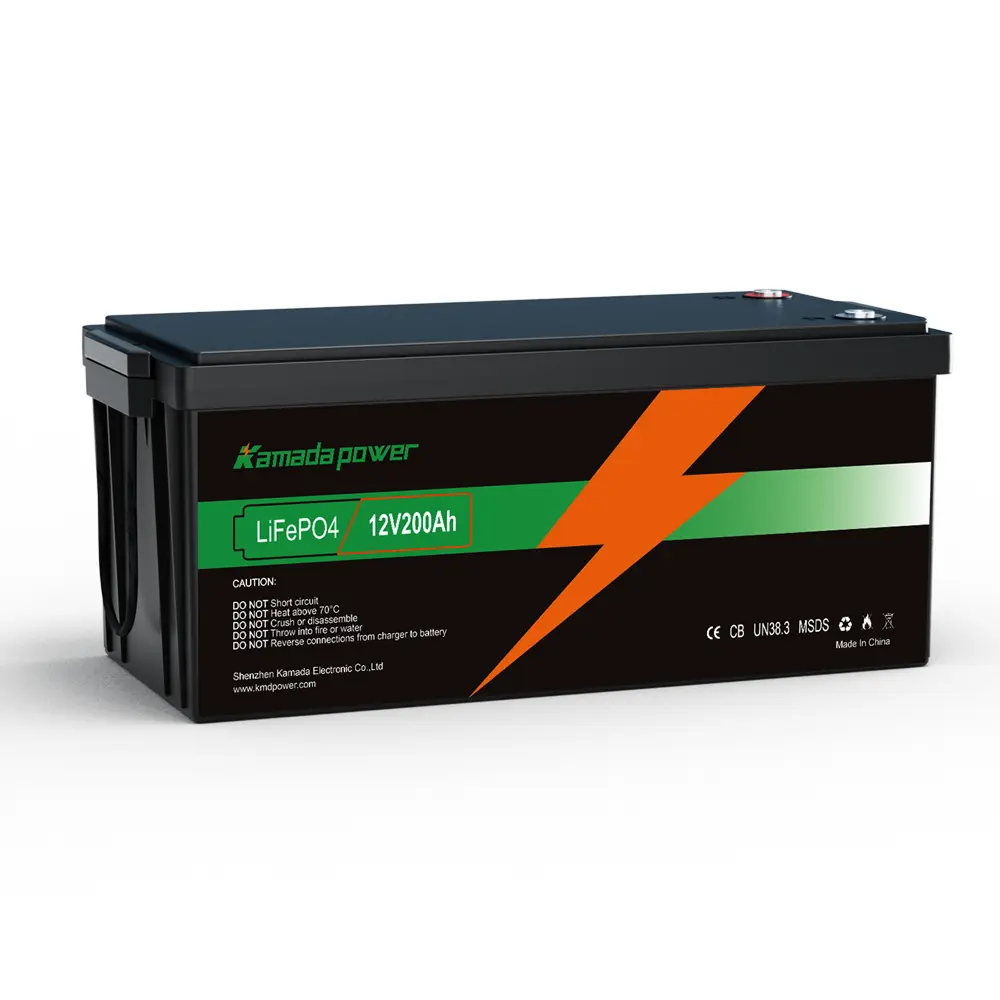
Kamada Power 12v 200Ah Lifepo4 Battery
The 10-Second Definition
Watts (W) = instant power. Watt-hours (Wh) = total energy. W decides if it starts. Wh decides how long it lasts.
If you remember only that, you’ll avoid most expensive mistakes.
Key Takeaways
W (Watts) = power right now. It’s the rate of energy flow in the moment. It answers: “Can the battery run this device?” Think: speed, horsepower, flow rate.
Wh (Watt-hours) = total energy available. It’s energy capacity, not a “power” number. One clean way to remember it: 1 Wh is the energy of 1 W delivered for 1 hour. It answers: “For how long can it run?” Think: distance, fuel tank size, volume.
The Golden Rule: You need W to handle the load’s peak (including inrush current), and Wh to last the duration. You can’t “make up” for one with the other.
W vs Wh Comparison Table
| Item | W (Power) | Wh (Energy) |
|---|
| Analogy | Car speed (mph) | Fuel tank (gallons) |
| Key question | Is it strong enough? | Is it big enough? |
| What it predicts | Will it start / run the load? | How long will it run? |
The 3-Step Buyer Audit
Step 1 — Power check (Continuous W): Does continuous output cover your steady load with margin?
Step 2 — Start-up check (Surge W + Duration): Can it handle inrush/startup spikes for long enough to start the motor/compressor?
Step 3 — Runtime check (Usable Wh × Efficiency): Do you have enough usable energy—under real conditions—to meet your runtime target?
That’s it. Three steps. Most “mystery failures” show up right here.
The Costly Mistakes Section
This is where projects go sideways—especially in industrial applications, telecom backup, light commercial refrigeration, and portable power for job sites. The buyer’s intent is good. The spreadsheet is neat. The field results are… painful.
Trap #1: The “Big Tank, Small Pipe” Error
Classic: buying a high-Wh battery (say 10 kWh) paired with weak inverter output or BMS-limited discharge (say 1000 W, or 1 kW).
What happens? The system has plenty of stored energy, but it can’t deliver enough instant power to start the real load.
Real-world examples I see often:
- Pumps (booster, sump, irrigation)
- Air conditioners / heat pumps
- Compressors (refrigeration, chillers, shop air)
These loads have a startup event that can be several times higher than their running power. If the inverter stage or the battery’s max discharge current is limited, the system will trip, brown out, or refuse to start.
And if you’re buying for an application engineer who’s going to install it? This trap becomes a relationship problem fast. Nobody likes the phrase, “We need to redesign.”
Trap #2: Ignoring Surge vs. Continuous Watts
Many loads are not polite. They surge.
A refrigerator is a simple example because everyone understands it. A fridge might run at ~150 W average while the compressor cycles, but it can surge up to ~1200 W at startup.
Now scale that behavior to industrial equipment and the numbers get serious.
If your battery system or inverter is rated 500 W continuous, but lacks real surge capability, it trips. The key detail buyers miss is that “surge” isn’t just a number. It has a duration. And under the hood, this is often an inrush current problem.
Duration matters more than most people think:
- A peak rating that lasts tens of milliseconds is often too short to be meaningful for motor starts.
- A surge rating that lasts 1–3 seconds can often start motors and compressors.
So when you see “Peak 2000 W” on a spec sheet, don’t nod and move on. Ask: peak for how long? Surge without duration is basically a half-answer.
Buyer note: Also ask how it was tested (resistive vs inductive loads). Vendors can quote peak W under easy conditions that don’t reflect motor-driven loads. If the load is motor-driven, ask about power factor and inrush behavior.
Trap #3: The “Brochure Capacity” Fallacy
“10 kWh” on a brochure is not always “10 kWh usable.”
Three common reasons:
- DoD (Depth of Discharge): Many systems don’t allow 100% discharge in normal operation. A supplier may rate at 100% DoD, but recommend 80–90% for life (and warranty terms may enforce that).
- Inverter efficiency: If you’re delivering AC output, conversion losses are real. Typical inverter efficiency lands around 85–95% depending on load level and inverter design.
- Temperature & derating: Cold can reduce available energy; heat can reduce allowable power output. Both can change performance and warranty assumptions.
So the clean capacity number is useful, but only if you know the conditions behind it. In procurement terms: you want apples-to-apples across vendors, not apples-to-apples-to-slightly-rotten-pears.
How to Audit a Battery Spec Sheet
This is the part that separates “we bought a battery” from “we bought a system that works in the field.”
The 4 Numbers You Must Verify
1) Continuous Power Output (W/kW) Can the system handle your steady-state load? If your load is a telecom cabinet, maybe continuous is modest. If it’s a job-site saw or a refrigeration compressor, continuous matters a lot.
2) Peak/Surge Power (W/kW) + Duration Can it handle startup spikes? Crucial nuance: ask “for how long?” A 1-second surge is not the same as a 10-millisecond surge. Not even close.
If the load is motor-driven, also ask:
- Was the surge tested on resistive or inductive loads?
- What assumptions were used around power factor and inrush?
3) Rated Capacity (Wh/kWh) The theoretical maximum stored energy. Good for marketing and rough comparison, but not for runtime promises.
4) Usable Capacity (Wh/kWh) — Under Stated Conditions This is the one people skip—and it’s the one that ruins projects.
Ask the vendor to define usable energy with these conditions clearly stated:
- DoD limit (e.g., usable to 90% DoD)
- Cutoff voltage / BMS cutoffs
- Temperature (e.g., 25°C vs 0°C)
- Discharge rate / C-rate (usable energy changes with high loads)
- AC output? If yes, clarify whether usable Wh is DC-side or AC-delivered (after inverter losses)
Also: in lithium-ion systems (LFP, NMC), the BMS enforces voltage and current limits that directly affect usable energy and power. That’s normal. What’s not normal is hiding it.
Here’s the sizing formula I use as a first pass:
Runtime (hours) = (Usable Wh × Efficiency) ÷ Load (W)
If AC output is involved, I often apply 0.85 as a conservative planning factor. It’s not pessimism—just what happens in the real world once you add conversion losses and operating conditions (especially at higher loads or with less efficient inverter designs).
Better yet: if a supplier can provide an efficiency curve (not just a single “peak” number), you’ll get a more accurate estimate. Inverters often have different efficiency at light load vs heavy load.
Expert note: if a supplier promises 100% efficiency, run away. Or at least ask for the test conditions and the curve.
Real-World Scenarios: Sizing It Right
These are simplified, but they mirror how real RFQs come in.
Scenario A: Home Backup (The Fridge & Router)
Load profile
| Item | Running (W) | Startup / Surge (W) | Notes |
|---|
| Fridge | ~150 W average | up to ~1200 W | Compressor inrush |
| Router | ~10 W | n/a | Steady load |
Requirement: 10 hours
Energy check (Wh): Average load ≈ 160 W Target energy ≈ 160 W × 10 h = 1600 Wh usable (before losses)
Power check (W): You need >1200 W surge capability, plus margin.
Verdict: A 2000 Wh battery with only 600 W output WILL FAIL. It has enough “tank,” but not enough “pipe.”
This is the simplest way to explain W vs Wh to a buyer: energy solves “how long,” power solves “will it start.” You need both.
Load: Circular saw at 1500 W Requirement: High power, short duration
Here, W matters more than Wh. A saw doesn’t care that you have 3000 Wh if the inverter can only deliver 1000 W continuous. It just won’t run.
Verdict: Prioritize high continuous W (often 2000 W+) with credible surge headroom. Wh is secondary unless you need long runtime between charges.
A buyer-focused comparison that comes up constantly:
- High-Wh, low-W unit: long runtime for small loads, useless for heavy tools.
- High-W, moderate-Wh unit: actually runs tools and motor loads, even if runtime is shorter.
Scenario C: Solar Energy Storage (ESS)
Focus: balancing kW (power) and kWh (energy) in an ESS.
A common pairing is 5 kW / 10 kWh, roughly a 0.5C discharge rate. In plain terms: at full power, the battery would empty in about 2 hours (10 kWh ÷ 5 kW = 2 h). That ratio often works for general backup and moderate peak support.
When might you need 10 kW / 10 kWh?
- Peak shaving where demand spikes are expensive
- Running high-startup loads during backup
- Microgrid applications where short, high-power events matter
So the “right” ratio depends on whether you’re power-limited (kW problem) or energy-limited (kWh problem). Good integrators ask that question early. Great ones document it in the proposal—along with derating assumptions and runtime math.
The RFQ Checklist: Copy-Paste These Questions to Suppliers
Don’t just ask for a price. Ask these so you’re buying the right W and Wh—and so your comparisons stay fair.
- What is the continuous power rating at 40°C (104°F)? Heat can reduce allowable power output. If the spec only applies at 25°C in a lab, you’re missing risk. Ask for the derating curve if they have one.
- What is the surge power duration—and how was it tested? Is it <20 ms or >3 s? That difference decides whether motors start or trip. Also ask: was it tested on resistive or inductive loads?
- Is the advertised Wh based on 100% DoD or a limited DoD? And what DoD is allowed under warranty? If there’s a warranty throughput limit, get it in writing.
- How do you define “usable capacity” (conditions)? Ask for: DoD limit, cutoff voltage/BMS cutoffs, temperature, discharge rate, and whether the usable Wh is DC-side or AC-delivered.
- What is the recommended C-rate (charge/discharge) and any repeat-surge limits? This impacts thermal performance, cycle life, and whether the system can repeatedly deliver high power without derating.
If a vendor answers these clearly and consistently, that’s a good sign. If they dodge, that’s also a sign—just not the one you want.
Conclusion
W represents “instantaneous power”—whether it can start and actually run the load; while Wh represents “energy capacity”—how long it can continuously operate. A mismatch between the two will inevitably lead to failure.
Stop buying unsuitable off-the-shelf products. Contact us,Tell us your continuous load and peak load requirements. We don’t just manufacture batteries; we are dedicated to meticulously designing the optimal balance of power (W) and energy (Wh) to ensure your project runs smoothly from the very first start.
FAQ
Is 1000W the same as 1kWh?
No. 1000 W is power (how fast energy is delivered). 1 kWh is energy (how much total). You can deliver 1000 W for one hour and that equals 1 kWh—assuming ideal conditions. But the units answer different questions: strength vs stamina.
If my load is 500W, how many Wh do I need for 8 hours?
Start with the simple math: 500 W × 8 h = 4000 Wh (4 kWh) usable at the load.
Then adjust for losses and real conditions. If AC output is involved and you plan with 0.85 efficiency: 4000 Wh ÷ 0.85 ≈ 4700 Wh of battery-side energy to net ~4000 Wh at the load (after losses). That’s why “rated capacity” alone can mislead you.
Why does my battery drain faster than the Wh rating?
Because the Wh rating often reflects rated capacity, not usable energy at your operating conditions. AC inverter losses, temperature effects, and BMS cutoffs all reduce what you actually get—especially at high loads.
Can I chain batteries to increase W output?
Usually no. Adding batteries in parallel typically increases Wh (energy), not W (power), unless the inverter stage is designed to scale. To increase W, you generally need a higher-rated inverter or a parallel inverter architecture with proper controls.
What if my load has a big startup surge but low average power?
Then you’re dealing with a power problem, not an energy problem. You need enough surge W (and surge duration) to start the load, even if the Wh requirement is modest.
What’s the difference between kW and kWh in an ESS proposal?
kW is deliverable power (instant capability). kWh is stored energy (runtime). A proposal with high kWh but low kW may look “big” but fail for motor loads or peak shaving.