Sodium-ion battery packs can be considered for AGVs, AMRs, and warehouse vehicles, but the decision should not start with chemistry alone. In warehouse automation, the battery works inside a moving control system: motor, controller, charger, docking station, BMS, fleet software, connectors, safety logic, and service workflow all affect reliability.
A pack may match the voltage and fit the compartment, yet still fail during acceleration, docking charge, cold-room operation, SOC-based scheduling, or recovery after BMS protection. For system integrators, the real question is not whether sodium-ion can power the vehicle, but whether the finished pack can support the full mission profile without causing downtime.
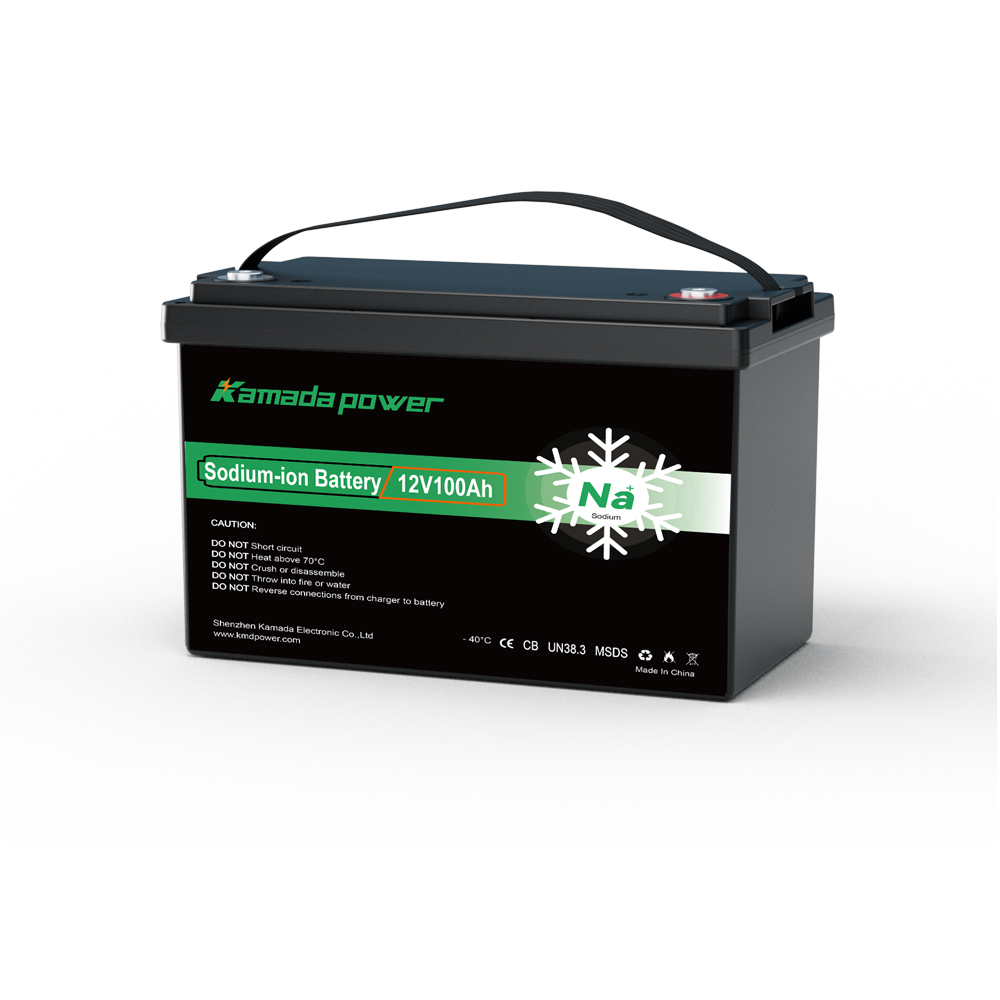
Kamada Power 12v 100Ah Sodium ion Battery
Start With the Vehicle Mission, Not the Battery Chemistry
AGVs and warehouse vehicles do not behave like simple backup batteries. They move, stop, lift, turn, dock, charge, report status, and return to service on schedule. That operating rhythm should define the battery.
A light-duty AMR moving small goods across flat aisles does not stress the pack like a pallet-moving vehicle, tow tractor, lift platform, cold-storage AGV, floor-cleaning vehicle, or heavy-load warehouse cart. One application may care most about route time. Another may care about startup current. A third may care about docking charge speed. A fourth may fail the business case if a technician must reset the battery after protection.
This is why voltage and capacity are not enough. They describe battery size. They do not describe whether the battery can survive the vehicle workflow. The voltage platform also depends on the vehicle design. Some warehouse vehicles may use 24V or 48V systems, while heavier platforms may use higher-voltage battery architectures. The pack must match the vehicle platform, not just the chemistry name.
For AGV sodium-ion battery integration, evaluate six boundaries first: peak current, opportunity charging, BMS communication, SOC data, cold-room behavior, mechanical reliability, and recovery after protection.
Peak Current Is Where Many Packs Fail First
AGV energy use may look moderate on average, but the difficult moments are short and demanding: starting with payload, climbing a ramp, lifting, turning under load, or restarting after an emergency stop.
Those moments expose the entire discharge path.
A sodium-ion pack must be evaluated for peak current, voltage sag, BMS overcurrent behavior, controller cutoff margin, thermal rise, and recovery after protection. If the BMS peak limit is too low, the vehicle may stop during acceleration. If voltage sag is too deep, the controller may reduce power or trigger a fault. If the connector or cable path adds too much resistance, the pack may look healthy while the vehicle still fails under load.
This is not only a cell issue. The current path includes cell configuration, BMS power components, busbars, terminals, connectors, cable gauge, fuse, and controller input behavior. A weak point anywhere in that path can turn a normal vehicle movement into a shutdown.
The pack should be judged by the hardest normal operating moment, not by average current.
Opportunity Charging Changes the Battery Design
Many AGVs and AMRs rely on opportunity charging rather than one long end-of-day charge. Opportunity charging means the vehicle takes small charging sessions during short stops or process gaps, which is common in automated industrial environments.
That changes the battery problem.
A sodium-ion pack used for opportunity charging must handle frequent partial charge cycles, charger wake-up behavior, current limits, temperature rise, and communication with the vehicle or charging dock. If the charger pushes current too aggressively, the pack may age faster or trigger protection. If the BMS blocks charging and the charger does not understand why, the vehicle may remain out of service. If the pack enters sleep or protection and cannot wake correctly at the dock, the fleet schedule becomes unreliable.
In an AGV system, charging is not just battery maintenance. It is part of vehicle availability.
Charger and BMS Communication Is Not Optional in Smarter Fleets
Some simple warehouse vehicles may run from voltage and current settings alone. Smarter AGVs usually need a closer relationship between the battery, charger, vehicle controller, and fleet software.
AGV chargers are often configured for the specific battery chemistry and voltage, and may communicate with the vehicle’s BMS and control system through digital I/O, CAN, or similar control paths. That communication can support safer automated charging in unmanned charging bays.
For sodium-ion packs, this matters because the charger may need to know charge permission, charge current limit, temperature status, SOC, alarm state, and recovery condition. If the charger only sees voltage, it may not understand whether the BMS is limiting current, blocking charging, waiting for temperature recovery, or reporting a fault.
A communication interface is only the channel. Protocol compatibility decides whether the system understands the battery’s limits.
Fleet Software Needs SOC Data It Can Trust
One AGV with a rough battery display is an inconvenience. A fleet with unreliable SOC data becomes a scheduling problem.
Fleet software may use battery status to decide whether a vehicle can accept another task, return to the charging dock, reduce speed, or request service. If SOC is wrong, the system may send a vehicle into a route it cannot complete. If SOH or alarm data is missing, maintenance becomes reactive. If battery status is delayed or misread, the fleet looks unstable even when the cells are not the root problem.
This is especially important for sodium-ion packs because SOC estimation should match the chemistry’s voltage behavior, load profile, and BMS algorithm. A controller profile built around another battery type may not provide reliable information.
For a system integrator, the pack should not only supply energy. It should provide battery data that the vehicle and fleet system can use.
The Real Integration Risks Fall Into Five Groups
The most useful way to evaluate a sodium-ion pack for AGVs is not to ask for a long parameter list. It is to identify which system boundary can break the vehicle workflow.
| Integration Boundary | What It Changes in the Pack | Failure If Ignored |
|---|
| Peak current and voltage sag | Cell configuration, BMS current limit, busbar, connector, cable path | Vehicle stops during acceleration, lifting, ramp climbing, or payload movement |
| Opportunity charging | Charge current logic, wake-up behavior, charger communication, thermal control | Vehicle docks but does not recover, charges slowly, or triggers protection |
| SOC and fleet data | BMS algorithm, communication protocol, controller interpretation | Route scheduling becomes unreliable or vehicles stop before task completion |
| Cold-storage operation | Low-temperature discharge, cold charging rules, sensor placement, derating | Vehicle runs in cold areas but cannot recharge correctly or trips under load |
| Mechanical integration | Enclosure, mounting, connectors, strain relief, vibration protection | Intermittent faults, loose terminals, connector damage, downtime |
This table is not a replacement for engineering validation. It shows where the design actually changes. A standard pack can work when these boundaries are simple. Custom design becomes safer when one of them becomes part of normal operation.
Cold Storage Changes More Than Runtime
Cold-storage warehouses create a different battery problem from normal indoor AGV routes.
A sodium-ion pack may have useful low-temperature discharge potential, but a finished pack still needs clear charging boundaries. A vehicle may operate in a cold room and then dock for charging while the cells are still cold. If the BMS blocks charging, the vehicle may stay offline. If the charger ignores the cold condition, the pack may be stressed. If voltage sag deepens under cold load, the controller may trip even though the pack worked at room temperature.
Cold operation should be judged in three moments: driving under load, docking for charge, and returning to service after temperature-related protection.
A general low-temperature discharge claim does not prove all three.
Mechanical Reliability Is Part of Battery Integration
AGVs and warehouse vehicles expose battery packs to vibration, repeated movement, tight cable routing, connector wear, dust, moisture from floor cleaning, and frequent service access. The battery may be installed in a compact chassis, close to motors, or in a location where connectors and cables move during maintenance.
Battery connectors are often among the vulnerable parts of warehouse vehicle systems, and robust connections help reduce downtime in environments with vibration and harsh operating conditions.
That means mechanical fit is not just whether the pack fits inside the compartment. It includes mounting points, terminal protection, connector orientation, cable strain relief, enclosure strength, service access, and thermal path. A sodium-ion pack can be electrically suitable and still fail as a vehicle product if the mechanical integration is weak.
A pack that requires installers to improvise brackets, cable routing, or connector protection is not ready for fleet deployment.
Standard Packs Work When the Workflow Is Simple
A standard sodium-ion pack may be suitable when the vehicle route is predictable, current demand is moderate, charging is slow or well controlled, the operating environment is mild, the controller is tolerant, and the fleet does not depend heavily on battery data.
That is a valid use case.
The need for custom design rises when the AGV depends on high peak current, frequent opportunity charging, automatic docking, cold-storage operation, accurate SOC reporting, communication with fleet software, compact installation, or unattended recovery after protection.
| Application Condition | Standard Pack May Be Enough | Custom Pack Is Safer |
|---|
| Vehicle duty cycle | Predictable route, moderate current, mild environment | High peak current, lifting, ramp climbing, repeated acceleration |
| Charging method | Slow or controlled charging | Frequent opportunity charging or automatic docking |
| System data needs | Basic voltage display is acceptable | SOC, SOH, alarm, and communication data affect fleet scheduling |
| Operating environment | Normal indoor warehouse | Cold storage, vibration, moisture, dust, or tight installation space |
| Service model | Manual inspection is acceptable | Unattended recovery and clear fault reporting are required |
The difference is not “standard pack versus better pack.” The difference is whether the standard pack’s validated boundary matches the vehicle workflow. A standard pack is acceptable when the application stays inside that boundary. A custom pack is safer when the vehicle changes the electrical, thermal, mechanical, communication, or recovery requirements.
Validate the Workflow Moments That Stop Operations
An AGV battery should not be approved only because the vehicle moves after installation. That is the easy condition.
The useful validation targets the moments that stop operations: startup with payload, ramp climbing, repeated acceleration, low-SOC driving, docking recharge, charger wake-up, cold-room operation, communication loss, BMS protection, and automatic recovery.
A good result means the vehicle starts reliably, completes routes, docks correctly, charges predictably, reports SOC consistently, handles faults in a serviceable way, and returns to operation without hidden manual steps.
For warehouse automation, the battery is successful only when the schedule stays stable.
Service Behavior Decides Fleet Acceptance
In a manual vehicle, an operator can notice a problem and respond. In an AGV fleet, weak recovery behavior can multiply downtime.
If a pack enters overcurrent protection, low-voltage protection, low-temperature charge blocking, communication fault, or sleep mode, the vehicle controller and service team need a clear path forward. A safe BMS event can still become an operations problem if the system cannot explain the state or recover cleanly.
The pack should match the service model. A small site with technicians nearby may tolerate manual inspection. A large automated warehouse needs clearer alarms, predictable wake-up behavior, and fault states the vehicle controller or fleet software can understand.
A battery that protects itself but leaves the vehicle stranded is not enough for serious automation.
Conclusion
Sodium-ion battery packs can be considered for AGVs, AMRs, and warehouse vehicles when the finished pack matches the vehicle’s workflow, current demand, charging rhythm, controller behavior, SOC needs, installation space, temperature range, and recovery logic.
Before approval, validate it in real operation. The goal is not only to power the vehicle, but to keep the fleet schedule stable.
For AGV, AMR, or warehouse vehicle projects, contact kamada power with your key system requirements. Our engineering team can help review the safer battery option for your platform.
FAQ
Can sodium-ion batteries be used in AGVs?
Yes, sodium-ion batteries can be considered for AGVs when the finished pack is validated against the vehicle’s real duty cycle, peak current, charger behavior, BMS logic, communication needs, and operating environment.
Are sodium-ion batteries suitable for AMRs?
They can be suitable for AMRs when the route profile, current demand, charging rhythm, size limit, and fleet data requirements are matched to the pack design. A light-duty AMR may be easier to support than a heavy-load AGV or lift vehicle.
What is the main battery risk in AGV applications?
The main risk is not average capacity. It is whether the pack can handle the hardest workflow moments: startup with payload, acceleration, ramp climbing, lifting, docking recharge, cold operation, BMS protection, and automatic recovery.
Can sodium-ion AGV batteries support opportunity charging?
They may support opportunity charging if the cell design, BMS, charger, thermal behavior, and communication protocol are built for frequent partial charging. The charger and BMS must understand charge permission, current limits, temperature status, and recovery state.
Is a standard sodium-ion pack enough for warehouse vehicles?
A standard pack may be enough for predictable routes, moderate current demand, mild environments, and simple charging. A custom pack is safer when the vehicle depends on high peak current, automatic docking, accurate SOC data, cold-storage operation, compact installation, or unattended recovery.
What should system integrators check before choosing a sodium-ion AGV battery pack?
System integrators should check vehicle voltage, peak current, voltage sag, controller cutoff margin, charger protocol, docking behavior, SOC reporting, BMS alarms, cold-room performance, connector reliability, mounting design, and recovery after protection.