A mobile workstation sent out of the freezer for charging cannot print labels or process stock inside it. The interruption may involve moving the cart, waiting for its battery to warm up, charging, and returning to service. A sodium-ion battery may shorten this process if an approved dock provides sufficient charging energy. Low-temperature charging alone, however, does not justify changing the battery platform. The practical question is how much workstation time can be recovered, and whether that time is valuable enough to change the equipment purchasing decision.
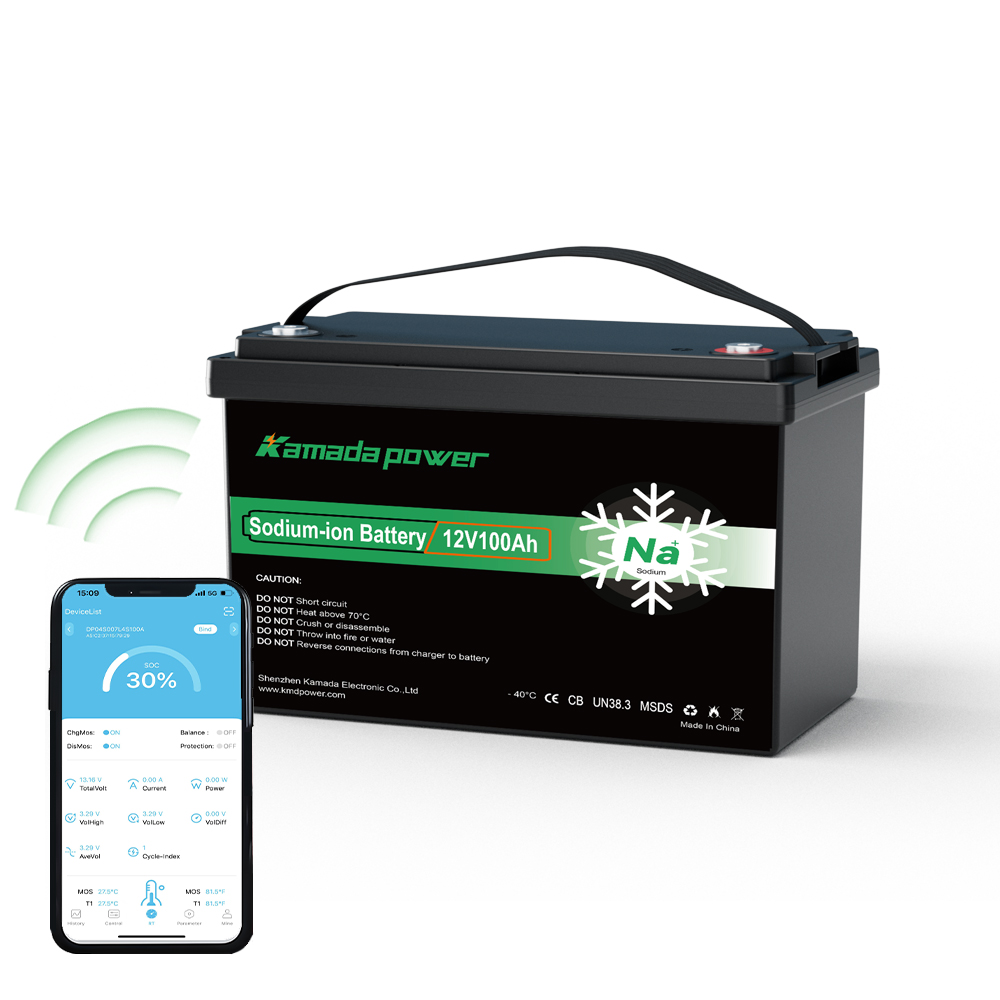
Kamada Power 12v 100Ah Sodium Battery
Where Does Off-Freezer Charging Consume Productive Time?
The Solcon 1100G mobile workstation illustrates the equipment class: a 12V 100Ah lead-acid configuration, a listed 350W continuous load rating, a 10A charger, and an optional battery exchange arrangement. Its enclosed design is intended for cold-storage use. This is an equipment reference, not an approved sodium-ion installation.
The ACD MAX BE TK deep-freeze workstation uses two 12V 60Ah lead-acid batteries in a 24V system. Its MAX BE/MAX Plus operating guide (V1.03, sections 20.3.1 and 25.2) requires charging outside the freezer, recommends an ambient temperature of at least 15°C (59°F) before charging, and limits exposure with the same original battery set to eight hours because of electrolyte freezing risk. Typical runtime is about eight hours at a 50VA load, not at every load. These restrictions apply to that equipment configuration.
An off-freezer charging event may include:
- Outbound and return travel, docking and disconnection.
- Temperature stabilization and waiting for a free charging position.
- Actual charging time during which the cart cannot serve its assigned task.
Count cart downtime separately from lost labor. Staff may perform other duties while a cart charges, even if colleagues must defer tasks requiring its printer or terminal.
How Much Workstation Availability Is Lost Across a Shift?
Measure availability against the hours during which the cart is required in its assigned work zone, not simply the hours it is powered on.
Add the nonoverlapping intervals of travel, docking, warming, queueing and charging that prevent service. If warming and waiting for a charger occur simultaneously, count that interval only once.
Available workstation-hours = Scheduled service hours – Nonoverlapping unavailable hours.
Suppose an eight-hour shift includes two charging trips, each requiring 20 minutes of travel and docking, plus 40 minutes of nonoverlapping charging downtime. There is no additional warming or queueing in this example.
The cart loses 80 minutes, leaving 6 hours and 40 minutes of service time (83.3% availability).
An approved in-zone dock that removes only the travel and docking time raises availability to 7 hours and 20 minutes (91.7%).
This hypothetical timeline assumes sufficient energy recovery; it is not field-test data.
Figure 1. Illustrative shift availability with equal charging durations.
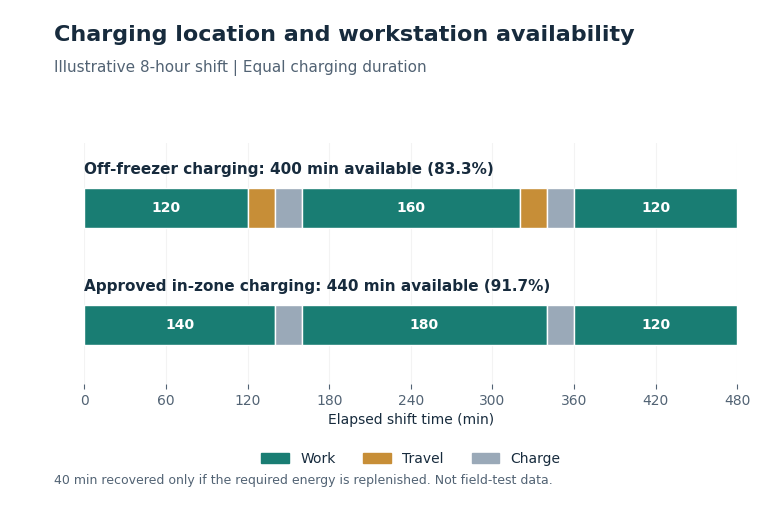
Each trip block represents the combined outbound and return travel and docking allowance; the diagram is a service-time ledger, not a physical travel sequence.
The gain is 40 minutes, or 10% of the original available time.
Ten carts on this schedule recover 400 equipment-minutes, not necessarily equivalent labor savings or throughput.
If charging already fits entirely into a break when nobody needs the cart, moving the charger may add little service value. Conversely, a cart unavailable during a labeling bottleneck can hold up work even when staff remain available.
Can a Sodium-Ion Pack Change the Charging Location?
The battery charging temperature, charger operating temperature, and complete workstation environmental rating all matter. Each component must stay within its own limits. Facility electrical, fire safety, and hygiene rules must permit the charging position.
A freezer at -25°C (-13°F), for instance, may be colder than a pack’s approved charging range. A pack limited to charging at -20°C (-4°F) or above cannot be charged at a pack temperature of -25°C. A closer, warmer approved dock may still save travel time.
Battery temperature is not necessarily room temperature. A cold pack can remain cold after entering a warm room; charging control must respond to the applicable measured battery temperature.
Consider a hypothetical 12V-class system that needs 120Wh of charging input before the next work period, at an average terminal voltage of 13.5V.
Charging input energy (Wh) = Average terminal voltage × Accepted current × Charging time (h).
At 10A, delivering 120Wh takes about 53 minutes; at 20A, about 27 minutes. A 10A charger cannot achieve the second result merely because a replacement battery permits 20A.
A 20-minute break supplies 45Wh at 10A or 90Wh at 20A. These are constant-current terminal-input calculations, not recoverable energy guarantees. Storage losses, current taper, temperature and connected loads affect the result.
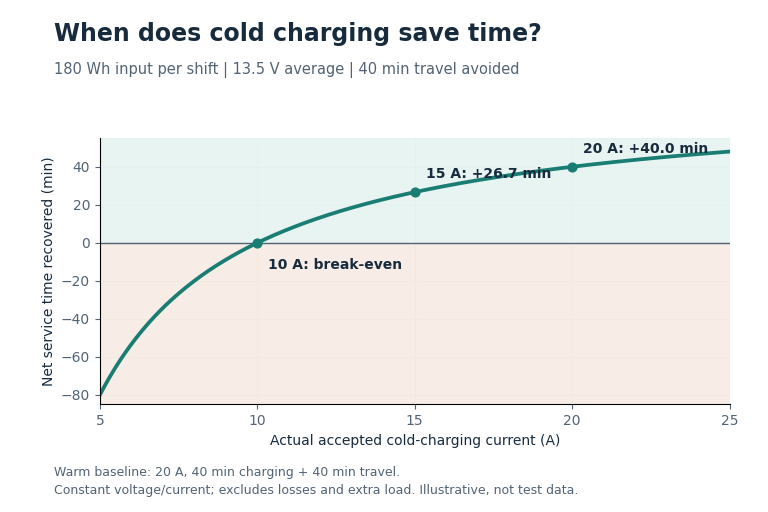
The earlier timeline assumes equal charging durations. To test that assumption, consider a separate case requiring 180Wh of terminal input per shift. At 13.5V and 20A, a warm dock requires 40 minutes of charging plus 40 minutes of travel. An approved cold dock at 10A requires 80 minutes of charging: no time is saved. At 20A it requires 40 minutes, saving the full travel allowance.
Net service time recovered = Avoided travel and handling time + Warm charging downtime – Cold charging downtime.
In this example, the break-even current is 10A; a positive gain requires more than 10A if voltage and all other assumptions remain unchanged. Use actual net battery power and nonoverlapping downtime, not rated charger current. More available work time may itself increase energy demand, so repeat the energy budget for the revised shift.
Figure 2. Illustrative charging-time break-even model, not measured performance.
For engineering screening, a previously supplied Kamada Power sodium ion battery pack reference specifies 10A at -20 to -10°C and 20A at -10 to 0°C, subject to the exact temperature boundaries and confirmed supply revision. Below -20°C, charging is outside that reference range. These are not verified specifications for every linked product variant. A nearer approved buffer-zone dock may therefore be more useful than a dock inside the freezer.
If a powered cart draws 100W from a DC bus receiving 135W from its charger, at most 35W remains for battery charging before further losses. A higher load may leave the battery discharging. With a separate mains-fed load supply and battery charger, the load need not consume that charging circuit’s output, although upstream supply limits still apply. The equipment must explicitly support operation while charging.
For a new 12V platform, a 12V 100Ah sodium-ion battery is a candidate. Match the specific pack revision to the inverter voltage range, load transients, charger profile, BMS limits and cold-temperature charge current. Lead-acid equalization or temperature compensation may be incompatible. A battery protection cutoff is not the inverter’s minimum operating voltage.
Cold-rated connectors and enclosures must also tolerate the intended environment and condensation risks during temperature transitions. If the workstation maker prohibits freezer charging, a different battery does not override that restriction; a new charging architecture needs equipment and facility approval.
How Do Battery Swaps Compare With Charging in the Work Zone?
An exchange system returns the cart to service with a charged pack while the depleted one recharges separately. It may suit consecutive shifts, short breaks or facilities that prohibit freezer charging.
For example, a cart averaging 100W at its AC outlets over eight hours, with 90% inverter efficiency and 80Wh of additional DC-side loads not included in that efficiency, needs:
(100W × 8h ÷ 0.90) + 80Wh ≈ 969Wh.
A 12V 100Ah nominal design represents 1,200Wh, so this no-recharge example requires at least 80.8% of nominal energy to be accessible before adding reserve. Printer bursts, thermal accessories and standby demand must be included in the actual load profile. Usable energy above the equipment cutoff must cover demand and reserve. The 350W rating is not average consumption.
On the same nominal basis, approved 1P-4P banks represent 1.2, 2.4, 3.6 and 4.8kWh. Meeting 969Wh without recharge or reserve requires accessible fractions of about 80.8%, 40.4%, 26.9% and 20.2%, respectively. These are sizing thresholds, not measured battery performance. Larger banks add weight and require adequate overnight charging. Parallel expansion retains the 12V voltage class; it cannot directly supply the ACD 24V architecture. A separately engineered OEM pack is an option for 24V systems or restricted installation space, subject to approval.
| Design approach | Main availability benefit | Constraint that may erase the benefit |
|---|
| Off-freezer charging | Uses an established, approved charging area | Travel, docking, warming, and charging queues |
| Approved in-zone charging | Avoids some cart transfers | Insufficient accepted current, restricted outlets, or no permission to charge in the freezer |
| Battery exchange | Keeps the cart available while a separate pack recharges | Spare inventory, exchange labor, and insufficient charging capacity |
| Larger fixed battery | May eliminate mid-shift charging | Cart weight, space, usable energy, and overnight recharge time |
A swap system needs enough packs to cover turnaround time. If one pack is removed every hour and takes three hours to become ready again, three packs may be in turnaround at steady state. If charging occupies all three hours, three independent charging positions are needed. If warming or queueing occupies part of the time, calculate charger occupancy separately. Allow for simultaneous exchanges and delays.
For swaps requiring shutdown, count saving transactions, restart and travel in downtime.
When Can In-Freezer Charging Reduce the Number of Workstations Needed?
Recovered time may reduce the number of carts an integrator needs to purchase. Fleet sizing depends on total service hours, simultaneous demand and reserve equipment.
A first-pass capacity calculation is:
Minimum carts by service hours = Required workstation-hours per shift ÷ Available hours per cart, rounded up.
Suppose a warehouse needs 80 workstation-hours in an eight-hour shift, with ten carts required simultaneously. Assume flexible task assignment and staggered interruptions. Add an illustrative battery exchange option with 20 minutes of total downtime per cart per shift.
| Charging architecture | Available hours per cart | Minimum carts by service hours | With one illustrative standby cart |
|---|
| Off-freezer charging | 6.67 | 12 | 13 |
| Approved in-zone charging | 7.33 | 11 | 12 |
| Battery exchange | 7.67 | 11 | 12 |
Use exact minutes, not rounded display hours. The hypothetical exchange option assumes enough charged packs and charging capacity. One standby cart is an illustrative reserve, not a general recommendation.
Recovering 40 minutes per cart reduces the service-hour lower bound from twelve carts to eleven. It does not prove that one cart can be removed: synchronized charging or uneven demand may make the actual requirement higher.
Check demand against available carts in individual time slots. With eleven carts and ten required simultaneously, two concurrent charging interruptions would leave only nine available. The working fleet must satisfy both the service-hour lower bound and the actual concurrent demand schedule before adding any separate standby reserve. A spare battery cannot cover a failed printer or inverter; spare packs and spare carts serve different purposes.
If both options yield eleven carts, compare spare inventory, infrastructure, modifications and handling costs. An uninterrupted existing workflow may gain little from either.
Annualize the incremental equipment and battery costs, and compare them with demonstrable avoided cart purchases, labor and service interruptions. Count a cart saving only if the schedule meets simultaneous demand and the required reserve. Do not double-count recovered labor and throughput.
FAQ
Can charging occur inside any freezer?
No. The battery, charger, workstation and facility must all permit charging at the actual operating conditions. Where equipment rules prohibit freezer charging, use an approved warmer dock or exchange architecture instead.
Is 100Ah enough for an entire shift?
It depends on measured load, conversion losses, accessible battery energy at the operating temperature, reserve and mid-shift replenishment. Nominal 100Ah capacity alone cannot establish full-shift runtime.
Is swapping better than charging in place?
Swapping can suit continuous work when spare packs are ready on time. In-place charging may be preferable when approved charging windows cover energy demand without interrupting required service. Compare total downtime and spare inventory costs.
Conclusion
A sodium battery can improve cold-storage workstation availability when its approved charging temperature and current shorten the charging workflow without creating an energy shortfall. Depending on the cart, the appropriate solution may be a standard 12V 100Ah sodium battery, an approved parallel bank, a custom OEM sodium ion battery pack, or an exchange system; retaining the existing charging location may be preferable where equipment or facility restrictions prevent a change. Contact Kamada Power with your shift schedule, freezer temperature, measured cart load, charging windows and simultaneous workstation demand to discuss battery sizing and compare the service availability of the available architectures.