Busbar vs. Daisy-Chain for Slimline Lithium Batteries. You bought slimline lithium batteries to save space—smart—but now you’re staring at a cramped compartment and thick DC cables, trying to avoid the two things that kill parallel banks: uneven current sharing from unequal resistance paths, and hot, stressed connections that slimline installs don’t forgive. That’s why the “quick daisy-chain vs clean busbar” debate never goes away—because advice that works in a wide-open battery room often falls apart behind seats, in drawers, or tight service bays. This guide shows what actually works, grounded in real electrical physics and slimline reality.
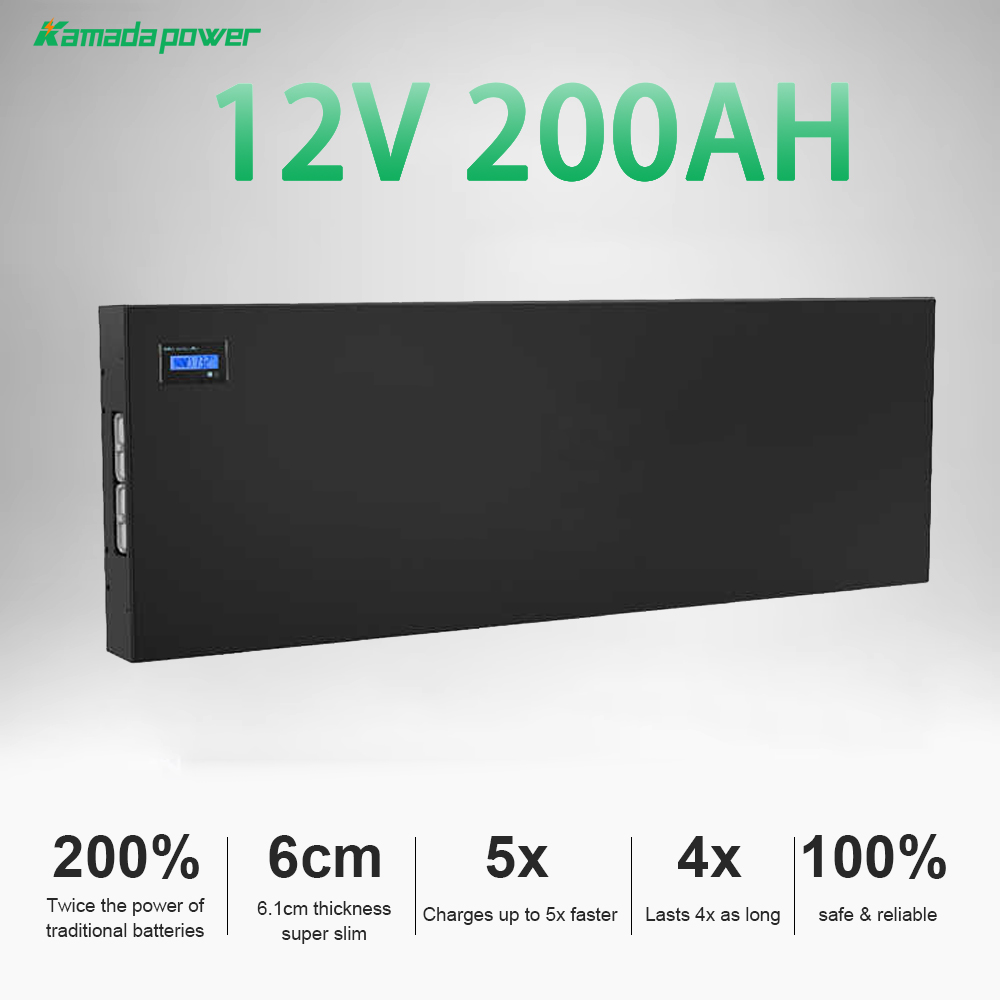
Kamada Power 12V 200Ah Slimline Lithium Battery
Understanding the Basics: Parallel Wiring 101
Parallel wiring means:
- Positive (+) to Positive (+)
- Negative (–) to Negative (–)
The result: you increase capacity (Ah) while keeping the same system voltage (12V, 24V, etc.).
The Golden Rule: Current follows the path of least resistance
In a parallel bank, if one battery has a lower-resistance path to the load/charger, it will work harder:
- it supplies more discharge current
- it accepts more charge current
- it heats more at its connections
- it tends to age faster
That can show up as:
- one battery cycling harder than the others
- “mystery” voltage sag under load
- warm/hot lugs or terminals
- a bank that should feel like 300Ah but behaves like less because the hardest-worked unit drifts first
Your wiring method is basically your tool for making those resistance paths as equal as practical.
Option 1: Daisy-Chaining (Direct Battery-to-Battery Jumpers)
What is it?
Daisy-chaining connects batteries in a sequence using jumpers:
Battery A → Battery B → Battery C → …
Then your main load/charge cables connect somewhere on that chain.
The Pros
- Cost-effective: fewer parts, no distribution blocks
- Simple for 2 batteries: fast and intuitive
The Cons
A common mistake is the ladder-style setup where both main cables land on the same end of the chain.
That makes one battery electrically “closer,” so it tends to do more work. Over time, that can lead to:
- uneven cycling
- uneven heating at connection points
- faster aging of the hardest-working battery
- more troubleshooting later
Slimline-specific problem: terminal crowding and lug stacking
Slimline batteries often have recessed terminals, protective covers, or limited stud length. In real installs, stacking multiple heavy lugs can cause:
- lugs not sitting flat
- terminals loosening over time
- covers not fitting back on (a real safety issue)
- stress on the stud/casing from stiff cable leverage
This is one of those problems that may look fine on install day and shows up months later.
Improved Daisy-Chain: Diagonal (Cross) Takeoff
If you want to use daisy-chain wiring, diagonal takeoff is the minimum acceptable version for most real-world builds.
Definition: Connect your main positive to the first battery in the chain, and your main negative to the last battery in the chain.
This forces the current to “see” more of the chain and helps reduce imbalance.
What diagonal wiring can do well (and where it gets fragile)
- For two batteries, diagonal wiring can work very well when:
- jumpers are sized for your maximum current
- connections are torqued correctly
- cables are supported so vibration can’t pry on studs
- For three batteries, it can work—but the build becomes much more sensitive to:
- jumper length differences
- lug/termination quality
- inconsistent routing
- terminal crowding
Key reality: diagonal improves sharing, but it’s still easier to “accidentally build imbalance” than with a well-executed busbar layout.
Option 2: Busbars (Common Connection Points)
What is it?
A busbar system uses:
- one positive busbar
- one negative busbar
Each battery gets its own pair of cables to the busbars, and your inverter/charger/load cables land on the busbars—not on the battery terminals.
The Pros
- More consistent current sharing (when installed correctly): You can keep each battery’s total path resistance very similar by using the same cable type, lug type, and near-matching cable lengths and routing.
- Cleaner cable management: Instead of stacking lugs on battery posts, you route cables neatly to a central point—huge for slimline compartments.
- Serviceability and expansion: Adding a future battery is straightforward and doesn’t require dismantling the whole bank.
The Cons
- Cost & space: busbars, covers, mounts, extra cable/lugs
- More terminations: more crimps and connections that must be done well
Important nuance: busbars don’t create “perfect balance” automatically. They simply make it much easier to achieve near-equal paths reliably.
Why Slimline Batteries Change the Game
If this were a wide-open utility room, you could “get away with more.” Slimline installs usually don’t give you that luxury.
1) Terminal location and the “wall of wire”
Slimline batteries often put terminals on the narrow end. Side-by-side daisy chains can force stiff jumpers to loop outward, creating a cable “wall” that prevents batteries from sitting flush to a bulkhead.
Busbars let cables exit in a more controlled direction (straight, or 90° with proper support), so the battery row can sit tighter.
2) Heating is about resistance—not chemistry
Lithium systems don’t like heat. But here’s the real truth:
Heat is usually I²R at a bad connection— not “because it’s lithium.”
Crowded terminals, uneven lug stacking, under-torqued hardware, oxidation, and vibration loosening are what create resistance spikes.
A busbar layout typically makes it easier to:
- keep lugs flat
- use protective covers
- inspect and re-torque
- avoid terminal “pileups” on the battery itself
That reduces the chance of connection resistance creeping up over time.
3) Vibration resistance (4×4 / marine reality)
In off-road or marine environments, stiff cables hanging off battery studs act like levers. Vibration can gradually loosen hardware or stress the terminal area.
A chassis-mounted busbar with properly supported cables provides strain relief and reduces mechanical load on battery terminals—especially valuable in tight slimline compartments.
Busbar vs. Daisy-Chain (Diagonal)
| Feature | Daisy-Chain (Diagonal) | Busbar System |
|---|
| Cost | Low | Moderate |
| Current sharing | Good for 2 (if built carefully) | Excellent potential for 2+ (highly controllable) |
| Space | No busbar mount needed | Needs mounting space + covers |
| Terminal crowding | Can get messy fast | Clean, fewer stacked lugs |
| Serviceability | Harder to test/expand | Easier to test/expand/maintain |
| Slimline suitability | Medium to Low | High (usually the cleanest build) |
Which Method Should You Choose?
Scenario A: Two Slimline Batteries, Moderate Current, Tight Budget
You can use diagonal daisy-chain wiring if you do it properly:
Checklist (don’t skip this):
- size jumpers for your maximum expected current
- ensure lugs sit flat and terminal covers can be reinstalled
- support cables so vibration can’t pry on studs
- torque connections to the battery manufacturer’s spec
Scenario B: Three or More Batteries, or Any High-Current Build
If you’re building:
- 3+ batteries, or
- high continuous current (especially 12V systems), or
- long cable runs / tight compartments / off-road vibration,
…then busbars are strongly recommended.
Instead of using a vague “2000W+” rule, use the real one:
Decide based on maximum amperage (and system voltage), cable length, and how tight the compartment is.
Installation Pro-Tips for Slimline Parallel Systems (Busbar Best Practices)
These are the details that separate a clean build from a future service call.
1) Match cable paths—don’t guess
Use the same:
- cable type and gauge
- lug type
- termination method
And keep battery-to-busbar cable runs as close as practical in length and routing. You’re not chasing “millimeters.” You’re eliminating obvious imbalance.
2) Fuse each battery’s positive lead (serious builds)
If one battery develops a fault, the other batteries can dump massive current into it.
Individual battery fusing limits fault current and reduces the chance of a catastrophic event.
Common choices include:
- MRBF (compact, battery-mounted)
- Class T (robust for high-current banks)
Place overcurrent protection as close to the source as practical, and follow the applicable standard for your environment (marine/vehicle codes can differ).
3) Size cable by current + length + allowable voltage drop
Avoid rules like “100Ah means 2/0.” That’s not how engineering works.
Cable gauge depends on:
- maximum continuous current
- surge current (inverters can pull hard)
- cable run length
- acceptable voltage drop
- temperature/installation conditions
Use inverter/charger manufacturer guidance plus a proper current/voltage-drop table.
4) Use the right busbar—and protect it
A busbar should be:
- rated for your expected current (continuous and surge)
- mounted securely
- covered/insulated (a dropped tool across an exposed busbar can be a fireworks show)
In vibration environments, use appropriate locking hardware and support cables with clamps.
5) Torque, re-check, and inspect
Loose connections are a top cause of heating in DC systems.
- torque to the manufacturer’s spec
- re-check after a few heat cycles
- inspect for discoloration, melting, or warm spots
Common Wiring Mistakes (Slimline Builds)
If you want to avoid the “it worked yesterday” problems, watch for these:
- Both main cables landed on one end of a daisy chain (classic imbalance)
- Stacked lugs that don’t sit flat (contact resistance → heat)
- No strain relief on heavy cables in a moving vehicle
- Undersized jumpers relative to inverter current (voltage sag + heat)
- No per-battery fuse in multi-battery parallel banks
- Exposed busbars with no cover (one dropped wrench away from chaos)
Conclusion
Diagonal daisy-chaining can be perfectly acceptable for a simple two-battery slimline setup—if you build it carefully. But as soon as you add batteries, current, cable length, vibration, or tighter packaging, busbars usually become the safer and more controllable solution. They reduce terminal crowding, make inspection easier, and help you build a parallel bank that stays stable over time. Contact us for customized slimline lithium battery solutions
FAQ
Can I mix old and new slimline batteries in parallel?
It’s strongly discouraged.
As batteries age, internal resistance and behavior can drift. Mixing old and new often causes the newer unit to carry more of the load (and age faster). If you must expand later:
- match chemistry and model
- match capacity and BMS limits
- align voltage/SOC before paralleling
- follow the battery manufacturer’s guidance
What happens if I daisy-chain 3 lithium batteries?
It depends on the layout.
A ladder-style chain with both main cables on one end is most likely to create imbalance and drift. Diagonal takeoff helps, but with 3+ batteries the system becomes more sensitive to:
- jumper length differences
- termination quality
- terminal crowding
- vibration loosening
- inconsistent routing
Busbars usually reduce these risks because they make a clean, repeatable layout easier.
Do I need busbar covers?
In most real builds: yes. Covered/insulated busbars dramatically reduce the risk of accidental shorts during installation, inspection, or service—especially in tight compartments.
Do I need a specific type of busbar for marine/4WD use?
“Need” depends on environment, but tinned copper is commonly preferred where moisture, salt, or corrosion is a concern. Corrosion increases resistance over time, and resistance is what causes heat.
Also prioritize:
- protective covers
- secure mounting
- vibration-rated hardware
- cable support/clamping