How Many Volts is a Batería marina? Ever turned the key at the boat ramp and heard… nothing? Just that hollow click. I’ve been there. More times than I’d like to admit. Whether you’re trying to fire up the outboard, keep the fish finder running, or push a trolling motor against the tide, knowing your voltage numbers isn’t just “maintenance.” It’s the difference between a great day and a tow home.
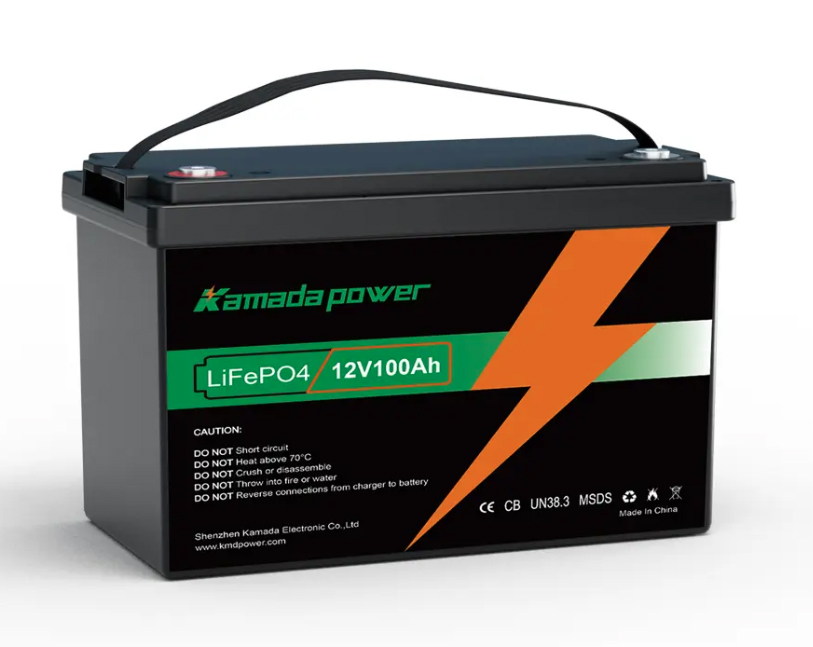
Batería Kamada Power 12v 100Ah Lifepo4
Standard Marine Battery Voltage
For the vast majority of us, 12 volts nominal is the standard. But here’s the thing: “12 volts” is just a label. If your meter actually reads 12.0V, you’re already in trouble. A healthy, fully charged battery sits higher.
- Lead-acid/AGM/Gel: 12.6–12.8V (resting)
- Litio (LiFePO4): 13.3–13.6V (resting)
If you’re running a big center console or a serious trolling motor, you might see 24V, 36V, or even 48V. Usually, that’s just a bunch of 12V blocks wired together in series to handle the load.
Why Marine Battery Voltage Matters More Than in Cars
Boats are brutal on batteries. It’s not like a car sitting in a garage. You’ve got the pounding from waves (vibration kills lead plates fast), salt air eating your connections, and moisture getting everywhere. Plus, deep discharges are common.
I’ve seen low voltage fry expensive chart plotters. In a car, if the battery dies, you coast to the shoulder. On the water? You drift. Keeping an eye on voltage is pretty much the only way to avoid that.
Common Marine Battery Voltages Explained
- 12V Systems (Most Common): The bread and butter. Starts your engine, runs the lights, powers the bait pump on small to medium rigs.
- 24V, 36V, and 48V Configurations: This is where the power is. High-thrust trolling motors—think Minn Kota or Garmin Force—eat amps. You get there by stacking 12V batteries in series.
- Rare Variants: Occasionally you’ll see old systems using 6V or 8V golf-cart-style batteries. Rare now, but they exist.
As electric propulsion gains popularity, I’m seeing a significant shift toward 36V and 48V setups. People want that sustained power without the voltage sag.
Marine Battery Types and Their Voltage Characteristics
| Tipo | Why you’d want it | The downside | What “Full” looks like |
|---|
| Plomo-ácido inundado | Cheap. You can find them anywhere. | Needs water. Spills acid if you crack it. | 12.6–12.7V |
| AGM | Sealed up tight. Handles the pounding. | Costs a bit more. | 12.7–12.8V |
| Gel | Deep discharge? No problem. | Pickier about charging. | 12.8–12.9V |
| Litio (LiFePO4) | Crazy light. Lasts forever. Charges fast. | Your wallet will feel it initially. | 13.3–13.6V |
Lithium continues to dominate new high-performance marine setups. The performance jump is real—mostly because the voltage doesn’t sag under load.
Fully Charged Voltage Ranges by Battery Type
Marine Battery State of Charge (SOC) Voltage Chart
Lead-Acid/AGM 12V Resting Voltage Chart
| Estado de carga (SOC) | Voltage (Resting) |
|---|
| 100% | 12.7V+ |
| 90% | 12.5V |
| 80% | 12.4V |
| 70% | 12.3V |
| 60% | 12.2V |
| 50% | 12.1V |
| 40% | 12.0V |
| 30% | 11.9V |
| 20% | 11.8V |
| 0% | <11.8V |
Lithium (LiFePO4) 12V Resting Voltage Chart
| Estado de carga (SOC) | Voltage (Resting) |
|---|
| 100% | 13.6V |
| 90% | 13.3V |
| 80% | 13.2V |
| 70% | 13.1V |
| 60% | 13.1V |
| 50% | 13.0V |
| 40% | 12.9V |
| 30% | 12.8V |
| 20% | 12.5V |
| 0% | <12.0V |
Nota: Voltage under load drops significantly. Always test at rest (no load/charge for 1–4 hours). Also worth knowing: LiFePO4 voltage is not a linear fuel gauge. It stays flat for most of the cycle, then drops fast near the end. Voltage gives you a rough idea—not an exact SOC—unless you’re using a shunt-based monitor.
How to Accurately Test Your Marine Battery Voltage
- Turn off everything. Bilge, lights, GPS. Disconnect the charger.
- Wait. Seriously. Let it rest 1–4 hours to settle.
- Grab your multimeter. Set to DC Volts (20V range).
- Red to positive (+), black to negative (-).
- Check the number against the charts above.
Common Mistake: Testing right after charging. You get a “surface charge”—maybe 13V+ on a lead-acid—that looks great but disappears the second you put a load on it. Seen it a million times.
Signs of Low Voltage and When to Worry
- That sluggish crank sound.
- Electronics flickering when you trim the motor.
- Below 12.4V resting (lead-acid) or around 13.0V (lithium): Get it on a charger soon.
- Below 11.8V: You might be shopping for a new battery soon. Damage happens fast here.
Charging Voltage Guidelines and Best Practices
- Don’t use a cheap car charger. Get a marine-specific smart one.
- Plomo-ácido/AGM: Bulk 14.4–14.7V, Float 13.2–13.6V.
- Litio: 14.2–14.6V (Check the BMS specs—they vary).
- Solar or alternator charging is solid for off-grid days. Just make sure the regulator matches your battery type.
Troubleshooting Common Voltage Issues in Marine Environments
- Sulfation (lead-acid): Basically crystals hardening on the plates. Equalize charge if the manual says okay.
- Corrosión: The green crust. Wire brush it off.
- Parasitic drain: Something’s eating power. Disconnect the negative cable when you store it.
- Overcharge: Cooks the electrolyte. Check your charger settings.
Lithium Marine Batteries – Are They Worth Switching?
Look, the shift to batería marina de litio is real and the market keeps growing. I held onto lead-acid for years because of the price, but the difference is night and day. You get 3x the life, half the weight, and the voltage stays high until the very end.
Pros:
- Resting voltage stays high (better for electronics).
- 4000+ cycles. Compare that to maybe 500 for lead-acid.
- BMS protects you from stupid mistakes.
Contras:
- Pricey upfront (though pays off in 3–5 years).
- You might need a new charger.
Voltage advantage: Lithium holds near-flat voltage under load, typically staying around 12.8–13.2V for most of the discharge. Lead-acid drops quickly. That means your trolling motor runs full power for most of the day instead of fading hour by hour.
Building Multi-Voltage Systems for Trolling Motors and House Banks
If you’re rigging for a trolling motor, pay attention.
- 24V: 2x 12V in series.
- 36V: 3x 12V in series.
- 48V: 4x 12V in series.
If you can, use a single 24V or 36V lithium pack instead of chaining 12Vs. Less wiring. If you do chain them, fuse everything and keep cable lengths equal. Sparks are not your friend.
Future of Marine Battery Voltages – Solid-State and High-Voltage Trends
Solid-state is the buzzword right now. It promises higher density, much higher thermal stability, and ultra-fast charging. However, let’s be realistic: while it is an emerging technology to watch, it isn’t widely available as a standard drop-in replacement just yet.
High-end electric vessel prototypes are starting to test solid-state tech, but for the average boater, availability and cost remain significant hurdles. We are seeing a push for 48V+ systems in electric boats, but for the foreseeable future, standard LiFePO4 remains the proven king of reliability and ROI. Solid-state might eventually become standard—but don’t hold your breath waiting for it this season.
Conclusión
So here’s the deal. Mastering these numbers prevents failures, extends life, and protects your wallet. Whether you stick with reliable lead-acid/AGM or drop the cash for lithium and high-voltage systems, the voltmeter is your best friend. Regular checks matter. Today’s tech is better than ever, but it still needs you to pay attention.
Ready to upgrade? Go test your voltage right now. Seriously. Consider lithium if you’re tired of replacing batteries every few years. Bookmark this guide. Stay safe and keep it charged! Póngase en contacto con nosotros hoy para obtener un customized marine battery solution tailored specifically for you.
Preguntas frecuentes
What voltage is a fully charged 12V marine battery?
Depends on the chemistry. Lead-acid or AGM should sit around 12.6–12.8V. Lithium? Expect 13.3–13.6V when it’s resting.
Can a marine battery read over 13V?
Absolutely. Lithium sits there naturally. Lead-acid will show 13V+ right after charging (surface charge), but it settles down.
How many volts should a marine battery have while running?
If your alternator is doing its job, you should see 13.8–14.4V. If the engine is off and you’re under heavy load, anything above 12V is generally okay.
Is 12.4V good for a marine battery?
Not really. That’s roughly 50–70% charge for lead-acid. I’d put it on a charger before heading out again.
What’s the difference between 12V, 24V, and 36V trolling motors?
Thrust and efficiency. Higher voltage lets you deliver the same power with less current and less heat. Better efficiency, longer runtime.
Are lithium marine batteries safe?
Yeah—mostly because of the BMS (Battery Management System). It shuts things down if they get weird. In many ways, it’s safer than acid sloshing around.
How long do marine batteries last?
Lead-acid? Maybe 3–5 years if you treat them well. Lithium? You’re looking at 8–10+ years easily.