Three hours of floor scrubber runtime does not guarantee three hours of productive cleaning. Operators turn at aisle ends, navigate around pallets, refill solution tanks and empty recovery tanks. Heavily soiled floors may need another pass. For cleaning equipment OEMs and distributors evaluating sodium-ion batteries, the useful purchasing metric is the area cleaned to an agreed standard per charge and per shift. Additional usable battery energy creates value only when it allows more acceptable cleaning within the available work window. Water capacity, working speed or charging availability may already limit output.
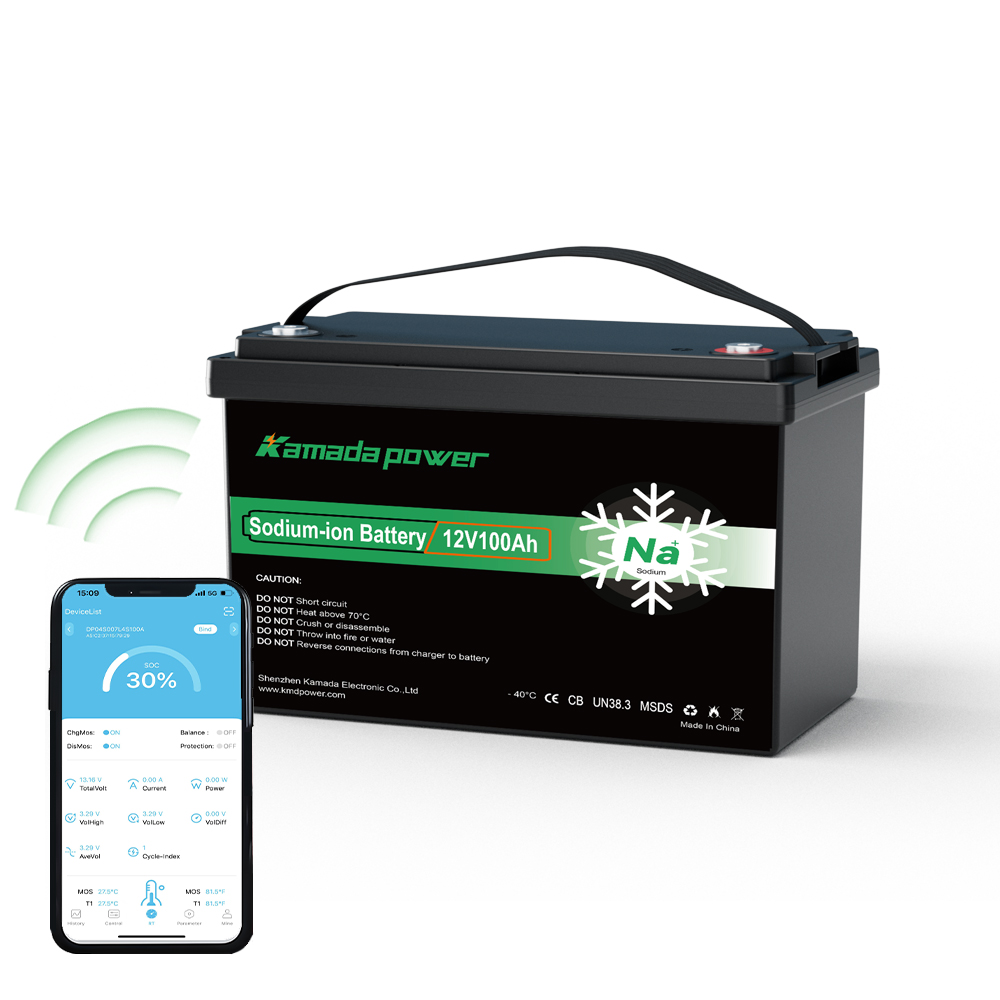
Kamada Power 12v 100Ah Sodium ion Battery
Why Does Three Hours of Machine Runtime Not Equal Three Hours of Cleaning?
Consider a commercial walk-behind scrubber with a 24V 100Ah battery system. One published equipment specification lists a maximum runtime of three hours and a coverage rating of 26,909 square feet per hour. Multiplying the two figures produces 80,727 square feet. These maxima are not established for the same duty.
The distinction is recognized in the industry. A July 2015 walk-behind scrubber brochure lists theoretical coverage of 1,858 m²/h for a 500 mm single-disk configuration, versus estimated conventional coverage of 1,388 m²/h for its self-propelled variant. The estimate accounts for practical speed and tank servicing. This is not a universal efficiency factor.
Theoretical coverage is calculated from effective brush width and forward cleaning speed. For a 20-inch cleaning head moving at 2 mph, the geometric coverage is 17,600 ft²/h before overlap or interruptions. The width of the rear squeegee must not be substituted for brush width: collecting water across a wider path does not mean the brush has scrubbed that entire path.
On an actual site, the shift includes four kinds of activity:
- Scrubbing and water recovery along the cleaning path.
- Turns, repositioning, travel to the next zone and obstacle avoidance.
- Solution refills, recovery tank draining and routine machine servicing.
- Repeat passes where the initial cleaning result is unacceptable.
Travel and repeat passes consume energy without adding new accepted area; tank servicing may consume time with motors off.
Suppose a three-hour cleaning window includes 125 minutes of active passes, 25 minutes of maneuvering and 30 minutes of tank servicing. If the active passes cover an average of 1,600 m²/h of unique floor area at the required quality, the accepted area is approximately 3,333 m² (35,880 ft²). That is a hypothetical operating example, not a measured runtime or coverage figure for either of the machines cited above.
Which Cleaning Modes Consume the Most Energy per Square Foot?
The brush loosens soil, the vacuum recovers dirty water, and on powered-drive machines the traction motor moves the scrubber. Pumps and controls add electrical loads.
The first equipment specification lists a 550W brush motor and a 500W suction motor. Their sum is not a measured battery input. Actual motor loading, controller losses and duty cycles matter. If electrical input were 1,050W at 24V, current would be about 44A before additional loads; this is illustrative, not measured machine current.
Higher brush pressure can increase motor load on rough concrete or with aggressive pads. But if one intensive pass replaces two lighter passes, energy per accepted square foot may fall.
Reducing vacuum power may save energy on smooth floors, but inadequate water pickup can leave wet streaks or require another pass. A failed water recovery requirement is not a productivity improvement.
Traction demand changes with machine mass, rolling resistance, ramps and repeated acceleration. Narrow aisles add maneuvering without adding new cleaned area; full and empty tanks can produce different drive loads.
Compare modes on the same floor, soil challenge and route, with defined soil-removal and residual-water acceptance criteria. Record brush pressure, pad type, solution flow and vacuum settings.
The relevant metric is:
Specific cleaning energy = Battery-terminal energy discharged (Wh) / Unique accepted floor area (m²).
Include energy used for turns, travel, repeat passes and powered tank servicing. Count accepted area only once. Meter unrelated loads separately for the shift budget. Use a discharge-only trial or separately meter charging and discharging.
Consider two hypothetical settings on the same 2,000 m² test route. A lighter brush setting consumes 600 Wh during the first pass but requires 300 Wh of additional work to meet the acceptance standard. Its total is 900 Wh, or 0.45 Wh/m². A more intensive setting completes the same area to the same standard using 800 Wh, or 0.40 Wh/m². Despite the potentially higher instantaneous brush demand, the second setting uses less energy per completed area.
These are hypothetical figures, not results from a sodium-ion battery pack test.
How Does the Battery Voltage Window Change the Area Cleaned per Charge?
A nominal 24V 100Ah system represents 2,400 Wh at 24V. Only energy delivered within the machine and battery operating limits is available for cleaning.
A sodium-ion battery pack has a chemistry- and design-specific voltage curve, internal resistance and protection settings. Existing lead-acid thresholds may not align with its discharge window; equal Ah does not guarantee equal cleaning energy.
The Tennant T300 operator manual (September 2024, p. 26) documents a useful distinction: at a flashing red battery indicator, scrubbing stops automatically, while powered-drive models retain travel capability. Energy reserved for returning to the charger is not cleaning energy.
Page 40 also requires the battery discharge indicator (BDI) and charger settings to match the battery type on relevant lead-acid models. On a sodium-ion OEM platform, an unsuitable voltage-to-SOC mapping or discharge algorithm could stop scrubbing prematurely; a BMS disconnect could instead interrupt controlled shutdown. The manual does not approve sodium-ion substitution and prohibits unapproved chargers. Do not change protection settings without OEM approval.
Fully charged pack voltage must fit all electronics and drives. The charger must meet the selected battery’s voltage, current, termination and temperature limits; a 24V label alone is insufficient.
A hypothetical 1,200W electrical demand requires 50A at 24V, or about 57A at 21V if power remains constant. At 21V, current is about 14% higher and resistive losses at unchanged resistance about 31% higher than at 24V. Actual controllers may limit current, reduce power or stop instead. Cable voltage drop, startup and pack resistance can bring the controller to its limit earlier.
Meter discharged Wh from the intended starting SOC to the earliest permitted machine or battery limit. Record controller voltage during simultaneous loads and motor startup. If brush or vacuum power falls below acceptable cleaning performance before shutdown, do not count subsequent energy as productive. Allow separately for an approved return-to-base reserve.
For an energy comparison, assume a representative cleaning trial uses 800 Wh to complete 2,000 m² of accepted cleaning. Specific cleaning energy is 0.40 Wh/m², equivalent to approximately 0.0372 Wh/ft². If the same duty can be repeated, a hypothetical battery delivering 1,600 Wh of usable cleaning energy could support 4,000 m², or about 43,056 ft². That is an energy-limited estimate, not a statement of actual sodium-ion battery performance.
| Usable cleaning energy after reserve | Energy-limited accepted area | Approximate area in ft² |
|---|
| 800 Wh | 2,000 m² | 21,528 |
| 1,200 Wh | 3,000 m² | 32,292 |
| 1,600 Wh | 4,000 m² | 43,056 |
| 2,000 Wh | 5,000 m² | 53,820 |
Illustrative calculation at 0.40 Wh/m², with unchanged duty, cleaning quality and sufficient water and time. Usable energy is not nominal pack energy.
A contract requiring 4,500 m² per charge at 0.40 Wh/m² calls for 1,800 Wh of usable cleaning energy excluding any separate reserve. On an illustrative 24V nominal basis, 80Ah, 100Ah, 120Ah and 150Ah represent 1,920, 2,400, 2,880 and 3,600 Wh. Delivering 1,800 Wh for cleaning requires respectively 93.75%, 75%, 62.5% and 50% of nominal energy, excluding return reserve. These are design candidates, not tested product specifications. Determine the accessible fraction at the intended load, temperature and end-of-life condition. The 4,500 m² target also requires a longer or more efficient work window than the three-hour example below.
For a 24V scrubber, consider a separately engineered 24V sodium-ion battery pack. Kamada Power 12V 100Ah sodium-ion battery is a finished-battery reference, not a compatible replacement. Approved 12V parallel configurations retain 12V-class voltage. Standard packs must not be connected in series without explicit approval.
Compare candidate chemistries on the same duty at recorded temperatures and starting SOC, using their approved charge and discharge limits. Compare usable Wh, accepted area and minimum loaded voltage, not simply Ah.
When Does a Larger Battery Fail to Improve Cleaning Productivity?
Assume the same 0.40 Wh/m², 1,600 m²/h active coverage, a three-hour window and 25 minutes of travel and maneuvering. Start with full solution and empty recovery tanks. Each fill supports 2,000 m² of accepted cleaning, and each combined refill/drain stop takes 15 minutes. Final servicing is outside the window. Assume the specific energy remains representative of each duty, including electrical overhead. At 1,600 m²/h, 0.40 Wh/m² implies 640 Wh per hour of active coverage, not measured simultaneous full-power motor input. For different routes, budget scrubbing, travel, tank servicing and other energy separately: fixed travel and discrete refill events can invalidate linear scaling.
Cleaning 4,000 m² requires 150 minutes of active cleaning, one 15-minute tank stop and 25 minutes of travel: 190 minutes in total. Even a battery capable of supplying the required 1,600 Wh cannot finish that area within 180 minutes under these assumptions.
After the first tank stop, the remaining active cleaning time allows a total of approximately 3,733 m². The time-limited area is therefore lower than the energy-limited area of the 1,600 Wh pack. Adding more energy does not raise that ceiling.
| Usable cleaning energy | Energy-limited area | Area achievable in 3 h under stated assumptions |
|---|
| 800 Wh | 2,000 m² | 2,000 m² |
| 1,200 Wh | 3,000 m² | 3,000 m² |
| 1,600 Wh | 4,000 m² | Approx. 3,733 m² |
| 2,000 Wh | 5,000 m² | Approx. 3,733 m² |
Figure 1. Illustrative cleaning area per three-hour window. Additional usable battery energy stops increasing output once travel and tank servicing constrain the available cleaning time. No product test data.
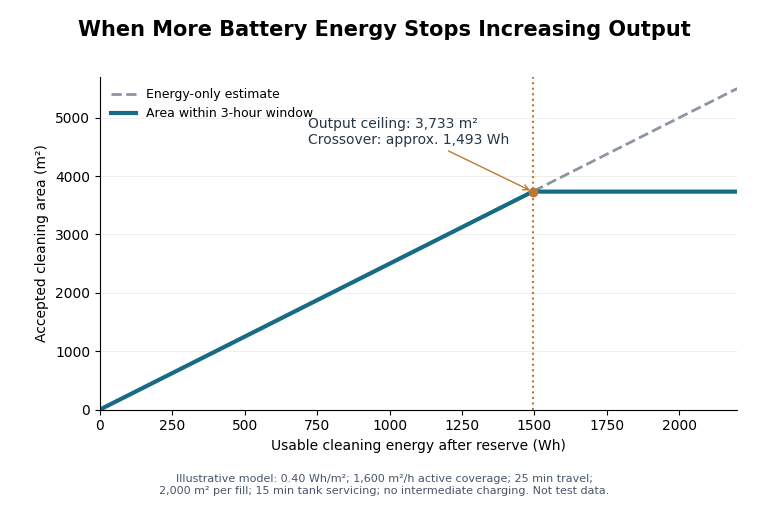
In this example the crossover occurs at about 1,493 Wh of usable cleaning energy. Above that point, a shorter refill route or more efficient water use at unchanged cleaning quality could be more valuable than another battery module. If the work window is extended, or the facility changes its refill process, the crossover must be recalculated.
The first cited machine lists 14 US gallons of solution capacity and 16 US gallons of recovery capacity (about 53 and 61 L). A hypothetical 53 L usable fill covering 2,000 m² implies 26.5 mL/m², not measured consumption. The practical tank limit is whichever tank reaches its permitted level first. Foam and recovery shutoff behavior can reduce usable volume. Measure area between service stops instead of assigning a universal water consumption rate.
Battery mass affects traction, axle loading and stability. Replacing heavy lead-acid batteries with lighter packs can also alter machine balance. OEMs must assess mounting, enclosure space, mass distribution and protection of the pack and connectors against water, cleaning chemicals and vibration. No ingress protection rating is assumed.
At 300W net terminal charging power, supplying 1,600 Wh takes at least 5 hours 20 minutes. Restoring 1,600 Wh of usable discharged energy takes additional allowance for storage losses, taper and temperature limits. Four hours of charging cannot replenish that energy at 300W. Extra capacity may bridge a temporary deficit, but not recurring undercharging.
Size for the contracted area, reserve and replenishment schedule. Purchase additional capacity only when energy remains the binding constraint.
FAQ
Can a 12V pack be used in a 24V scrubber?
Not directly. Parallel 12V packs do not raise voltage. Without an explicitly approved architecture, specify a separately engineered 24V-class OEM pack with compatible voltage and power limits.
Can nameplate coverage be multiplied by maximum runtime?
Not reliably. Maximum ratings may represent different conditions. Account for actual cleaning speed, brush width, overlap, repeat passes, travel and tank servicing, then check usable energy.
Does a bigger pack always clean more area?
No. Tank stops, work windows, machine mass and charging constraints may cap output before energy runs out. Compare accepted area per shift at equal quality.
Conclusion
Select a sodium-ion battery around accepted cleaning area per shift, usable Wh and the scrubber’s voltage and current requirements. Standard 12V packs and approved parallel configurations are candidates only for compatible 12V equipment; 24V platforms require a separately engineered architecture. Reject unapproved substitutions. For a custom sodium-ion battery assessment, contact Kamada Power with your system voltage, brush, vacuum and traction motor load profiles, cleaning mode, required square feet per shift, BDI and controller cleaning-stop limits, and charging window.