Winter Solar CCTV Battery: Sodium-Ion Battery vs LiFePO4. For -15°C solar CCTV, failures typically result from cold-charging limits and voltage sag rather than capacity shortage—a gap Sodium-ion battery bridges effectively. This guide focuses strictly on practical engineering, from controller settings to wiring strategies, ensuring your 12V deployment is truly field-ready for winter conditions.
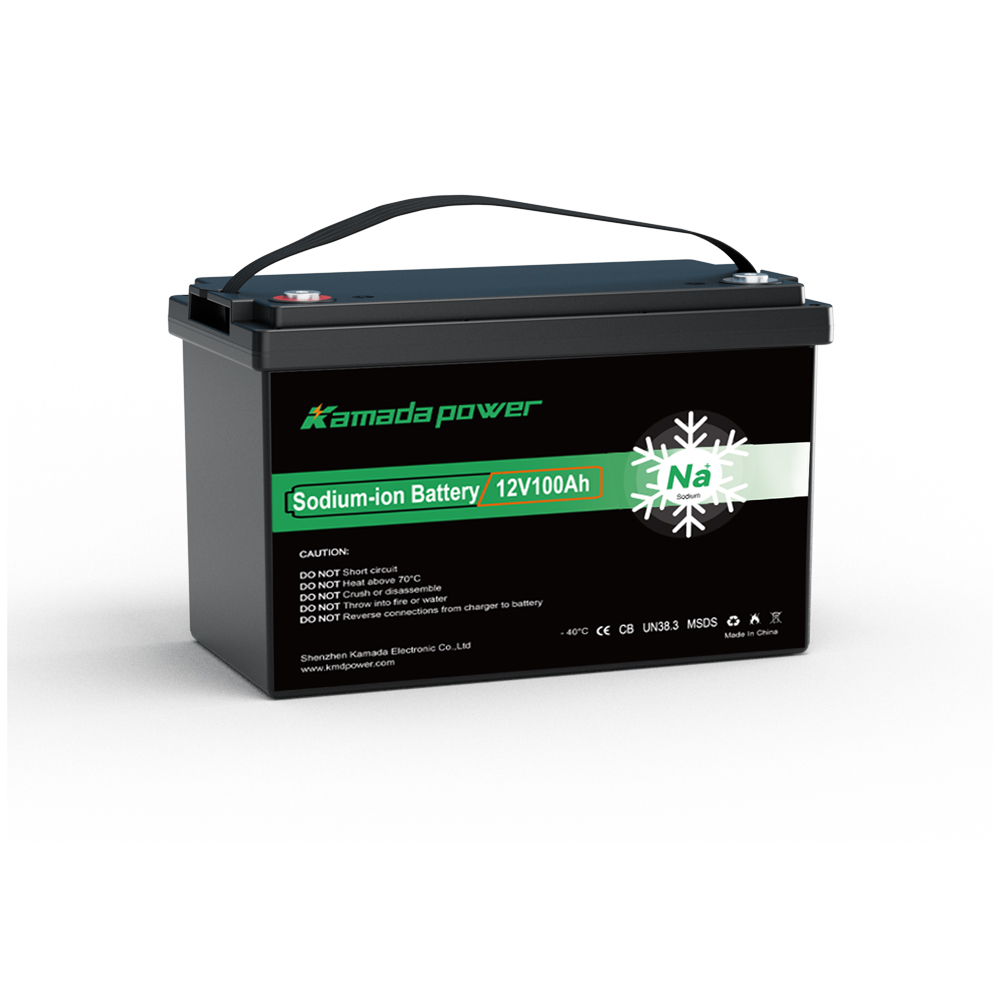
Kamada Power 12V 100Ah Sodium ion Battery
Why Outdoor Solar Monitoring Batteries Fail in Winter
Most “12V” solar systems don’t fail because of a lack of capacity. They fail because of physics—and winter makes the physics louder.
Short days. Low sun angle. Cold batteries. Longer nights. Plus cable loss that suddenly matters because 12V doesn’t leave much room for mistakes. In the field, you typically see one of two failure modes.
The “Frozen Charge” Effect (a Common LFP Pain Point)
Lithium Iron Phosphate (LiFePO4) is excellent in many projects. But in winter monitoring sites, one limitation shows up again and again:
Many LFP packs reduce charge current or block charging at low cell temperatures (often around 0°C / 32°F unless the system has heating or a different BMS strategy).
So you get the classic winter headache: your PV is producing power on a sunny cold morning, but the battery won’t accept it (or only sips a tiny amount). Meanwhile, the load keeps draining. By evening, the site is already behind on energy.
Two real-world notes that matter more than brochures:
- Ambient temperature isn’t cell temperature. In a metal enclosure with wind, cells can be colder than the air.
- Some LFP systems use self-heating. It can work, but it adds cost and complexity—and it consumes energy at the exact moment winter solar is limited.
If your symptom is: “PV looks fine, but SOC never recovers in winter,” this is usually why.
The Voltage Sag Trap (Lead-Acid’s Winter Weakness)
Lead-acid can generally charge in the cold, but it has a different problem: voltage sag, especially when cold and under surge load.
At -20°C, a 12V lead-acid battery under load can dip below device cutoffs (routers, radios, and NVRs can be picky), triggering a reboot loop—even when the battery still has energy left.
Once reboot loops start, they feed themselves:
- device boots → current spikes
- voltage dips → device resets
- repeat until the site goes dark
This is why “buy a bigger battery” sometimes doesn’t fix anything. You don’t need more theoretical Wh. You need better behavior under winter conditions.
Fast diagnostic tip: If your camera/router keeps rebooting at night, check LVD settings + cable loss + surge behavior before buying a larger battery.
The Engineering Reality: 12V 100Ah Sodium-Ion at -20°C
This is where Sodium-Ion Battery can change the game for outdoor monitoring deployments—especially sites that live around -10°C to -20°C.
The key win isn’t a magic marketing number. It’s that Sodium-Ion can be designed to accept charge at sub-zero temperatures (under defined conditions), so you can harvest winter solar instead of watching it get wasted.
1) True Charging at -20°C (Under Defined Limits)
Unlike LFP, Sodium-Ion cells commonly use hard carbon anodes, which can support safer ion intercalation at low temperatures.
- The spec (for our 12V 100Ah pack): charging down to -20°C (-4°F), discharging down to -40°C (-40°F)
- The field result: you can capture limited winter solar during short days, keeping the system alive while many standard LFP packs are restricted
One professional caveat (and it’s a good thing, not a problem):
Low-temperature charging depends on charge current, cell temperature, and BMS strategy. In plain English: charging at -20°C typically requires a sensible current limit, not “full-speed charging like it’s summer.” That’s normal engineering.
If you want us to confirm the -20°C fit for your site, send:
- minimum ambient temperature + where the battery sits (pole box / cabinet / indoor)
- PV wattage + controller model
- average load (W) + any surge/boot spikes
We’ll confirm whether the cold-charge window and current limits match your real duty cycle.
2) Cycle Life That Actually Reduces Truck Rolls
Lead-acid batteries in harsh outdoor cycling often last 300–500 cycles (commonly 1–2 years in daily cycling). Our Sodium-Ion packs are rated for 6,000+ cycles at 80% DoD (under defined test conditions).
- OpEx impact: remote sites usually don’t lose money on the battery—they lose money on service visits. Fewer replacements means fewer truck rolls.
Here’s the part people don’t like hearing, but it’s true:
Cycle life isn’t only chemistry—it’s settings + temperature + duty cycle. The gap between “6,000 cycles” and “premature aging” is usually one of these:
- charge voltage too aggressive
- no cold-weather current limiting
- LVD set wrong so the pack gets abused
- poor enclosure thermal behavior
That’s why controller setup matters as much as the battery choice.
MPPT/PWM Controller Compatibility (And the One Non-Negotiable)
A common concern we hear is: “Do I need a special ‘Sodium’ solar controller?”
Usually, no. You just need a controller that is programmable.
Our Sodium-Ion batteries are designed to work with standard MPPT/PWM controllers—including common programmable models from brands like Voltronic, EPEVER, and Victron—as long as you can customize voltage setpoints and charge current limits.
Quick warning that prevents avoidable failures: If a controller only offers fixed presets (AGM/GEL/Lithium) and won’t let you edit voltages and charge current, it’s not “compatible” in the way you need for cold-weather reliability.
Critical Settings Checklist (What You Must Set)
Sodium-Ion voltage behavior is not identical to lead-acid or LFP. To get long life and stable winter operation, tune your controller using the exact values from the battery datasheet for your model.
- Bulk/Absorption Voltage: set per datasheet (varies by pack design and BMS limits)
- Float Voltage: set per datasheet (and in many monitoring deployments, float is configured conservatively)
- Max Charge Current Limit: crucial for cold charging; stable, controlled charging beats aggressive charging in winter
- Low Voltage Disconnect (LVD): set based on usable voltage range and load sensitivity (too high wastes capacity; too low can cause unnecessary stress)
- Low-Temp Charge Strategy: if your controller supports it, coordinate with the BMS cold-charge limits rather than forcing summer behavior
Two field tips that stop “mystery reboots”:
- Measure voltage at the load, not only at the controller. Cable loss can make your router see lower voltage than the controller thinks.
- Give surge loads breathing room. Radios/routers/NVRs can spike on boot, and 12V systems punish thin/long cables.
High-intent offer: Using a Voltronic or generic MPPT controller? Don’t guess. Send us a screenshot of your current settings page. Our engineers will mark up the recommended Sodium-Ion parameters and send it back to you for free.
To make the review fast, copy/paste this:
- Controller brand + model
- PV panel wattage + Voc/Vmp (or a label photo)
- Battery location + minimum temperature
- Cable length + gauge (battery→controller, battery→load)
- Load list (average W + peak/surge notes)
Sodium-Ion vs LFP vs Lead-Acid for Outdoor Solar Monitoring
Here is how the chemistry stacks up for winter reliability in outdoor solar monitoring systems.
| Feature | Sodium-Ion (Na-ion) | LiFePO4 (LFP) | Lead-Acid (Gel/AGM) |
|---|
| Sub-zero charging | Strong (depends on current limit & BMS strategy) | Often limited at low temp unless heated / special BMS strategy | Possible but slow; efficiency drops in cold |
| Cycle life potential | 6,000+ (under defined test conditions) | Often high (varies by cell/BMS/temp; heating adds complexity) | 300–500 (often less in harsh daily cycling) |
| Energy density | Medium | High | Low (heavy) |
| Voltage stability in cold | Good (more stable than lead-acid) | Good | Poor (sag increases in cold and under surge) |
| Total cost of ownership | Best for cold/remote (fewer service visits) | Best for mild climates / mature ecosystem | Often highest over time (replacements + labor) |
Verdict: If your site regularly drops below freezing and is unattended, Sodium-Ion Battery is often the better technical fit—especially when the real pain is “winter charging doesn’t happen” or “voltage dips cause reboots.”
If your climate is mild and you already run a heated enclosure, LFP can still be a great option. The right answer depends on the site, not the brochure.
The Reference Configuration: 12V 100Ah (Why It’s the Sweet Spot)
For most single-pole monitoring systems, a 12V 100Ah unit is a practical standard. It fits common enclosures and can replace bulky lead-acid blocks.
It’s also easy to spec, easy to standardize across projects, and simple for procurement teams to approve.
Quick Runtime Math (A Useful First Pass)
Runtime (Hours) = (Battery Wh × 0.9 usable factor) ÷ Load (Watts)
Example scenario:
- Load: 2× cameras + 1× 4G router = 25W average
- Battery: 12.8V × 100Ah = 1280Wh
- Estimate: (1280Wh × 0.9) ÷ 25W ≈ 46 hours
That’s close to 2 days of autonomy without sun—a healthy safety margin for many deployments.
One practical reminder: always sanity-check peak load. A router or radio can spike on startup. If wiring is long or thin, that spike becomes a voltage-drop event, not a capacity event.
If you want a quick sizing recommendation, send:
- average load (W)
- peak/surge notes (or device models)
- target autonomy hours
- minimum temperature
- PV watts + controller model
…and we’ll reply with a simple PV + battery sizing suggestion.
Top 3 Installation Mistakes That Kill Winter Uptime
Even with the right battery, projects fail when the basics are off.
- Undersized PV panels In winter, you might only get 2–3 “peak sun hours.” A system that “barely” recovers in summer often collapses in winter.
- Wrong LVD settings Using lead-acid default cutoffs can cause early shutdown while the Sodium-Ion pack still has usable energy. Worse, repeated deep hits from bad settings can shorten life.
- Ignoring cable loss On 12V systems, long or thin cables create voltage drop. Combined with cold weather, this can trick devices into thinking the battery is dead.
If you remember only one thing: reboots are usually settings + wiring before they’re chemistry.
Quick Project Fit Check (Go / No-Go)
Sodium-Ion is a strong candidate if you can check these boxes:
- Does the site temperature drop below -5°C (23°F)?
- Is the site unattended or expensive to visit?
- Do you need a 12V system that fits standard enclosures?
If “yes” to the above, Sodium-Ion is likely your best path forward.
Want the fastest Go/No-Go? Send this in one message:
- minimum temperature
- battery enclosure type (pole box / cabinet / indoor)
- PV watts + controller model
- load list (avg W + peak/surge)
- cable length + gauge
We’ll tell you what will work, what to change, and which controller settings to use.
Conclusion
Sodium-Ion Battery can close the winter gap with sub-zero charging capability and high cycle-life potential—but remote monitoring sites don’t succeed on chemistry alone. They succeed on correct setpoints, sensible current limits, and wiring that doesn’t sabotage a 12V system.
So don’t gamble on presets. Don’t copy an AGM profile and hope. Send us your load profile and controller model. Contact us — Kamada Power. As a sodium ion battery manufacturer in China, we can provide a 12V Sodium-Ion battery matched to your deployment conditions—from BMS cold-charge strategy to controller setpoints and form factor—so your winter uptime stops being a seasonal surprise.
FAQ
Can Sodium-Ion really charge at -20°C without a heater?
It can—when the pack and BMS are designed for it and the charge current is limited appropriately. The exact limits depend on the battery model and your site conditions. Share your minimum temperature, PV/controller, and loads, and we’ll confirm fit.
Do I need a special “Sodium” MPPT controller?
Usually no. You need a controller that lets you set custom voltages and charge current limits. If it’s locked to presets (AGM/GEL/Lithium) with no editing, it’s not the right tool for cold-weather reliability.
Why does my solar camera system reboot at night in winter?
Most of the time it’s voltage sag caused by cold batteries, surge loads, and cable loss—plus an LVD setting that’s too high or not matched to the load. Measure voltage at the load, not just at the controller.
Is 12V 100Ah enough for my CCTV + router?
Often yes for small sites, but it depends on average load, surge, and how many winter sun hours you get. The quick math helps, but real sizing needs your load list and the minimum temperature.