An OEM wants to replace one or two 100Ah batteries in a pole-mounted solar CCTV cabinet with sodium-ion packs. The new housing may obstruct the MPPT controller, leave no space for terminal lugs, or fail to pass through the door. A 100Ah rating does not define physical dimensions or guarantee a drop-in replacement. Verify usable space, approved orientation, wiring, structural support and future removal—not just catalogue sizes.
Approve only when each proposed pack and the complete one- or two-pack assembly can enter, be mounted, connected and later removed from the usable cabinet space. Decide: standard pack, revised mounting, custom pack or reject.
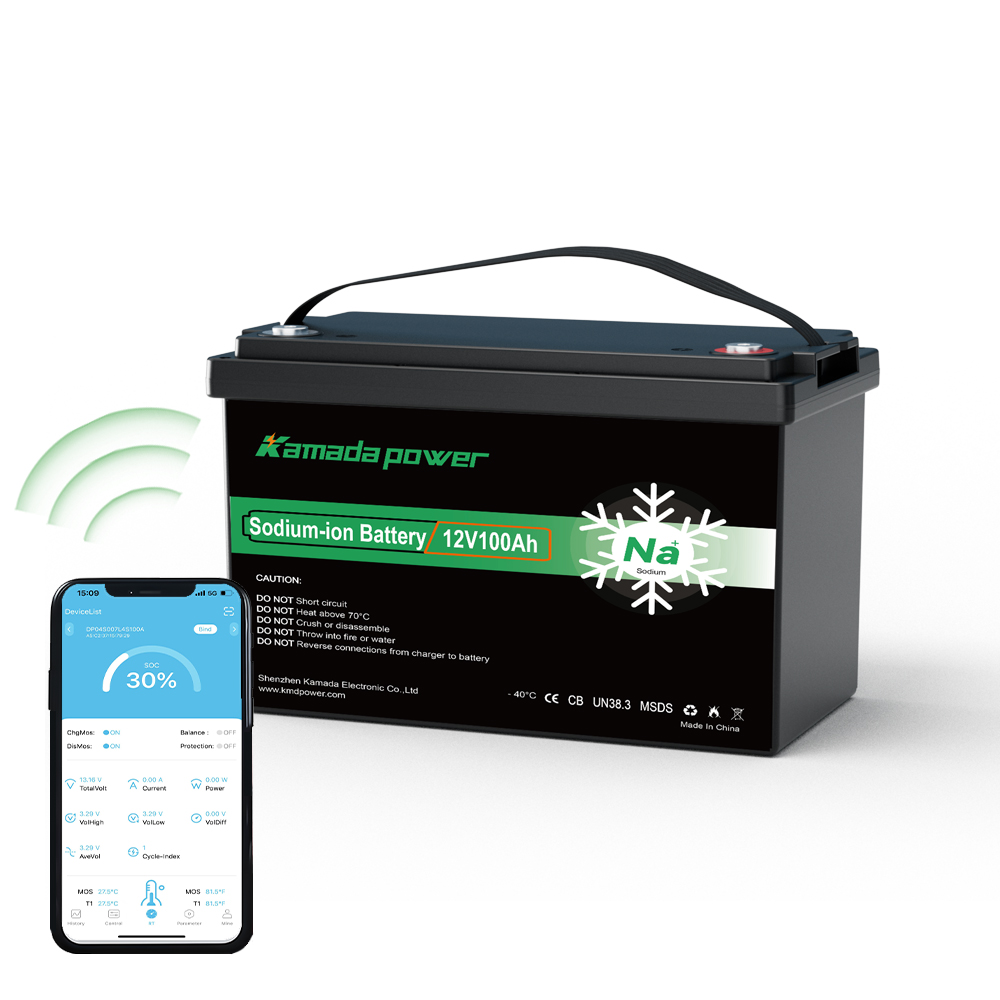
Kamada Power 12v 100AH Sodium-ion Battery
Does Fits Two 100Ah Batteries Mean Any 100Ah Pack Will Fit?
No. Amp-hours describe charge capacity; they are not a housing standard. A commercial enclosure illustrates the difference.
Speco Technologies lists SXA200/SXA300/SXA400 enclosures at 21.5 × 16 × 14.5 inches (H × W × D), with space specified for two 100Ah batteries of reference size 9.2 × 12.3 × 6.7 inches (H × W × D). These are external cabinet and reference battery dimensions, not verified usable bay measurements or a guarantee for every 100Ah pack. Source: Speco enclosure datasheet.
The Kamada Power 12V 100Ah Sodium ion battery manufacturer datasheet supplied for this review gives 363 × 212 × 230 mm (L × W × total height) and approximately 13.5 kg. A Kamada Power application article repeats those dimensions. However, the 12V 100Ah sodium ion battery lists 266 × 168 × 209 mm, also 13.5 kg, under a 12.8V model designation. These descriptions are not proven to refer to the same production revision. Obtain the controlled drawing and part number before approving an installation.
| Source / component | Published size or mass | What it establishes |
|---|
| Speco SXA enclosure outside | About 546 × 406 × 368 mm (H × W × D) | Not usable battery-bay clearance |
| Speco reference 100Ah battery | About 234 × 312 × 170 mm (H × W × D) | Reference envelope, not universal fit |
| KMDPOWER supplied 12V 100Ah datasheet | 363 × 212 × 230 mm (L × W × TH) | Candidate pack; terminal protrusions and orientation still need checking |
| KMDPOWER online 12.8V 100Ah description | 266 × 168 × 209 mm | Different published envelope; revision unconfirmed |
| KMDPOWER reported battery mass | ~13.5 kg per pack | Verify production assembly mass before structural review |
Inch-to-millimeter values are rounded from the published inch dimensions (1 inch = 25.4 mm). These manufacturers have not been represented as having tested their products together.
For the supplied datasheet pack, the longest edge is 363 mm, compared with about 312 mm for Speco’s reference battery; the online catalogue envelope has a 266 mm longest edge. A larger edge does not alone prove failure, nor does a smaller one prove fit. Check one-pack and two-pack layouts separately: two reference bays may not form one unobstructed space, and the terminal/door clearance of each pack matters.
Figure 1 — Published 100Ah battery envelopes are not interchangeable
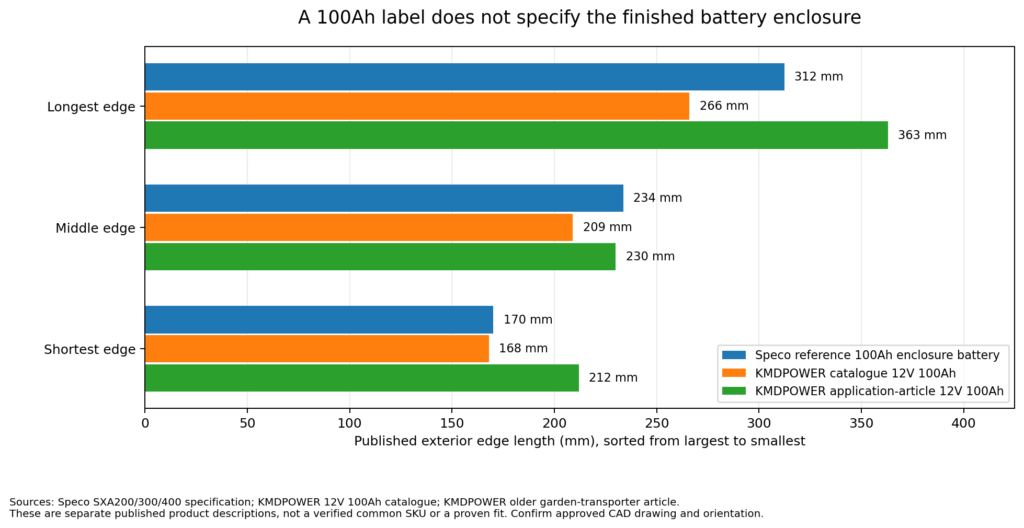
Sorted exterior edge lengths only, not installed orientations or cabinet clearances. The two Kamada Power descriptions are not confirmed as one SKU. No manufacturer has tested this pairing as represented here.
Which Dimensions Matter Inside an Already Equipped CCTV Cabinet?
Measure the usable battery bay, not the cabinet outside: account for walls, brackets, door hardware, glands, charge controller, PoE devices and restraints. For two-pack replacements, measure both positions and the space needed for separate terminals, wiring and removal; two bays are not necessarily one open volume.
A useful fit model has three envelopes:
- Battery envelope: the finished pack’s approved exterior geometry, including handles, feet, displays, protruding terminals, and manufacturing tolerances.
- Installed envelope: battery plus brackets, terminal protection, connector bodies, cable exits, and any required clearances specified by the pack maker.
- Service envelope: the door opening, insertion/turning path and removal path needed to install and service the pack without damaging wiring, electronics or seals.
Check all three envelopes in a manufacturer-approved orientation:
Clearance on an axis = measured unobstructed bay dimension − required installed dimension on that axis.
A positive result is only a screening check. Terminal, fastening, ventilation and maintenance clearances still apply. For two packs, repeat the check with both installed simultaneously, not one at a time.
A dimensional check that looks good—but is not yet a pass
Consider a hypothetical bay measuring 300 × 230 × 190 mm. If the online catalogue pack (not the 363 mm datasheet pack) is approved to present 266 × 209 × 168 mm along those axes, gross clearance is 34, 21 and 22 mm. This is arithmetic only, not a measured cabinet or approval of that orientation.
Terminal lugs, covers and latches can consume these margins. The pack may not pass through the opening or turn around interior equipment. A final-position fit is not an insertion-path pass.
Will the Terminals, Fuses, and Cables Still Be Accessible?
A casing can fit while a terminal lug, cable bend, fuse holder or door clearance still fails.
Check terminal position, approved orientation, lug/connector type, torque, protective caps, cable exit, fuse and isolation access. Do not relocate protection merely to save space.
Use the actual power-cable manufacturer’s bend-radius requirements and allow space for a supported exit. Do not copy a bending-radius number from unrelated control wiring into battery-lead design.
Provide glands and strain relief independently of the electrical termination. Rittal enclosure guidance is an example of why cable support and electrical contact are separate design checks.
Acceptance requires safe isolation, covered terminals, inspectable protection, and battery removal without exposing live conductors.
Can the Cabinet and Pole Mount Support the Replacement Pack?
Cabinet dimensions do not establish shelf, strap or pole-bracket ratings. The KMDPOWER datasheet gives ~13.5 kg per pack; two are ~27 kg. Speco lists its empty enclosure at ~28 lb (~12.7 kg), so the cabinet plus two packs alone would total ~39.7 kg, excluding controllers, brackets, cables, solar panels and other hardware. This is an illustrative mass sum, not an approved installed load or pole rating.
Check the shelf, pole, straps, fasteners, center of mass and wind/vibration loads for the complete configuration. A restraint sized for the original reference battery may not fit a replacement.
Restrain the pack mechanically, never with its terminals or harness. Do not drill or clamp its casing without approval; allow access to any actual service ports.
The supplied KMDPOWER datasheet says IP65 but also describes the pack as “splash-proof”; the online 12.8V listing says IP67. Do not transfer that IP67 claim to the supplied datasheet configuration. Confirm the actual production test evidence. In all cases, altered glands, doors or cutouts must preserve the finished cabinet’s required ingress protection. Rittal likewise qualifies particular gland plates only when correctly installed.
This article checks mechanical suitability. Temperature rise and battery derating in a sun-heated cabinet require a separate thermal qualification; a passing fit test is not a thermal pass.
How Should an OEM Carry Out a First-Article Battery Fit Check?
Test a production-revision cabinet with an approved pack or dimensionally accurate dummy including terminal guards. If the design calls for two batteries, mock up both together before live electrical testing.
| Fit gate | Evidence to collect | Pass, revise, or reject? |
|---|
| Entry and orientation | Door-opening measurement, pack drawing, approved mounting attitudes | Each pack can enter, turn, seat and leave without damage in an approved orientation |
| Installed clearance | CAD clash check or measured clearances at actual mount points | Complete one- or two-pack assembly fits with guards and spacing |
| Connection and protection | Wiring route, terminal cover, fuse access, cable manufacturer’s bend requirements | Cables are supported; safe connection and isolation remain accessible |
| Retention and structural load | One-/two-pack mass, center of gravity, shelf and pole-load check | Approved fasteners and supports can carry the complete installed assembly |
| Sealing and service | Gland/door checks and timed removal trial | Required environmental protection and future replacement access are preserved |
| Electrical integration | Approved pack and charger data, system schematic | Electrical compatibility is validated separately; physical fit alone is not approval |
Photograph the installed full pack count, terminal side, shut door and actual removal path. Log revisions, interference, unsafe terminals, overload or insufficient space.
What should trigger a redesign rather than a field workaround?
Reject pinched leads, bare terminals, unsupported orientations, unverified supports and doors touching the pack. Do not rely on improvised field changes.
When Is a Custom Pack Better Than Changing the Cabinet?
When the standard pack fails, compare these outcomes:
Modify the cabinet or mounting kit. Suitable where structure, ingress protection and production repeatability can be maintained.
Evaluate a different approved pack enclosure. A different housing or terminal position may help, but a smaller package cannot be promised without revalidating BMS, thermal, electrical and mechanical requirements.
Reject the retrofit. Reject if access, safety or electrical compatibility cannot be validated. Two-pack parallel operation also requires approval for the exact battery revision; it does not create space or permit arbitrary stacking.
The procurement question is therefore not “Can you supply a 100Ah battery?” It is “Can you supply a finished pack that is electrically qualified and repeatedly installable in our existing CCTV enclosure?”
What Should an OEM Send for a Battery Fit Review?
Send internal bay CAD, opening and insertion-path measurements, photos, present battery size, one-/two-pack requirement, mounting details and estimated quantity. Add charger and loads for separate electrical review.
For a battery-fit review, start with the Kamada Power 12V 100Ah Sodium-ion battery, but request the approved engineering drawing before declaring a match. Kamada Power 12v 100ah sodium ion battery security-systems application provides general context; this article concerns a narrower decision: repeatable installation, cable access, retention and serviceability in a specific CCTV cabinet.
Return one decision: standard pack, mounting redesign, custom pack evaluation or reject—with the approved drawing, pack count and responsible owner.
FAQs
Are all 12V 100Ah batteries the same physical size?
No. Ah and voltage do not standardize dimensions, mass, terminals or orientation. Use the exact drawing.
If the battery is smaller than the enclosure’s outside dimensions, will it fit?
Not necessarily. Walls, door hardware, electronics, restraints and the opening reduce usable space.
Can I rotate a sodium-ion battery onto its side to make it fit?
Only if that orientation is approved for the specific pack and mounting. Geometric fit alone is not permission.
Does an IP67 battery eliminate the need for a weatherproof CCTV box?
No. IP ratings apply to specific tested products. The supplied 12V KMDPOWER datasheet lists IP65 (and “splash-proof”), while a separate online listing states IP67. Confirm the exact revision, then assess the entire cabinet and cable entries.
Is a custom slim battery always the best fix for a crowded power cabinet?
No. Revised mounting or cabinet design may be simpler. Custom packaging requires separate validation.
Conclusion
A 100Ah label cannot establish cabinet fit. The supplied kamada power12V 100Ah sodium ion battery datasheet specifies 363 × 212 × 230 mm, while its online listing gives another envelope; confirm the production revision and approved drawing. Validate usable bay space, one or two packs together, insertion/removal paths, terminals, supports and ingress protection. More Ah does not fix a physical-interface failure. For standard or custom 12V 100Ah sodium ion battery projects, contact Kamada Power with cabinet CAD, pack count, electrical BOM and estimated annual quantity for a revision-specific fit review.