At a winter job site, a parked utility truck may need warning lights, radios and a warm cab long after mechanical work ends. For work truck upfitters and fleet operators, a sodium-ion auxiliary battery is worth considering when compatible electrical loads account for enough genuinely avoidable idle time to recover the installed system cost. It is not a universal substitute for engine-driven equipment. The U.S. Department of Energy’s guidance on medium-duty vehicle idle reduction identifies battery-based auxiliary power, dedicated heaters and other alternatives for stationary vehicle operation. Separate engine-dependent work from electrical demand before pricing winter energy.
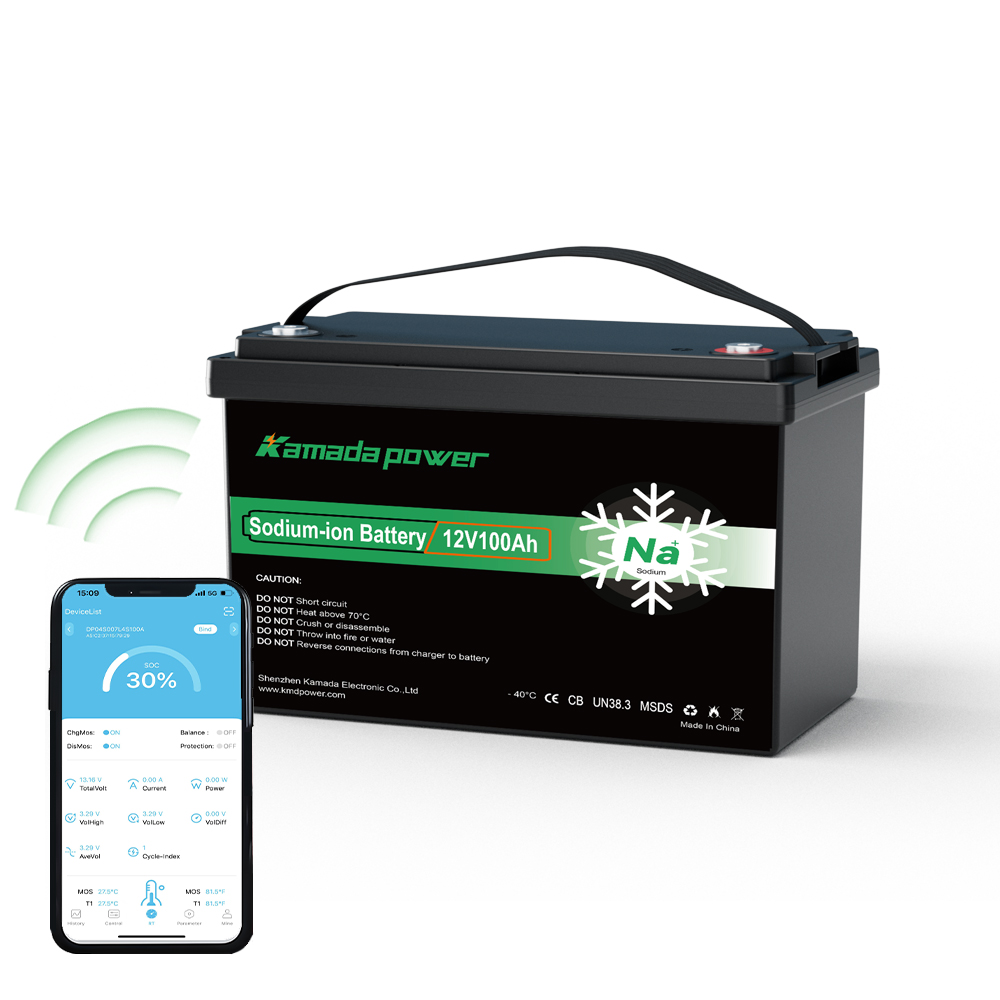
Kamada Power 12v 100Ah Sodium-ion Battery
Which Work Truck Tasks Actually Require the Engine to Stay On?
Stationary engine hours are not interchangeable. An aerial lift truck may drive its hydraulic pump through a power take-off (PTO) connected to the powertrain. Stopping the engine during that work removes the power needed to operate the lift. An electric PTO could change the architecture, but it requires a separate engineering and safety assessment.
The NREL study on PTO and idle behavior in utility vehicles (2017, NREL/TP-5400-66747) examined 75 electric-PTO and 10 conventional-PTO vehicles, primarily aerial lift trucks. Separating PTO from idle operation is essential for sizing an auxiliary battery.
| Stationary truck function | Engine-off battery assessment |
|---|
| Warning lights, radios and telematics | Candidate electrical loads; preserve required safety functions. |
| Task lighting and approved tool chargers | Measure actual demand, including inverter standby. |
| Engine-driven PTO and hydraulic pump | Exclude unless an approved alternative supplies the mechanical work. |
| Cab heating and defrosting | Assess heat demand and safety; compare dedicated heaters. |
| Required warm-up, regeneration or other OEM-mandated operation | Exclude where the engine must run. |
A truck recording five stationary engine hours might spend two hours on PTO work, half an hour on other mandatory engine operation and two and a half hours on electrical-only demand. If the battery can cover two of those last hours, the achieved reduction is two hours, not five.
Log engine status, PTO engagement, accessory current, temperature and job records on a common time base. Assign each minute to mutually exclusive operating states. Count an interval only if all necessary engine-dependent services have approved alternatives. Powering lights from a battery saves no idle fuel while the engine must run for hydraulics or heat. Exclude idle time that could already be eliminated through ordinary shutdown procedures. After installation, compare actual engine hours under equivalent work and weather conditions.
How Much Stored Energy Can Replace an Hour of Idling?
Measure engine-off loads at the proposed auxiliary bus. For AC appliances, measure DC input at the inverter or calculate conversion losses separately, but not both.
For a hypothetical service truck, assume 180W of average DC accessory demand, a 90W average AC tool-charging load with 90% conversion efficiency, and 20W of additional inverter standby averaged over the full interval (outside active conversion). Battery demand is 180 + 90/0.90 + 20 = 300W, or 300Wh per engine-off hour. Heating is excluded.
Replacing 2.4 hours consumes 720Wh at the battery terminals. With a planning reserve of 15% of deliverable energy, the required demonstrated usable capacity is 720/0.85 ≈ 847Wh, assuming no charging during that interval. A hypothetical 1,000W electric heater running throughout would add 2,400Wh at the load terminals before conversion losses. Cab heat cannot be hidden inside a generic accessory allowance.
Preserve starter reserve through approved auxiliary isolation and charging; do not assume cranking suitability. Verify loaded bus voltage, sustained and transient current, BMS protection and safe recovery for radios, inverters and safety-related accessories.
An approved DC-DC charger may be needed for vehicle replenishment. Its input voltage, output profile, temperature limits and response to BMS disconnection must match both vehicle and battery. Direct alternator connection is not assumed suitable. Alternator nameplate output is not available charging power: engine speed, regulated voltage, vehicle loads (including defrost), DC-DC limits and temperature-dependent battery charge acceptance constrain recovery. Check vehicle transients, wiring and protection.
The Kamada Power 12V 100Ah sodium-ion battery is a candidate for compatible auxiliary applications. Confirm the exact model and revision; nominal Wh are not demonstrated winter usable Wh. Approved 2P–4P configurations provide 12V-class 200–400Ah; approved 2S2P provides a 24V-class 200Ah option. Check module matching, branch current sharing, protection coordination and the effects of a module trip. A custom auxiliary pack may be more appropriate when the standard configuration is oversized or cannot meet vehicle requirements. Verify vibration resistance, mounting restraint, road-splash exposure and applicable electromagnetic compatibility. Other series combinations and vehicle fit are not implied.
How Does Winter Change the Cost of Battery-Based Idle Reduction?
After hours outdoors, charging limits depend on cell temperature, not air temperature alone. A cold discharge rating does not authorize charging at the same temperature or current.
A 2026 Applied Energy study of early commercial sodium-ion cells reports that tested sodium-ion cells retained 51%–62% of their 25°C discharge capacity at −40°C under its 0.2C discharge protocol. Resistance and voltage–SOC behavior vary by chemistry; cold discharge does not establish cold charge acceptance. These cell results are not Kamada Power sodium ion battery pack ratings. Increased resistance can lower loaded voltage to the auxiliary equipment’s cutoff before the battery reaches its permitted discharge endpoint. During charging, the BMS may limit or interrupt current; the charger must respond safely.
Return to the 720Wh accessory example. One hour of driving that restores 500Wh of net recoverable battery energy leaves a 220Wh daily deficit. If cold conditions restrict recovery to 150Wh, the deficit grows to 570Wh. Both rates are hypothetical, not product ratings. Net recoverable energy is energy available for subsequent auxiliary discharge after losses and any simultaneous loads within the measurement boundary.
A larger battery postpones a recurring deficit rather than resolving it. Establish a sustainable charging schedule using approved vehicle charging, depot shore power or both. Include any battery-heater energy, whether drawn from the battery or grid, and the time needed to reach an approved charging temperature. Avoid counting heating energy twice.
Cab heating is a separate demand. DOE identifies fuel-fired air heaters, coolant heaters and retained engine heat as alternatives. A heat-only truck may be better served by a dedicated heater; a combined heater and auxiliary battery may suit mixed loads. Compare equivalent cabin temperature and defrosting service, with approved installation and safety requirements.
Which Operating Costs Remain After the Engine Is Turned Off?
Use fuel consumption measured during eligible idle intervals, not a generic heavy-truck fuel rate or the rate during hydraulic work. Shore charging requires metered grid electricity, including charger losses, over comparable starting and ending battery energy. Include incremental demand charges where applicable.
Alternator charging also costs energy. Estimate the additional driving fuel attributable to charging using comparable routes and vehicle states or a validated model. Do not assign the whole driving fuel bill to the auxiliary system. If extra stationary charging is needed, track gross displaced idle hours and subtract the charging fuel from gross fuel savings. Report net engine-off hours separately; do not deduct charging time and fuel twice.
For an illustrative eligible engine-off hour replenished by shore power, assume:
- Baseline avoidable fuel rate: 0.45 US gal/h; diesel price: $4.00/US gal.
- Metered recharge energy: 0.40kWh/h, including losses; electricity tariff: $0.25/kWh.
- Incremental usage-related auxiliary service and wear allowance: $0.20/h.
Gross avoided fuel costs $1.80/h. Recharge costs $0.10/h. Subtracting the wear allowance gives $1.50/h net operating savings, before annual fixed costs. The 0.40kWh input replenishes the hypothetical 300Wh/h battery demand. No additional heating or stationary charging is assumed. Add these costs when required.
Annual fixed costs include annualized incremental installed battery, charger, protection, enclosure and integration costs, plus fixed service expenses. Use a defensible capital recovery period, replacement schedule and residual value. Do not count replacements in both fixed costs and the per-hour wear allowance. Credit reduced engine maintenance only where expenditure is genuinely avoided; unchanged mileage-based costs remain.
At What Daily Idling Duration Does the Investment Break Even?
Break-even occurs when annual operating savings cover fixed system costs.
Break-even displaced idle hours per year (before any additional charging idle) = Annual fixed system cost ($/year) ÷ Net operating savings ($/avoided hour).
If net savings are zero or negative, increasing idle reduction hours cannot recover a positive fixed cost under that cost structure.
Assume an annual fixed system cost of $900 and the $1.50/h net savings calculated above. The threshold is $900/$1.50 = 600 avoided hours/year, or 2.4 avoided hours/day over 250 eligible days. The $900 is hypothetical, not a quote or life claim.
| Annual fixed system cost | $0.75/h net savings | $1.50/h net savings | $2.25/h net savings |
|---|
| $600/year | 3.20 h/day | 1.60 h/day | 1.07 h/day |
| $900/year | 4.80 h/day | 2.40 h/day | 1.60 h/day |
| $1,200/year | 6.40 h/day | 3.20 h/day | 2.13 h/day |
Hypothetical sensitivity analysis, assuming 250 eligible working days per year. Net savings are after replenishment and usage-related costs; annual fixed costs exclude costs already charged per hour. Values are rounded. These are economic thresholds, not battery runtime predictions.
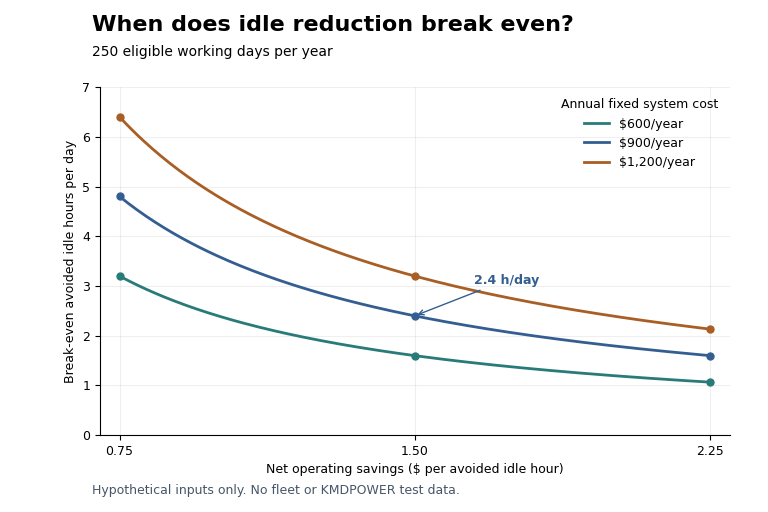
Figure 1. Daily break-even thresholds for a work truck auxiliary power system, assuming 250 eligible days per year. The highlighted case requires 2.4 avoided hours per day at $900 annual fixed cost and $1.50/h net savings. Curves follow the break-even formula. All inputs are hypothetical; no fleet or Kamada Power test data.
A winter-only opportunity needs a different denominator
If relevant winter demand occurs on only 100 days and no savings occur during the rest of the year, the same $900 cost and $1.50/h net savings require six avoided hours per eligible day, not 2.4. A truck with only two eligible hours per winter day would save $300 annually before fixed costs, leaving a $600 shortfall. By contrast, three avoided hours on each of 250 days generate $1,125 before fixed costs and $225 after them. These are annualized comparisons, not cash payback periods.
For varying seasonal duties, calculate each season’s net savings and sum them. A single average hourly rate must be weighted by actual avoided hours.
Compare the alternative that would really be purchased
If a dedicated heater eliminates the same idle hours more cheaply, a large battery for electric heat may be the wrong investment. DOE’s idle reduction research summary identifies dedicated heating as an economical alternative for heat-only long-haul duty; it does not establish savings for utility trucks. Separate the idle-reduction business case from chemistry selection. If approved sodium-ion battery and LFP systems eliminate the same engine hours, both receive the fuel savings. Compare installed cost, winter usable Wh, recoverable charging energy, thermal management and service life at equivalent work, heat and starting-system protection. Both tests must pass.
FAQ
Can an auxiliary pack replace the starter battery?
Not by assumption. Auxiliary cycling duty and engine cranking have different current, temperature and reliability requirements. Keep the starting system protected and use the exact battery only for approved applications. Starting duty requires separate validation.
Is engine charging free?
No. Count incremental engine fuel, including extra stationary charging, or metered shore electricity at the applicable tariff. Compare equal starting and ending battery energy.
Is sodium-ion always cheaper than LFP?
No. Installed system cost, winter usable energy, charging restrictions, thermal management, service life and integration expenses depend on the specific products and duty cycle. Compare approved systems using measured service data rather than chemistry labels or nominal Ah alone.
Conclusion
Sodium-ion auxiliary battery selection for cold-weather work trucks should begin with genuinely avoidable idle hours and measured engine-off electrical demand at the required service level. Usable Wh at winter temperatures, sustained and transient current, vehicle charging compatibility, recoverable charging energy and net avoided operating cost determine suitability. Standard 12V-class packs or approved parallel configurations may be considered for compatible auxiliary buses, with approved 2S2P or custom OEM designs where the vehicle requirements justify them. Starting duty and unapproved legacy replacements remain outside this scope. Contact Kamada Power with eligible idle hours, auxiliary load profiles, winter temperatures, vehicle charging details and local fuel and electricity costs for application-specific OEM battery sizing and architecture comparison.