Solar Panels and Generators: Why a Whole Home Battery System Delivers Uninterrupted Power. At 2:13 a.m., the grid drops and your generator roars to life—running loud and inefficiently just to sustain a few minor loads. This common frustration proves that resilience isn’t a product problem, but a system-design problem. By integrating solar, battery, and generator into a unified hybrid microgrid, the battery transforms from simple storage into a strategic control layer that smooths transitions and optimizes generator efficiency. We specialize in designing these coordinated systems for industrial and mission-critical sites where downtime is never an option.
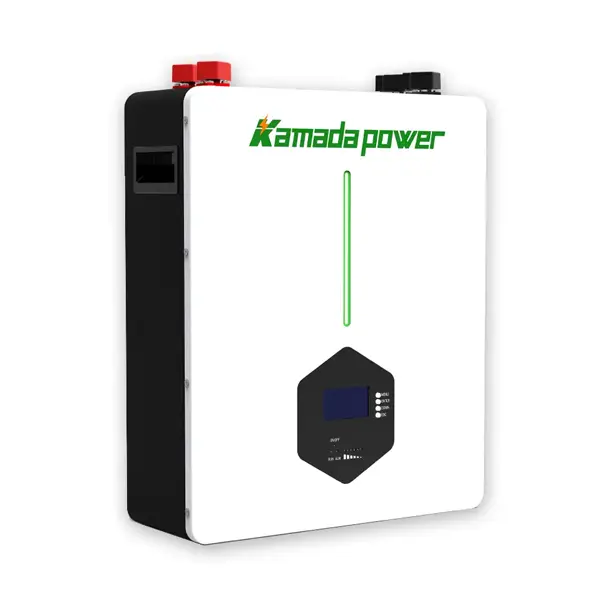
Kamada Power 10kWh Powerwall Home Battery
Why Add a Battery If You Already Have a Generator?
If you already own a generator, the question is fair: Why add another major component?
In practice, adding a battery often:
- Reduces generator runtime
- Improves fuel efficiency
- Stabilizes power quality
These benefits usually become obvious after the first long outage.
A battery transforms a generator from a blunt emergency tool into a precise, on-demand energy source.
Core Benefits Explained
1. Silent, Instant Power When It Matters Most
Nighttime is the weak point of solar-only backup. With no battery, the generator becomes the only option—even for small, steady loads.
With a battery in the system:
- Night = battery (silent, instant, stable)
- Day = solar first, generator only if required
A common real-world case: a mixed-use site with a small server rack, refrigeration, security systems, and network equipment. Overnight loads may only be 1–3 kW, yet without a battery the generator runs continuously.
With battery storage, the generator shuts off—and critical systems stay online quietly.
2. Dramatically Better Fuel Efficiency
Generators are notoriously inefficient at low loads. Operating at 15–30% capacity wastes fuel and, for diesel units, can cause long-term issues like wet stacking.
Batteries are the opposite. They thrive on controlled, predictable charging.
Instead of running a generator all night at low load, a hybrid system allows you to:
- run the generator for shorter, efficient windows,
- charge the battery at an optimal load point,
- shut the generator down and let the battery carry the site.
Think of it like driving: steady highway speed is far more efficient than stop-and-go traffic. The battery smooths the generator’s duty cycle.
3. Zero-Interruption Power (UPS-Level Ride-Through)
Even fast-start generators take seconds to stabilize after an outage. For sensitive equipment, that delay matters.
Batteries provide UPS-level ride-through, bridging the milliseconds-to-seconds gap so you avoid:
- flicker,
- resets,
- nuisance trips,
- control system or PLC faults.
For industrial and commercial sites, power quality isn’t a luxury—it’s the difference between a clean restart and hours of troubleshooting.
How a Three-Source Hybrid System Actually Works
At its core, this is a control problem: multiple sources, variable conditions, and prioritized loads. A hybrid system succeeds only when it has a clear control strategy and defined operating states.
The Brain of the System: Smart Gateway or ATS
A properly designed Smart Gateway or Automatic Transfer Switch (ATS) handles:
- source prioritization (grid, solar, battery, generator),
- grid isolation and anti-islanding,
- coordinated generator start/stop logic.
Without this control layer, sources can fight each other—or worse, create unsafe backfeed conditions.
Energy Flow Logic
- Normal Conditions
- Grid and solar power the site
- Excess solar charges the battery
- Grid Outage (Daytime)
- Solar powers loads
- Battery buffers transients and supports peaks
- Grid Outage (Night)
- Battery powers the site silently
- Battery Reaches Low Threshold
- Generator auto-starts
- Powers loads and recharges the battery (if supported)
That last point is critical. Many systems fail because they cannot run loads while charging the battery. This limitation often comes down to inverter capability, system architecture, or poor commissioning. This is where integration experience matters.
AC-Coupled vs. DC-Coupled Systems — What Actually Matters
Coupling strategy often determines whether a project is straightforward—or turns into a troubleshooting exercise.
AC-Coupled Systems
In AC-coupled designs, PV and battery systems connect on the AC side.
- Typically easier to retrofit onto existing solar
- More flexible with mixed inverter brands
- Often more generator-friendly in real installations
For retrofit projects, AC coupling often reduces redesign risk and project timelines.
DC-Coupled Systems
In DC-coupled systems, solar and batteries share a DC bus.
- Potentially higher efficiency in some modes
- Tighter integration in new builds
- More restrictive compatibility—especially with generator charging paths
Compatibility Checks That Are Often Missed
Before finalizing equipment, verify:
- Does the inverter support generator AC input?
- Can it manage frequency-shift power control in islanded mode?
- Is simultaneous load + charge supported?
If your architecture assumes loads can be “paused” to charge the battery, that’s not a backup strategy—it’s a failure mode.
Proper System Sizing: Avoiding the Two Most Common Mistakes
Mistake #1: Undersizing the Battery
Battery sizing isn’t just about kWh. kW capacity matters—both for charge acceptance and discharge capability.
An undersized battery leads to:
- inefficient generator cycling,
- excessive battery stress (high C-rates),
- insufficient surge support for motors, compressors, and pumps.
A well-sized battery should absorb the generator’s practical charging rate while still supporting critical loads.
Mistake #2: Oversizing the Generator
In hybrid systems, batteries handle surge loads and short peaks. That often allows for a smaller generator than a generator-only design would require.
Instead of sizing for worst-case inrush, you size for:
- steady-state critical loads,
- plus a reasonable battery charging rate.
The result: lower capex, simpler maintenance, and better fuel economics during long outages.
Quick Reference: Roles of Each Source
| Source | Primary Role | Best At | Limitation |
|---|
| Solar | Energy generation | Daytime loads | No night output |
| Battery | Energy management | Silent backup, surge loads | Finite capacity |
| Generator | Extended emergencies | Long outages, high energy | Noise, fuel use |
Projects We’re Often Asked to Fix
These are common failure patterns we see in the field:
- Batteries that cannot charge from the generator
- Generators oversized yet still inefficient
- Solar shutting down during outages
- Transfer switches not designed for multi-source operation
- No clear owner of integration responsibility
Most hybrid systems don’t fail because of bad equipment. They fail because no one owns the integration risk.
Step-by-Step: Building a Reliable Hybrid System
- Audit Critical Loads Identify what must stay online. A critical-loads panel strategy simplifies both design and operation.
- Verify Inverter and ATS Compatibility Confirm operating modes, generator interaction, anti-islanding behavior, and commissioning requirements—especially in multi-vendor systems.
- Choose the Right Battery Chemistry For whole-home and light commercial systems, LiFePO₄ (LFP) is often preferred for safety, thermal stability, and cycle life. Chemistry matters—but so do BMS quality, thermal design, and warranty terms.
- Professional Installation and Commissioning This is not a DIY project. Fault currents, grounding, code compliance, and system commissioning determine whether the system performs as designed.
Conclusion
Uninterrupted power isn’t about adding more equipment; it’s about coordination—leveraging solar for low-cost energy, generators for extended outages, and batteries as the control layer for quiet, seamless, and efficient operation. Most systems fail because no one takes responsibility for integration, but that is precisely the part we own. If you have solar or a generator and are considering a battery, Contact Kamada power and send us a one-line summary of your critical loads; we’ll tell you if a hybrid system will actually work—and where others usually fail—before you spend a dime.
FAQ
Can a generator charge a solar battery?
Yes—if the inverter and system architecture support it. Always verify generator input capability and simultaneous load + charge behavior.
Do I need a special transfer switch?
In most cases, yes. Hybrid systems require an ATS or smart gateway designed for multi-source control and proper grid isolation.
Does solar shut down when the generator runs?
Not necessarily. In well-designed systems, solar can operate alongside the generator, with controlled curtailment as needed.
How long can a battery power a site?
It depends on critical load and usable capacity. Runtime modeling based on real load profiles is essential.
Can I retrofit a battery onto existing solar?
Often yes—especially with AC-coupled designs—but compatibility checks are non-negotiable.