Starlink has changed how 4WD canopy power systems are designed. A fridge, LED lights, USB chargers, and a water pump are still common loads, but touring vehicles, work utes, and remote service fleets now also need reliable internet where mobile networks are weak.
For canopy builders, ute conversion workshops, fleet integrators, and overland brands, the question is not simply “Can a lithium battery run Starlink?” The real question is whether the system can support runtime, recover from solar and alternator charging, and protect both the battery and communication load through practical low-voltage cutoff.
A slimline lithium battery is often a strong fit because it can be installed against a canopy wall, behind drawers, or near the front panel. But battery shape alone does not solve the design problem. Starlink power draw, cable voltage drop, DC conversion, inverter loss, solar input, and low-voltage settings all need to be checked together.
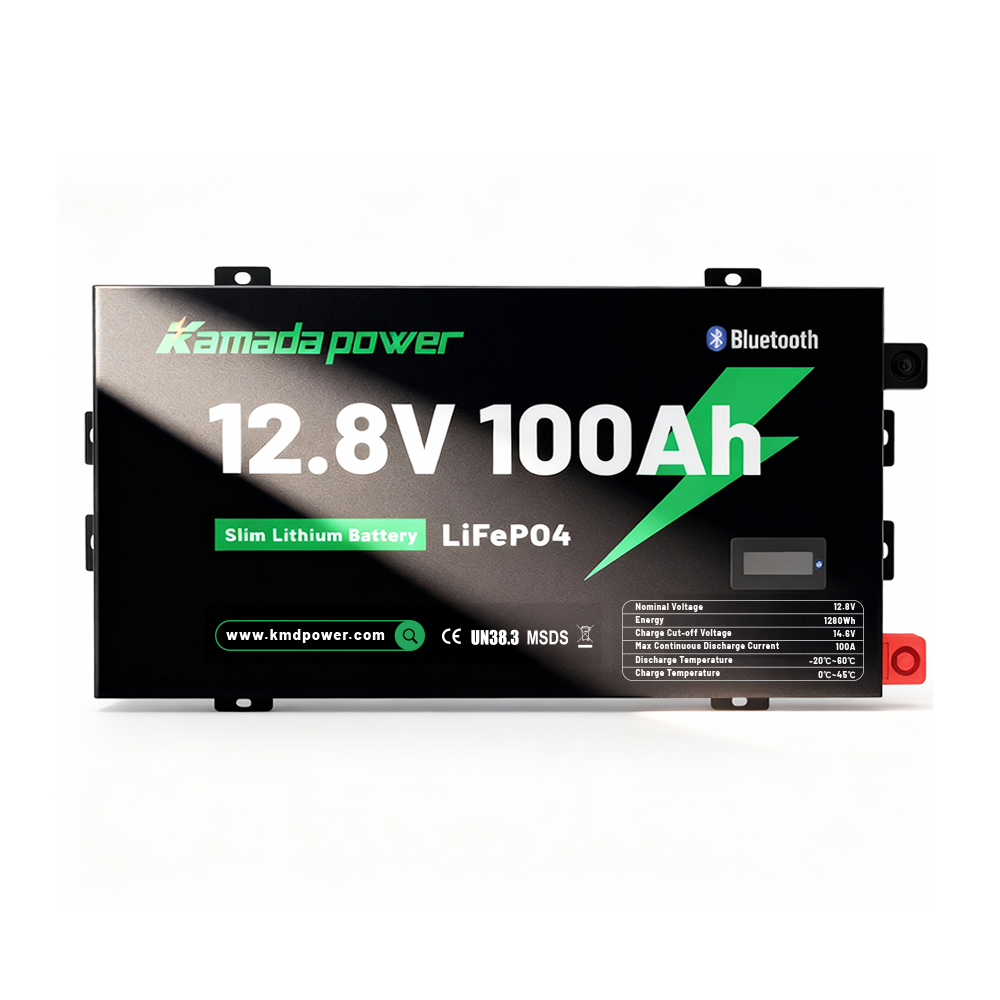
Kamada Power 12v 100Ah Slimline lithium battery
Quick Answer
For most 4WD canopy builds, Starlink Mini is the easiest current model to integrate with a slimline lithium battery system. The official Mini specification sheet lists 25–40W average consumption and a 12–48V, 60W input rating. For a design estimate, 35–40W is safer than the lowest possible value. The current Standard 4 X specification lists 75–100W average consumption. Other Enterprise or Performance hardware must be checked by exact model and current official specification sheet rather than assigned one generic wattage.
Why Starlink Needs a Different Canopy Power Plan
Traditional canopy systems were often sized around intermittent loads. A fridge cycles on and off. LED lights are used at night. A water pump runs briefly. Starlink can become a continuous load. If a user works remotely, uploads files, or keeps the system online for emergency communication, the daily energy demand becomes significant.
This matters in B2B projects because the end user may blame the canopy, battery, or installer if Starlink drops offline at night. The root cause may be undersized capacity, weak solar recovery, long cable runs, inverter loss, or a low-voltage cutoff point that was never explained.
The correct design sequence is:
Starlink model → runtime target → other 12V loads
→ usable battery energy → solar and alternator recovery
→ wiring and fuse protection → cutoff and reconnect logic
If the system is quoted only by “100Ah” or “200Ah”, the design is incomplete.
Starlink Power Consumption: Confirm the Exact Hardware
Starlink names and hardware generations change. Record the exact product name, hardware generation, specification-sheet revision, power method, cable length, and whether snow-melt or heating features can operate before approving a canopy design.
| Hardware | Official Average Power at Time of Review | Vehicle-Power Note |
|---|
| Starlink Mini | 25–40W; 12–48V, 60W input rating | Best fit for compact DC canopy systems, but voltage at the device must remain within range |
| Standard 4 X | 75–100W average | Usually supplied through its AC power system; include inverter and idle losses if AC is used |
| Enterprise or Performance hardware | Model-specific | Obtain the current official sheet; do not reuse a legacy “Standard,” “Actuated,” or “Flat High Performance” estimate |
The Mini and Standard values above are based on official specification sheets checked in July 2026. Recheck the current sheet before quotation because hardware and power specifications can change.
Runtime Calculation: Use Watt-Hours, Not Only Amp-Hours
The most common sizing mistake is talking only about amp-hours. Runtime depends on watt-hours.
Battery energy in Wh = battery voltage × battery Ah
Estimated runtime = usable battery Wh ÷ load W
A 12.8V 100Ah slimline lithium battery has about 1,280Wh nominal energy. In real canopy design, keep a margin for BMS limits, low-voltage cutoff, temperature, wiring loss, DC conversion, and other connected loads.
| Slimline Battery Size | Nominal Energy | Conservative Usable Energy | Starlink Mini at 35W |
|---|
| 12V 100Ah | ~1,280Wh | ~1,000Wh | ~28 hours |
| 12V 150Ah | ~1,920Wh | ~1,500Wh | ~42 hours |
| 12V 200Ah | ~2,560Wh | ~2,000Wh | ~57 hours |
These numbers are for Starlink only. In a real 4WD canopy, the same battery may also support a fridge, lights, laptop charging, USB-C devices, water pump, or camera system.
| Slimline Battery Size | Conservative Usable Energy | Standard 4 X Planning Case at 90W |
|---|
| 12V 100Ah | ~1,000Wh | ~11 hours |
| 12V 150Ah | ~1,500Wh | ~16 hours |
| 12V 200Ah | ~2,000Wh | ~22 hours |
This is why a battery that feels generous for Starlink Mini may be too small for Standard 4 X or other higher-power hardware, especially when the customer wants overnight or 24-hour operation.
DC Power or Inverter?
For Starlink Mini, a DC-based setup is usually easier to justify because the Mini accepts a 12–48V input. A DC system can reduce unnecessary conversion steps, heat, and standby loss compared with converting battery power to AC and then back to DC through the supplied power system.
However, “DC” does not automatically mean “safe” or “stable.” A nominal 12V LiFePO4 system can approach or fall below 12V at the device during low state of charge, startup, a long cable run, or a poor connection. The installer must validate voltage at the Starlink input under worst-case load and use a suitable regulated converter when direct battery voltage cannot remain within the specified range. Connector type, fuse protection, cable size, polarity, and strain relief must also be controlled.
An inverter may still be used when the customer has a Starlink kit that requires its AC power supply, or when the canopy already includes an AC system. In that case, runtime should be derated for inverter loss and idle consumption. The inverter also needs ventilation in a closed canopy exposed to heat.
Solar Input: How Much Solar Is Needed?
Solar sizing should start with daily energy use, not panel wattage. A 200W panel does not produce 200W all day. Output changes with location, season, angle, heat, dust, roof-rack shadow, trees, clouds, and cable/controller losses. PVWatts estimates PV energy production using location and system inputs, and its model also accounts for system-loss categories such as soiling, shading, wiring, and connections.
| Use Case | Daily Starlink Energy |
|---|
| Mini at 35W for 4 hours | ~140Wh/day |
| Mini at 35W for 8 hours | ~280Wh/day |
| Mini at 35W for 24 hours | ~840Wh/day |
| Standard at 90W for 8 hours | ~720Wh/day |
| Standard at 90W for 24 hours | ~2,160Wh/day |
Then add real-world margin. Panels may be flat instead of tilted. Roof racks may create shade. In winter, the same panel area may recover much less energy than in summer.
| Customer Use | Daily Energy Before Other Loads | Solar Design Direction |
|---|
| Mini, 4h/day at 35W | about 140Wh/day | Small solar may offset the load when local yield is validated |
| Mini, 8h/day at 35W | about 280Wh/day | Size PV from location, season and mounting loss; 150–250W may be a starting discussion, not a guarantee |
| Mini, 24h/day at 35W | about 840Wh/day | Requires substantial daily recovery plus reserve for poor sun |
| Standard 4 X, 8h/day at 90W | about 720Wh/day before inverter loss | Plan solar and alternator charging together |
| Standard 4 X, 24h/day at 90W | about 2,160Wh/day before inverter loss | Usually exceeds what a small canopy PV array can recover reliably |
Alternator charging is important. A DC-DC charger can restore energy when solar is weak, especially during winter travel, shaded camps, forest tracks, or high-latitude use.
Low-Voltage Cutoff: The Hidden Cause of Starlink Dropouts
Low-voltage cutoff is often ignored until the customer reports that Starlink shuts off before the battery display looks empty. This can happen when voltage falls under load, the cable is too long, the converter drops out, the inverter reaches its low-voltage alarm, or the battery is close to the BMS protection point.
| Protection Layer | Purpose | Design Note |
|---|
| Battery BMS cutoff | Last-resort battery protection | Should not be used as the normal daily shutdown point |
| System-level low-voltage cutoff | Controlled load management | Better for protecting runtime, battery life, and user experience |
For a communication load, the goal is not to drain the battery until the BMS cuts power. The goal is to keep voltage stable enough for Starlink to operate, protect the battery from deep discharge, and give the user a predictable shutdown point.
Installers should define the cutoff voltage, reconnect voltage, protected circuits, Starlink priority, fridge priority, and customer action after cutoff. This is especially important for fleet vehicles and remote work canopies.
Suggested Wiring Architecture
A Starlink-ready canopy should be built as a managed DC power system, not a random collection of devices.
Vehicle Alternator → DC-DC Charger → Slimline Lithium Battery
Battery → Shunt → Fuse Box / DC Distribution
Fuse Box → Starlink, fridge, LED lights, USB-C, pump, accessories

Solar Panel → MPPT Solar Controller → Battery / DC Bus
Each output should have proper fuse protection. The Starlink circuit should be clearly labeled and separated from high-surge loads where possible. Cable sizing should consider total current, length, route, heat, and acceptable voltage drop.
For OEM canopy brands, the wiring layout should be repeatable. The same battery position, shunt location, fuse labels, switch labels, and customer manual should be used across builds.
What Battery Size Should Canopy Builders Recommend?
Battery size should follow the customer’s real use case.
Battery size should follow total daily watt-hours and required autonomy, not the Starlink name alone.
| Scenario | Design Direction | Key Assumption to Verify |
|---|
| Mini used several hours, battery starts full, vehicle drives daily | 100Ah may be sufficient | Include converter loss and all other canopy loads |
| Mini plus fridge, lighting and laptop | 150Ah or 200Ah may provide better reserve | Use measured fridge Wh/day and required parked time |
| Mini used continuously through poor solar weather | Calculate a larger bank and recovery system | Capacity delays a deficit but does not correct inadequate charging |
| Standard 4 X | Full energy-system review | Include 75–100W average, AC conversion loss where applicable, and other loads |
| Fleet or emergency communication | Redundancy, priority loads and documented cutoff logic | Define minimum communications runtime and recovery method |
| Enterprise or Performance hardware | Model-specific engineering | Obtain the exact current official specification before sizing |
A 12V 100Ah slimline lithium battery can support Starlink Mini in a light, defined duty cycle. A 150Ah or 12V 200Ah Slimline lithium battery may be more suitable when Mini shares the battery with a fridge, lights, and laptop charging. Standard, Enterprise, and Performance hardware should be treated as project designs.
Common Mistakes to Avoid
Do not size the system only by Ah. Do not ignore the fridge, lights, laptop charging, pumps, or cameras. Do not assume solar panel wattage equals daily recovery. Do not use the BMS cutoff as the normal shutdown method. Most importantly, do not assume Standard 4 X, Enterprise, or Performance hardware has the same load or power-input requirements as Mini.
When a Slimline Battery System Is Not the Right Choice
A slimline battery system is not ideal when the customer expects a small canopy battery to run Performance Starlink 24/7 without enough charging input. It is also not ideal when the canopy uses inverter-heavy loads in a hot, poorly ventilated space. If the vehicle spends most of its time in shade or winter conditions and the customer expects solar-only recovery, the system may disappoint.
It is also risky when the installer cannot control wiring quality, fuse selection, cable route, connector type, or cutoff settings. In those cases, the battery may be blamed for failures caused by the installation.
RFQ Checklist for Starlink-Ready Canopy Battery Systems
Before quoting a slimline lithium battery for a Starlink-ready 4WD canopy, send these details:
| RFQ Information | Why It Matters |
|---|
| Starlink model | Determines load range |
| Target runtime | Determines battery capacity |
| Other 12V loads | Prevents undersizing |
| Solar panel wattage and space | Determines recovery ability |
| DC-DC charger size | Determines driving recharge speed |
| Canopy layout drawing | Confirms fit and cable route |
| Ambient temperature range | Affects charging and discharge design |
| Cutoff and reconnect preference | Defines protection strategy |
| Installation quantity | Supports OEM or private label quotation |
For OEM and private label projects, also confirm battery dimensions, mounting direction, terminal position, BMS current rating, communication options, label requirements, packaging, certification documents, and sample test plan.
Technical Reference Note
The Starlink Mini power and input figures in this article are based on the official Mini specification sheet. The Standard 4 X power figure is based on the official Standard specification sheet. Both were checked in July 2026; recheck the current hardware sheet before publishing a quotation or installation specification.
Conclusion
A Starlink-ready 4WD canopy system should be designed around runtime, charging recovery, and low-voltage protection—not battery capacity alone. Compact systems are generally better suited to lower-power Starlink setups, while higher-power models require more careful battery and solar sizing.
For OEM or fleet projects, standardize the slimline lithium battery, DC-DC and solar charging, fused distribution, shunt monitoring, circuit labels, and cutoff settings. Contact Kamada Power send your Starlink model, runtime target, load list, charger size, solar area, and canopy layout for a suitable battery configuration.
FAQs
How long will a 12V 100Ah lithium battery run Starlink Mini?
Using a conservative usable energy estimate of about 1,000Wh, a 12V 100Ah lithium battery may run Starlink Mini for about 28 hours at a 35W average load, before adding other canopy loads or conversion losses.
Can Starlink Mini run from a 12V battery?
Yes, Starlink Mini supports a 12–48V input rating, but the system still needs correct cable sizing, fuse protection, connector quality, and stable voltage. Starlink states that performance is guaranteed only with its included power supply and cable, so third-party DC setups should be validated before fleet use.
How much solar do I need for Starlink in a canopy?
For Starlink Mini, 150–250W solar may be a starting discussion for moderate daily use, but the result depends on location, season, mounting, and other loads. Continuous operation needs a calculated solar-and-alternator recovery plan. Standard 4 X and other higher-power hardware require a full energy budget.
Why does Starlink shut off before the lithium battery is empty?
Common causes include voltage sag, cable voltage drop, inverter low-voltage cutoff, DC converter dropout, loose connectors, poor fuse holder contact, or a battery close to its protection threshold.
Is a slimline battery better than a portable power station?
For temporary camping, a portable power station may be convenient. For fixed 4WD canopy builds, a slimline lithium battery system is usually better for OEM installation, fused distribution, DC-DC charging, solar input, battery monitoring, and long-term serviceability.