Beach camping looks simple: park on sand, pull out the fridge, connect a solar blanket, and use quiet 12V power. In real builds, the battery system works in a harsher environment. Heat increases fridge consumption. Sand gets into plugs, fuse boxes, switches, and solar leads. Salt air can corrode exposed terminals. Solar blanket output changes with angle, shade, cable length, and controller quality. After the trip, the vehicle may sit unused for weeks with small loads still connected.
For 4×4 brands, canopy builders, installers, and distributors, the key question is not only “what Ah size should we sell?” A better question is: can the slimline lithium system survive real beach use, recharge properly, and remain safe during long idle periods?
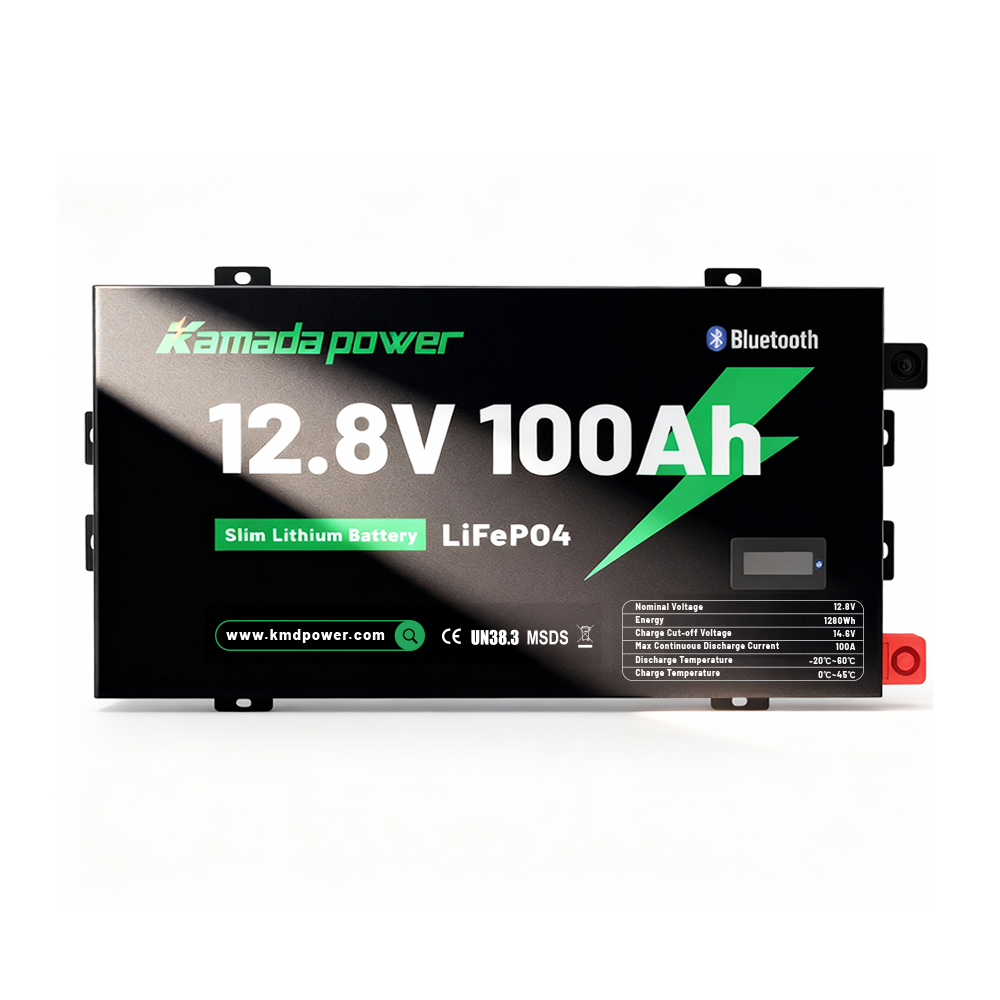
Kamada Power 12v 100ah slimline lithium battery
Why Beach Camping Is Different
A beach campsite often combines high temperature, reflected sunlight, wind-blown sand, moisture, and salt air. These conditions affect the full electrical system, not only the battery.
Many “battery problems” are actually system problems: a dirty solar plug, undersized cable, hot charger location, loose crimp, parasitic load, or fridge working harder than expected. For B2B sellers, even a reliable battery can create complaints inside a poor system.
Who Needs This Type of Battery System?
A slimline lithium battery is chosen when the vehicle has limited space. It can be mounted on a canopy wall, behind a seat, beside a drawer system, or inside a compact electrical board.
This makes it suitable for 4×4 canopy builders, ute tub installers, off-road accessory brands, battery distributors, camping trailer builders, and private label 12V power kit suppliers.
What Loads Does a Beach Camping Battery Power?
Most beach camping builds start with a fridge. The fridge runs day and night, so it usually decides the base battery size.
| Load | Use Pattern | Design Note |
|---|
| Fridge/freezer | 24-hour cycling | Main continuous load |
| LED lights | Evening use | Small but predictable |
| USB-C charging | Intermittent | Usually low energy |
| Water pump | Short bursts | Low daily energy |
| Inverter | Appliance-dependent | Needs current check |
A simple fridge-and-lights weekend build may need a modest battery. A dual-fridge, Starlink, laptop, or inverter build may need a larger battery bank and a stronger charging plan. The correct size depends on daily energy use, expected trip length, solar recovery, and reserve margin, not Ah alone.
Is a Slimline Battery a Good Fit for Beach Camping?
Yes, a slimline LiFePO4 battery can be a strong fit when space is limited and the installation is protected. Beach vehicles already carry recovery gear, water tanks, fridge slides, drawers, chairs, awnings, and camping equipment. A bulky battery box can waste storage space, while a slimline battery can use vertical or side-wall space.
However, slimline does not mean problem-free. The system still needs correct fusing, secure mounting, lithium-compatible charging, connector protection, and a long-idle plan. Heat-producing electronics such as DC-DC chargers and inverters also need the clearances and airflow specified by their manufacturers.
Battery Placement: Where Should It Be Installed?
Better locations include a canopy side wall, protected drawer-side cavity, behind-seat compartment, tub-side electrical bay, or serviceable battery board. The location should allow inspection, cable replacement, fuse access, and BMS checking.
Avoid places where sand or wet gear can sit against terminals, where cargo can strike the case, or where charger, inverter, fridge-compressor, and solar heat can accumulate. The battery enclosure itself should follow the battery manufacturer’s installation limits; ventilation is especially important around chargers and inverters that generate continuous heat.
For most slimline LiFePO4 camping batteries, under-bonnet installation should not be assumed. Only batteries validated for engine-bay heat should be used there.
Sand Protection: The Case Is Only One Part
Many customers ask whether the battery is dustproof or waterproof. That is useful, but incomplete. In beach camping builds, external parts often fail before the battery itself.
Sand can affect Anderson plugs, solar blanket connectors, switch panels, fuse boxes, charger vents, relay contacts, USB sockets, and unsealed cable entries. A protected battery case does not make the full installation protected.
Good design practices include covered connectors, cable glands, strain relief, protected fuse boxes, shielded mounting, clear labels, and a solar input that does not lie directly in wet sand. Avoid claiming “sandproof” unless the full system is tested together.
Heat Reality: Why Beach Camping Uses More Power
Beach heat affects the system in two ways. First, the fridge works harder, especially when customers open it frequently or load warm drinks. Second, the electrical area can heat up from sun exposure, charger heat, inverter heat, and poor airflow.
Ambient temperature is not the same as battery temperature. A closed canopy or tub can become much hotter than outside air. If the battery or charger reaches its protection limit, the BMS or charger may reduce output, stop charging, or shut down temporarily.
High temperature can also shorten long-term battery life, especially when the battery stays at high state of charge for long periods. Beach camping is still suitable for lithium systems, but the build should avoid unnecessary heat exposure.
For installers, the rule is simple: keep the battery away from avoidable heat sources, separate heat-producing electronics where practical, follow their clearance requirements, verify thermal derating limits, and explain hot-weather operation to the customer.
Solar Blankets: Useful, But Not Magic
Solar blankets are popular because they are portable and easy to aim toward the sun. They also allow the vehicle to stay in shade while the blanket is moved into a better charging position.
But rated wattage is not real all-day output. Solar production can drop because of poor angle, cloud, shade, dirty surface, high panel temperature, long cable runs, low-quality controllers, or voltage loss.
For B2B kits, the solar blanket is one charging input, not a guarantee of unlimited runtime. The system still needs battery reserve for night use, cloudy weather, and hot-day fridge demand.
A reliable layout is:
Solar blanket → lithium-compatible MPPT controller or DC-DC charger with solar input → slimline battery → fuse box → loads.
The solar input should have polarity labels, suitable cable size, protected connectors, strain relief, and simple user instructions.
DC-DC Charger, MPPT, or Direct Solar?
A beach camping build usually benefits from both alternator charging and solar charging. The DC-DC charger helps recover the battery while driving, especially in vehicles with smart alternators.
For solar blankets, MPPT control is usually preferred because it can improve energy harvesting under changing sunlight and panel voltage. The charger must match battery chemistry, charge voltage, current limit, and temperature limits.
Do not connect unregulated solar directly to a lithium battery. Do not assume every charger has the right LiFePO4 profile. Do not use long, thin solar leads. For installer kits, check the charger model before quotation.
Runtime Planning for Beach Camping
Runtime planning should start from energy, not marketing capacity. First, list every load: fridge, lights, USB charging, pump, inverter, Starlink, and compressor use. Then estimate daily energy use in Wh/day or Ah/day, with a heat margin for the fridge.
Next, decide the required autonomy. One night is very different from a three-night beach stay with cloudy weather. Finally, match battery capacity with solar and DC-DC recovery.
The following examples are starting points only. They assume a 12.8V LiFePO4 battery, a reserve rather than routine full discharge, and charging conditions that have been checked for the actual trip.
| Example Duty | Load and Autonomy Assumptions to Confirm | Battery Direction | Solar Direction |
|---|
| Light weekend | One efficient fridge, lights and phones; roughly 30–50Ah/day; daily driving or one parked night | 100Ah may be sufficient | 120–200W can provide useful support in good sun |
| Longer parked stay | Roughly 50–80Ah/day; 1.5–2 parked days; hot-weather margin included | Often 150–200Ah | 200–300W, checked against location and season |
| Dual fridge or Starlink | Model-specific continuous energy plus fridge duty cycle; cloudy-day reserve required | Calculate from Wh/day; 200Ah+ may be justified but is not automatic | Calculate expected Wh/day from real solar conditions |
| Inverter-heavy build | AC appliance watts, operating time, surge current and inverter idle draw defined | Engineered system | Solar alone may not recover the daily energy |
Do not quote from this table alone. Final sizing should use the actual fridge model, measured or credible Wh/day, required parked autonomy, average driving time, charger output at operating temperature, local solar conditions, and the customer’s reserve target.
Long Idle Time: The Hidden Failure Mode
Beach camping vehicles are often used hard for a weekend and then parked for weeks. During storage, the battery may still be connected to monitors, Bluetooth modules, chargers, relays, trackers, switches, LEDs, or other small loads.
LiFePO4 self-discharge is usually low, but parasitic loads can slowly drain the battery. If the vehicle sits long enough, the battery may reach low-voltage protection. The customer may then think the battery is dead, when the real issue is idle current.
Long-idle instructions should be part of the kit design. Tell customers to turn off accessory circuits if the vehicle will not be used for weeks, disconnect unnecessary loads, store the battery according to the manufacturer’s SOC recommendation, avoid extreme heat, check SOC periodically, and recharge before the battery reaches low-voltage protection.
A clear isolation switch and customer label can reduce warranty misunderstandings.
Wiring, Protection, and Specification Checklist
A good slimline battery system should be easy to inspect and hard to misuse. Battery-side protection should include a main fuse close to the battery positive, correct cable size, secure crimping, protected terminals, proper hold-down bracket, and no loose gear rubbing against cables.
Load distribution should use a fuse box rather than random inline fuses. Fridge, lights, USB, pump, and accessory circuits should be labeled. High-current inverter loads need a separate correctly sized circuit. Solar input should use a covered connector, clear polarity label, correct cable size, suitable fuse or breaker where required, and a lithium-compatible controller.
For a B2B project, the specification should include dimensions, mounting direction, weight, terminal position, continuous and peak discharge current, charge voltage, charge current limit, low-voltage cutoff, temperature range, IP rating, BMS logic, and monitoring options such as Bluetooth, CAN, RS485, UART, or shunt compatibility.
For OEM or private label projects, confirm these details before sample approval.
Common Mistakes in Beach Camping Battery Builds
Sizing only by Ah. A 100Ah battery and a 200Ah battery can both disappoint the customer if the load profile and charging recovery are wrong.
Trusting solar blanket rated wattage. Real-world output depends on sun angle, shade, heat, cable loss, and controller performance.
Ignoring heat inside the canopy. Closed compartments can become much hotter than the weather forecast.
Leaving loads connected for months. Parasitic loads can drain the battery during idle time.
Treating IP rating as full-system protection. A protected battery enclosure does not protect exposed plugs, switches, fuse boxes, or poor cable entries.
Using the wrong charger. The DC-DC or solar charger must match LiFePO4 charging requirements and current limits.
When a Slimline Lithium Battery Is Not the Right Choice
A slimline lithium battery is not suitable for every beach camping build.
It may not be the right choice when the battery must be installed in an unvalidated engine bay, the system needs to run high-power AC appliances for long periods, the installer cannot provide fuse protection, or the battery will be directly exposed to wet sand, washdown water, or salt spray.
It may also be unsuitable when the customer expects a small solar blanket to run heavy loads indefinitely, when the canopy has no airflow, or when the vehicle will sit unused for months with loads still connected and no storage procedure.
Saying “no” to the wrong application builds more trust than selling into a system that will disappoint the customer.
RFQ Checklist Before Quotation
For 4×4 brands, canopy builders, and distributors, the best quotation starts with real installation data. Before requesting a slimline battery quote, send the vehicle model, installation location, available battery space, required voltage and capacity, main loads, fridge model, solar blanket wattage, controller type, DC-DC charger model, expected camping duration, maximum ambient temperature, idle time, IP rating, branding needs, certification needs, MOQ, and annual volume.
With this information, the battery supplier can recommend a safer specification instead of guessing from Ah alone.
Conclusion
A slimline LiFePO4 battery can be an excellent choice for beach camping builds, especially when canopy space is limited and the system needs a clean, fixed 12V power layout. But the battery should not be treated as a standalone box. Beach camping adds sand, heat, salt air, solar variability, and long idle time. These factors must be handled through placement, wiring, charging, protection, and customer instructions.
The best product is not always the biggest battery. It is the battery system that matches the real load profile, fits the available space, works with the selected DC-DC and solar charger, and remains easy to service after months of real outdoor use.
If you are developing a slimline battery kit for beach camping, 4×4 canopy builds, or private label off-road power systems, Contact Kamada Power send your available space, load list, charger model, solar blanket wattage, target market, and expected idle time. Our team can help match the slimline lithium battery specification, BMS configuration, enclosure design, and OEM branding requirements to your application.
FAQ
What size slimline battery do I need for beach camping?
A 100Ah battery may be sufficient for a light, well-defined weekend duty cycle, while longer parked time, hot-weather fridge demand, Starlink, or inverter use can justify 150Ah, 200Ah, or a larger engineered system. The decision should come from daily Wh, autonomy, and expected recharge—not the load name alone.
Can a solar blanket keep a camping fridge running?
Yes, if the solar blanket output, sunlight hours, controller, cable size, battery capacity, and fridge consumption are matched. It is a charging source, not a guarantee of unlimited runtime.
Is a slimline lithium battery safe in a 4×4 canopy?
Yes, if it is mounted securely, protected by correct fusing, kept away from excessive heat, and installed with proper cable protection.
Can sand damage a battery system?
Yes. Sand usually damages external parts first, such as connectors, fuse boxes, switches, plugs, and cable entries.
Should I install a lithium battery under the bonnet?
Do not assume this is safe. Most slimline LiFePO4 camping batteries are better installed in a canopy, tub, or cabin-side location unless specifically validated for under-bonnet heat.
What should I do if the vehicle is unused for months?
Disconnect accessory loads, store the battery according to the manufacturer’s SOC recommendation, avoid extreme heat, check SOC periodically, and recharge before low-voltage protection.