For many 4×4 owners, the choice is between a portable power station and a fixed slimline lithium battery system. A portable unit is simple, removable, and suitable for weekend trips with light loads, especially when the vehicle cannot be modified.
However, touring, trade, fleet, and overland canopies often become complete power platforms for fridges, lights, tools, pumps, Starlink, inverters, alternator charging, and solar. At that point, the priority is safe integration, durability, serviceability, and reliable daily operation. Portable power stations offer convenience, while fixed slimline lithium systems are better suited to permanent canopy installations and repeatable OEM or fleet builds.
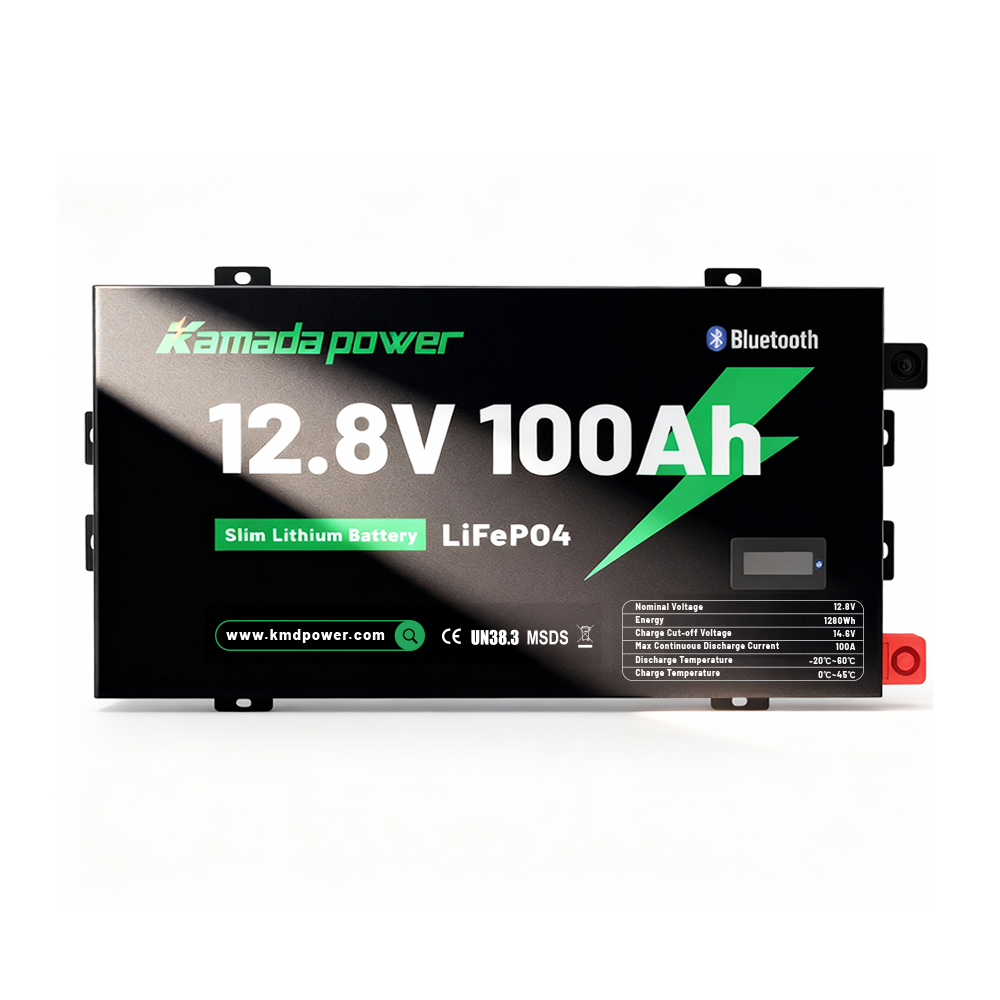
Kamada Power 12v 100Ah Slimline lithium battery
The Real Difference Is System Architecture
Many buyers compare portable power stations and fixed slimline batteries by looking only at watt-hours or amp-hours. That is useful, but incomplete. Two products may have similar energy capacity on paper, yet work very differently inside a canopy.
A portable power station is an all-in-one product. It usually combines the battery, BMS, inverter, AC sockets, USB outputs, DC outputs, display, and charging electronics in one case. The user charges it at home or from solar, places it inside the canopy, and plugs devices into it.
A fixed slimline lithium battery system is part of the vehicle’s electrical system. The battery is mounted inside the canopy and connected to a DC-DC charger, solar input, fuse block, busbars, switch panel, monitoring display, Anderson plugs, and sometimes an inverter. It takes more planning, but it gives the installer more control over charging, wiring, circuit protection, and load distribution.
So this is not really “portable power station versus battery.” It is “portable all-in-one power versus fixed vehicle-integrated power.”
When a Portable Power Station Makes Sense
A portable power station can be the right choice when the vehicle is used for occasional camping and the electrical demand is light. The user can charge it at home, place it in the canopy before the trip, run a few devices, and remove it when the vehicle returns. For phones, cameras, laptops, LED lights, a small fridge, and occasional campsite AC power, this may be practical.
It also suits users who do not want permanent vehicle modification. Some drive leased vehicles, rental vehicles, company vehicles, or new 4x4s they are not ready to cut, drill, or wire.
The built-in inverter is another reason people choose portable units. If the main requirement is occasional AC output for a laptop charger, camera battery charger, or small campsite device, an all-in-one unit is easy to understand.
Where Portable Power Stations Become Limited
The limitations depend on the product class. A basic portable power station is designed to sit somewhere and supply power through built-in outlets; it is not normally the fixed distribution center for several protected canopy circuits. Higher-end modular ecosystems can add alternator chargers, expansion batteries, solar inputs, and distribution accessories, but their compatible interfaces, hardwiring options, repair model, and installation limits still need to be checked product by product.
In a real canopy build, the owner may want the fridge hardwired, lights switched from a panel, a water pump connected to a protected circuit, an Anderson outlet outside the canopy, and solar input mounted on the roof. If every device is plugged into a portable unit, cables may run across drawers, tools, recovery gear, or camping equipment. That increases the chance of accidental disconnection, cable damage, and poor user experience.
Charging can also become a limitation—or a strength—depending on the ecosystem. Basic units may rely on a low-power vehicle outlet. Current modular systems can use dedicated alternator chargers in the several-hundred-watt range, and some reach roughly 800W or more. The real questions are whether the power station accepts that input, whether the vehicle and wiring can support it, and whether the product can integrate the required permanent circuits. A fixed lithium system is designed from the start around project-specific DC-DC charging, solar, cable routes, and protected distribution.
Serviceability is another difference. If a charger, inverter, display, or internal board fails inside an all-in-one unit, the user may need to send the whole product for service. In a fixed system, the installer can often diagnose and replace one component, such as the DC-DC charger, fuse block, monitor, inverter, cable, or battery. For fleet buyers, that difference can be critical.
Why Slimline Lithium Batteries Fit 4×4 Canopies
Canopy space is valuable. Every millimeter used by the electrical system is space taken away from drawers, tools, fridges, recovery gear, water tanks, or camping equipment. This is why slimline lithium batteries are popular in ute canopy and 4×4 builds.
A slimline lithium battery is designed to fit into narrow spaces. Depending on the canopy design, it may be installed behind a drawer system, against the canopy wall, near the headboard, behind the rear seat area, or in a dedicated electrical compartment. Compared with a standard battery box shape, the slim form factor gives builders more layout options and helps keep the cargo area cleaner.
For installers, the slimline format also supports repeatable design. Once the bracket, cable route, fuse location, and charger position are defined, the same layout can be used across multiple vehicles. This matters for 4×4 accessory brands and fleet ute builders because repeatable installation is easier to train, inspect, document, and service.
Portable Power Station vs Fixed Slimline Lithium System
| Factor | Basic Portable Power Station | Modular Vehicle-Capable Power Ecosystem | Fixed Slimline Lithium System |
|---|
| Best use | Occasional removable power | Removable power with selected vehicle accessories | Permanent, project-specific canopy power |
| Installation | Very simple | Moderate; may require alternator charger and dedicated cables | Professional electrical installation |
| Alternator charging | Often vehicle-socket limited | Can be several hundred watts; verify device and vehicle compatibility | Selected DC-DC system matched to battery and alternator |
| Solar integration | Built-in input, usually product-specific | Often supports larger arrays and expansion | Controller and array selected for the project |
| Permanent 12V circuits | Usually limited to built-in outlets | Possible on some ecosystems, but interface-dependent | Strong with busbars, fuse blocks and labelled branches |
| Serviceability | Whole-unit or manufacturer service | Modular within the vendor ecosystem | Individual charger, fuse block, inverter, monitor or battery can often be replaced |
| Fleet repeatability | Suitable only for simple standard use | Possible after product-specific validation | Strong when the installation and documentation are controlled |
| OEM customization | Usually limited | Mostly ecosystem-defined | Strong for case, BMS, terminals, labels and kit design |
The decision is not “portable bad, fixed good.” A basic unit solves a convenience problem. A modular ecosystem adds vehicle capability. A fixed slimline system gives the installer the greatest control over permanent wiring, protection, component selection, and OEM standardization.
Runtime Depends on the Load
A common mistake is asking, “How long will this battery run my canopy?” without listing the actual loads. Runtime depends on fridge size, ambient temperature, lighting hours, inverter use, solar input, charging time, and how often the vehicle is driven.
A basic energy estimate starts with this formula:
Battery energy in Wh = battery voltage × battery Ah
For example, a 12.8V 100Ah LiFePO4 battery stores about 1,280Wh of nominal energy. A 200Ah battery stores about twice that. Real usable runtime will be affected by inverter losses, BMS settings, cable voltage drop, temperature, battery age, and whether the load is AC or DC.
A fridge and a large inverter behave very differently. A fridge cycles on and off, so its average daily energy use may be moderate. A high-power AC load can drain a battery much faster. If the user runs an induction cooker, kettle, power tool charger, or large inverter load, the system must be designed around peak current as well as total energy.
For You, this is where a professional supplier should slow the conversation down. Before recommending 100Ah, 150Ah, 200Ah, or 300Ah, the supplier should ask what the canopy must actually run and how the battery will be recharged each day.
Charging Is Often the Deciding Factor
Charging is often the hidden reason why a fixed slimline system becomes the better choice. A canopy battery is only useful if it can recover energy reliably.
A portable power station may charge from AC, solar, a vehicle outlet, or a dedicated alternator accessory. This works well when the compatible inputs can recover the actual daily load. The weakness is not that every portable unit charges slowly; it is that charging power, cable route, connectors, product compatibility, and permanent-load integration are defined by the selected ecosystem rather than freely engineered for the canopy.
A fixed system is normally built around a DC-DC charger. This charger manages power from the vehicle alternator and charges the lithium battery with a suitable profile. It also helps protect the starter battery and gives the installer a defined charging current. Many canopy systems also combine DC-DC charging with MPPT solar input, so the battery can charge while driving and while parked.
This matters for canopies with roof solar panels. A fixed solar input can be wired neatly and protected properly. The user does not need to unpack cables or connect temporary adapters every time. For long touring trips, mining service vehicles, mobile technicians, and remote work utes, this difference is practical, not theoretical.
Safety Is a System Design Issue
A fixed lithium system is only better when it is designed and installed correctly. The main fuse should sit close to the battery positive terminal. Cable size should match current and cable length. The battery must be mounted against vibration, chargers and inverters need airflow, and wiring should be protected from sharp edges, moving drawers, water, dust, and heavy cargo.
For installers and OEM brands, labels are not cosmetic. Clear labels on the fuse block, isolator, solar input, DC-DC input, and external Anderson outlet can reduce service mistakes later. The biggest mistake is treating a lithium canopy system like a simple accessory. It is a small power system installed into a moving, vibrating, hot, dusty vehicle.
Cost Should Be Judged by Total System Value
A portable power station often looks cheaper because there is no installation labor, no separate inverter, no fuse block, and no custom wiring. For light use, that can be a smart financial decision.
For professional canopy builds, total cost should include installation time, cable management, user training, warranty claims, downtime, and replacement method. A fixed slimline lithium system has a higher upfront design cost, but it can be standardized, labeled, mounted securely, and serviced component by component. For 4×4 canopy brands and distributors, it can also become part of a branded canopy power package instead of a loose retail accessory.
Removable Canopies and Hybrid Systems
A removable jack-off canopy does not automatically require a portable power station. A fixed slimline battery can be installed inside the canopy if the connection between vehicle and canopy is designed correctly. The canopy may use an Anderson quick disconnect, main isolation switch, protected DC-DC input, solar input, and labeled wiring harness. When the canopy is removed, the electrical connection can be disconnected cleanly.
For many users, the best answer is a hybrid system. The fixed slimline battery runs the fridge, lights, pump, sockets, and canopy circuits. A smaller portable power station is used separately for the tent, laptop, camera gear, or emergency AC output. This gives the user both professional canopy integration and flexible portable power.
When Not to Choose Each Option
A fixed slimline lithium system is not always the right answer. If the user cannot modify the vehicle, only camps occasionally, has no qualified installer, or only needs to charge small electronics, a portable power station may be the better choice. A fixed system also does not make sense if the budget does not allow proper fusing, cabling, charging hardware, and secure mounting.
A basic portable power station is less suitable when the canopy has many permanent 12V loads, exposed plug-in cables are unacceptable, or the buyer needs custom BMS, terminals, enclosure, and labels. A modular power ecosystem may solve some of these issues, but fleet buyers should validate alternator charging, hardwired distribution, environmental protection, service procedure, replacement availability, and vendor lock-in before standardization.
The best decision comes from the use case, not from marketing claims. Light removable use favors a portable unit. Permanent canopy power favors a fixed slimline system.
What You Should Send Before Quotation
For a serious 4×4 canopy project, the supplier should not quote only from a requested capacity. The buyer should provide the vehicle model, canopy type, available installation space, voltage, target capacity, daily load list, inverter power, DC-DC charger current, solar wattage, terminal preference, mounting direction, IP requirement, monitoring requirement, branding needs, sample quantity, and expected order volume.
For OEM or private label projects, also explain whether the battery will be sold as a standalone pack, included in a complete canopy power kit, or installed by approved dealers. This helps the supplier recommend the right battery size, discharge capability, terminal layout, BMS option, and sample testing plan before mass production.
Conclusion
A portable power station suits removable, occasional power for weekend camping or light loads, especially when the vehicle cannot be modified. A fixed slimline lithium battery system is better for touring, work utes, fleets, and OEM canopies that need multiple loads, integrated charging, protected wiring, and repeatable installation.
For canopy builders and installers, the decision should begin with the load list, available space, charging method, inverter, solar input, and installation requirements—not the battery label alone.
Need a Slimline Lithium Battery for a 4×4 Canopy Project?
Contact us. Kamada Power supports custom slimline LiFePO4 battery packs for 4×4 canopies, work utes, touring vehicles, and OEM/private label power kits.
If you are developing a canopy power system, send us your installation space, load list, charger current, solar wattage, inverter size, target voltage, target capacity, and estimated order quantity. Our engineering team can help recommend a suitable slimline lithium battery configuration before quotation.