Low-Temperature Performance: Sodium Ion vs LFP for Outdoor Monitoring Equipment. It’s a familiar story for procurement officers: your solar-powered LFP systems work flawlessly in July, only to go dark when the first winter freeze hits. You aren’t facing an equipment breakdown; you’re battling the hard “Cold Charging Limit” of standard Lithium, which physically cannot accept a charge below 0°C. For years, the only workaround for maintaining 24/7 uptime on critical outdoor gear has been wrapping batteries in energy-hungry heating pads—a costly and unreliable patch. There is a better way. It’s time we talk about Sodium-Ion battery packs, the chemistry that doesn’t just survive the cold—it thrives in it.
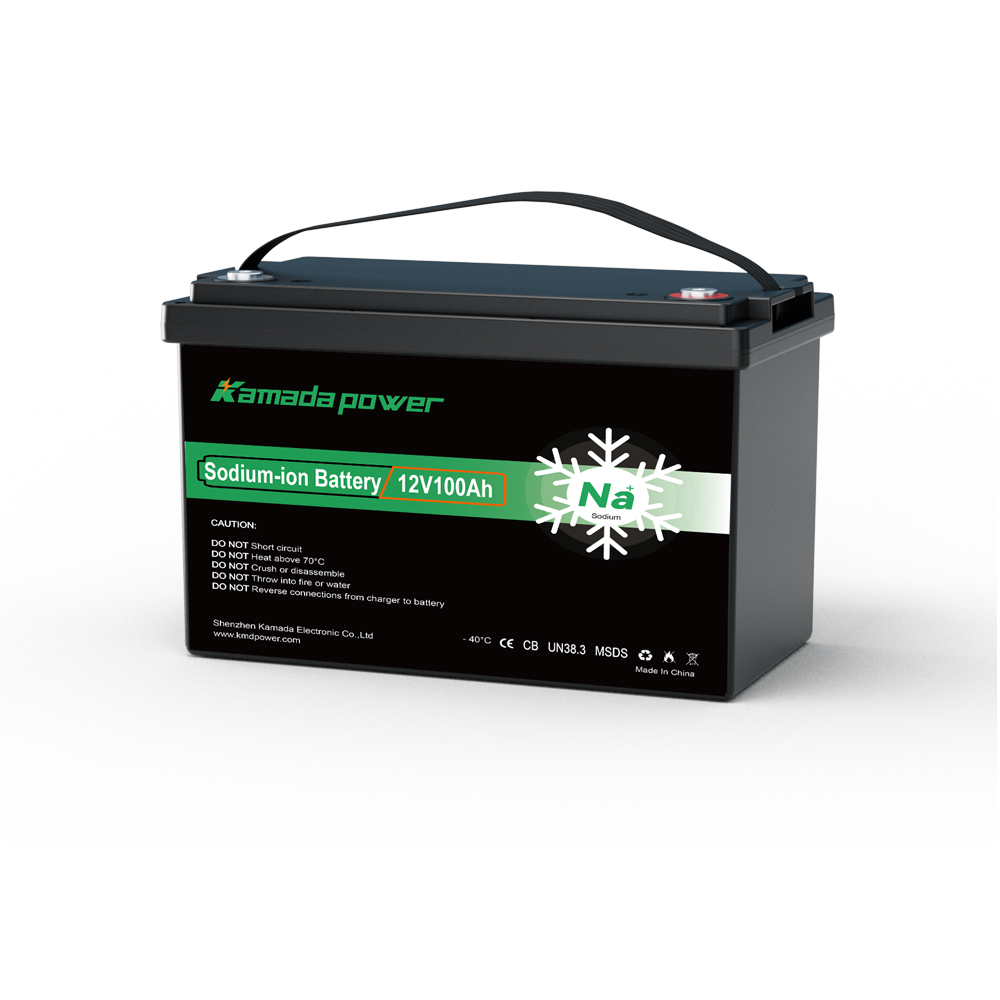
Kamada Power 12V 100Ah Sodium ion Battery
The “Frozen Battery” Problem: Why LFP Fails in Winter
To understand why Sodium-ion battery is gaining traction in the EU and US industrial markets, we first have to look at why LFP (Lithium Iron Phosphate) struggles when the mercury drops.
The Charging Limit (0°C/32°F)
Most datasheets for LFP batteries will show a discharge temperature down to -20°C. That looks fine on paper, but it’s a trap. The real bottleneck isn’t discharging; it’s charging.
Here is the technical reality: Inside a lithium cell, ions move between the cathode and anode through a liquid electrolyte. As temperatures approach freezing (0°C/32°F), that electrolyte becomes sluggish. The viscosity increases.
If you try to force a charge current into the battery in this state, the lithium ions can’t intercalate (absorb) into the graphite anode fast enough. Instead, they pile up on the surface of the anode in metallic form. This is called Lithium Plating.
Lithium plating is catastrophic. It permanently degrades capacity and can create dendrites—microscopic spikes that pierce the separator and cause short circuits. Because of this, a high-quality Battery Management System (BMS) has a hard-coded rule: Cut off all charging current below 0°C.
So, even if it’s a sunny winter day, your LFP battery sits there, refusing to accept a single watt of power.
The Hidden Cost of Heating Pads
Engineers have tried to patch this problem with heating pads. The logic seems sound: use some battery power to warm the cells up to 5°C, then start charging.
But from our experience working with industrial clients, the math rarely works out in the field.
A typical heating film consumes 20-30W. In winter, solar harvest hours are short—maybe 4 to 5 hours of effective light. If you have a standard 50W or 100W solar panel, the heater becomes a parasite. It burns through the first two hours of sunlight just trying to warm the battery. By the time the battery is warm enough to accept a charge, the sun is already going down. You end up in a power deficit, and the system eventually shuts down.
Voltage Sag & Device Reboots
Even if the battery has some charge left, cold weather causes the Internal Resistance (IR) of LFP cells to spike.
Let’s say your security camera triggers its IR night vision LEDs. That creates a sudden current draw. Because the battery’s internal resistance is high due to the cold, the voltage sags instantly. If it drops below the camera’s cutoff voltage (usually 10.8V or 11V for 12V systems), the camera reboots. It enters a “boot loop,” draining the battery further without ever recording data.
Sodium-Ion: The Cold Weather Game Changer
Sodium-ion Battery (Na-ion) isn’t just a cheaper alternative to lithium; structurally, it is a superior beast for extreme temperature performance.
Charging at -20°C Without Heaters
This is the killer feature for anyone designing off-grid systems. Due to the unique properties of sodium-based electrolytes and hard carbon anodes, sodium ions maintain high mobility even in freezing conditions.
You can safely charge a sodium-ion battery pack at -20°C (-4°F) at reasonable rates (usually 0.5C to 1C) without risking plating or dendrite formation.
Think about what that means for your solar sizing. You don’t need to waste energy on a heating resistor. 100% of the energy your solar panel harvests goes directly into chemical storage. In the low-light conditions of a Nordic or North American winter, every watt-hour counts.
Capacity Retention (90% vs 50%)
Let’s look at the data. If you take a standard LFP pack and expose it to -20°C, you might—if you’re lucky—get 50% to 60% of its rated capacity out of it. It falls off a cliff.
In contrast, Sodium-ion cells retain about 85% to 90% of their capacity at -20°C. We’ve even seen tests at -30°C where they still deliver over 80%. For a procurement officer, this means you don’t need to buy a massively oversized battery just to compensate for winter losses. A 100Ah Sodium battery in winter performs like a 100Ah battery, not a 50Ah one.
Stable Operating Voltage
Remember the “voltage sag” issue? Sodium-ion has naturally higher ionic conductivity. This results in lower internal resistance in the cold. When your modem fires up to transmit data, the voltage stays stiff. Your equipment stays online.
Case Study: Solar Wildlife Camera in Canada (-25°C)
We recently consulted on a project involving wildlife monitoring stations in Northern Alberta, Canada. The environment is brutal, with weeks of temperatures hovering around -25°C.
The Failed LFP Setup (Oversized & Complex)
The original setup used a 12V 100Ah LiFePO4 battery with an integrated self-heating BMS. To support the heater, they had to install a 100W solar panel.
The result? Failure. During a week of overcast weather, the solar panel couldn’t generate enough current to run the heater and charge the battery. The heater drained the reserve energy, and the system went dark for three weeks until a technician could drive out (at significant cost) to swap the unit.
The Success of Sodium-Ion (Simple & Robust)
We replaced the unit with a Sodium-Ion battery pack and actually downgraded the solar panel to 50W.
The result? Success. Even at sunrise, with the air temp at -20°C, the Sodium battery immediately accepted charge current. There was no heating pad to feed. The system remained online 24/7 throughout the winter. The simplicity of removing the thermal management system actually increased the overall reliability.
I want to be transparent here—Sodium isn’t magic, and physics still applies. There is a trade-off, and usually, it’s about density.
Why Sodium-Ion Battery is Bulkier
Sodium atoms are physically larger and heavier than Lithium atoms. Consequently, the gravimetric energy density of current Sodium-ion cells is around 140-160 Wh/kg, compared to LFP which is pushing 160-170 Wh/kg (and NCM which is much higher).
Practically speaking, a Sodium battery pack might be 20% to 30% physically larger than an equivalent LFP pack.
Does Size Matter for Pole-Mounted Boxes?
For an EV, size matters. But for a stationary NEMA enclosure on a utility pole? Usually, no.
Asking an installer to use a slightly deeper waterproof box is a minor inconvenience. In fact, increasing the enclosure size by 2 inches is significantly cheaper and easier than upgrading the solar panel, wind-load brackets, and cabling to support a heated Lithium system.
System Cost Analysis: Why Sodium is Cheaper Overall
If you just look at the cell cost today, Sodium might seem slightly more expensive or at parity with LFP due to supply chain novelty. However, procurement officers need to look at Total Cost of Ownership (TCO).
The “De-rating” Math
With LFP in cold climates, engineers have to “oversize” the system. To get 50Ah of usable power in winter, they buy a 100Ah LFP battery. To charge that battery and run a heater, they buy 200W of solar.
With Sodium-ion, you don’t need to derate nearly as aggressively. You can use a 60Ah Sodium pack and a 80W panel to achieve the same reliability. You save money on the panel, the mounting hardware, the shipping weight, and the cabling. The battery might cost a few dollars more, but the system costs less.
Comparison: LFP (LiFePO4) vs Sodium-Ion (Na-ion) Low-Temp Specs
Here is a quick reference guide for your engineering team:
| Metric | LFP (LiFePO4) | Sodium-Ion (Na-ion) |
|---|
| Min. Safe Charging Temp | 0°C (32°F) | -20°C to -40°C |
| Capacity at -20°C | ~50-60% | ~85-90% |
| Heating Pad Needed? | Yes (Mandatory) | No |
| Voltage Stability (Cold) | Poor (High Sag) | Excellent |
| Energy Density | High (Compact) | Moderate (Bulkier) |
| Best For | Summer/Temperate Zones | Winter/Arctic/Alpine |
Buyer’s Guide: Configuring Your Sodium System
Ready to test Sodium ion battery for your next deployment? Keep these two tips in mind to avoid integration headaches.
Choosing the Right MPPT Controller
Sodium-ion has a different voltage curve than LFP. A standard 12V Sodium pack often has a nominal voltage of roughly 12.4V (3.1V per cell), whereas LFP is 12.8V (3.2V per cell).
If you use a standard “LiFePO4” setting on your solar charge controller, you might overcharge the Sodium pack. Ensure your MPPT controller has a “User Defined” mode where you can manually set the bulk and float voltages, or look for newer controllers that explicitly list “Sodium/Na-ion” support.
IP Ratings for Winter
The battery chemistry works in the cold, but does your enclosure? Winter brings condensation and snowmelt. Even if the battery is robust, ensure your pack is sealed to IP67 standards. We’ve seen perfectly good Sodium batteries fail because water dripped onto the BMS terminals inside a cheap IP54 enclosure.
Conclusion
For outdoor monitoring and industrial equipment, the battle isn’t about maximum capacity; it’s about continuous availability. It’s irrelevant if your LFP battery holds more energy in July if it refuses to charge in January. Sodium-ion technology has matured to the point where it is the most logical choice for high-latitude and alpine applications. It eliminates the complexity of heating systems, maintains stable voltage during power spikes, and ensures that when the sun rises on a freezing morning, your system actually charges. Don’t let the cold compromise your data integrity.
Stop fighting the winter with heaters and oversized panels. Contact Us to upgrade your monitoring gear with our Kamada Power Sodium-Ion Battery today and ensure 24/7 uptime, no matter the weather.
FAQ
Can I charge sodium batteries with a standard lead-acid charger?
Generally, yes, but with caution. Sodium-ion battery charging profiles are surprisingly similar to Lead-Acid (CC/CV curves). However, you must check the voltage cut-offs. If the lead-acid charger has a “desulfation” or “equalization” mode that spikes voltage high (above 15V for a 12V system), it could damage the sodium BMS. Always use a charger where you can disable equalization.
Do I need to insulate a sodium-ion battery?
While you don’t need a heating pad, basic insulation (like foam lining in the box) is still a good idea. It helps retain the heat generated by the battery’s own operation, keeping the internal resistance as low as possible. But unlike LFP, active heating is not required for safety or charging.
What is the lowest temperature for sodium-ion batteries?
Most commercial sodium-ion cells are rated to discharge down to -40°C (-40°F). Charging is usually safe down to -20°C (-4°F) or -30°C depending on the specific cell manufacturer. Always check the specific datasheet for your pack, but expect performance vastly superior to Lithium.
What if I accidentally mix Sodium and LFP batteries in a bank?
Do not do this. They have different discharge curves and nominal voltages. Connecting them in parallel will cause current to rush from the higher voltage battery to the lower one, potentially causing BMS shut-offs or safety hazards. Always keep battery chemistries separate.