Lithium-ion vs. NiMH: What is the Difference? A European OEM procurement manager once emailed us a photo that made me wince: a tray of “AA-sized” cells from a field device—some labeled NiMH, some Li-ion—mixed like they were interchangeable. The failure report was blunt: random resets, swollen cells, and one melted battery door. That’s the trap: they can look similar, but they’re electrically and chemically different, and the wrong swap can mean anything from “won’t run” to over-voltage damage or a charging safety incident. Rule of thumb: pick Li-ion for high energy/power per weight when the device + charger are designed for it; pick NiMH for robust, cost-efficient 1.2V AA/AAA replacements.
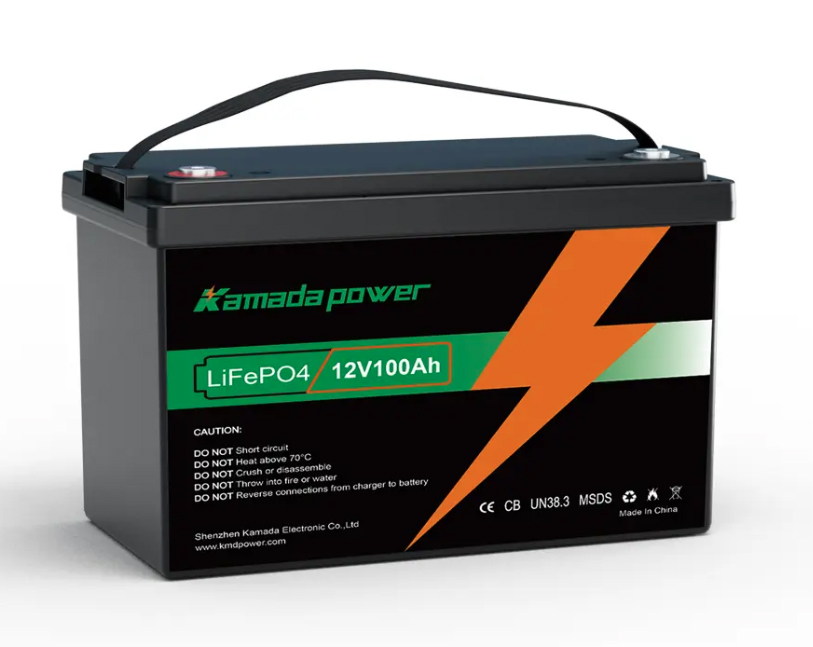
Kamada Power 12v 100Ah Lifepo4 Battery
The Quick Comparison NiMH and Lithium-ion
| Feature | NiMH | Lithium-ion (Li-ion) |
|---|
| Nominal Voltage | 1.2V per cell | 3.6V/3.7V per cell (typical) |
| Energy Density | Medium | High |
| Self-Discharge | Moderate (Low-Self-Discharge types are much better) | Low (generally) |
| Memory Effect | Minimal (not like old NiCd) | None (but it ages differently) |
| Cycle Life | ~500–2000 cycles (depends heavily on depth of discharge and charge control) | ~300–1000+ cycles (varies widely by chemistry, design limits, and thermal profile) |
| Cost | Lower upfront | Higher upfront (plus protection/charging complexity) |
If you’re buying for a program, that voltage row alone should slow you down. 1.2V vs 3.7V is not a rounding error. It’s an entirely different system.
Key Differences Explained
1. Voltage & Energy Density (The Big One)
Let’s start with the part that quietly breaks products.
A standard NiMH AA cell is 1.2V nominal (it might be ~1.4V fresh off charge, then settles). A standard Li-ion cell is 3.6V/3.7V nominal (4.2V fully charged for common Li-ion).
So what happens if someone drops a normal 3.7V Li-ion cell into a device designed for 1.2V NiMH?
- Best case: the device refuses to start (if it has protection).
- Common case: it starts, then overheats regulators or fries front-end electronics.
- Worst case: it becomes a charging hazard because the device’s “charger” is not a Li-ion charger.
EEAT safety note (important): The only time “Li-ion AA” is a safe drop-in for AA slots is when it’s a 1.5V regulated Li-ion AA—a Li-ion cell inside, plus a DC-DC regulator that outputs ~1.5V. Those are designed specifically to mimic alkaline behavior in devices that expect 1.5V. A bare 14500 cell (Li-ion in AA size) is not the same thing—it’s still ~3.7V nominal.
Now, energy density: Li-ion wins. That’s why phones, laptops, drones, handheld scanners, and most modern battery packs are Li-ion (often NMC/NCA or LFP depending on the application). You get more watt-hours per kilogram and per liter. For a buyer, that translates into:
- lighter devices,
- longer runtime at the same weight,
- or smaller packs for the same runtime.
NiMH is bulkier for the same energy. It’s not “bad.” It’s just not chasing the same performance envelope.
2. Self-Discharge & Shelf Life
Here’s a quick mental test I use with clients: the drawer test.
You install fresh cells, then the device sits in a warehouse, a service van, or a spare-parts drawer for 6–12 months. What do you come back to?
- Standard NiMH historically had noticeable self-discharge. You might pull it out and find it annoyingly low or flat.
- Low Self-Discharge (LSD) NiMH—think the “Eneloop class” category—changed that game. LSD NiMH can hold charge far better than older NiMH designs, making it practical for remotes, sensors, and standby gear.
- Li-ion generally has low self-discharge, but it has a different enemy: calendar aging. Even if you don’t cycle it much, high state of charge + heat can reduce capacity over time.
So which is better for infrequently used devices? Often Li-ion looks better on “still has charge later,” but LSD NiMH can be surprisingly competitive—and sometimes more forgiving in uncontrolled storage.
Procurement tip: if your spares sit for long periods, specify LSD NiMH explicitly. “NiMH” alone is not a complete spec.
3. Charging & Safety (Critical)
This is where people get hurt—literally—if the system is mixed up.
Charger incompatibility is non-negotiable:
- NiMH chargers often use ΔV (delta-V) detection and temperature behavior to terminate charge.
- Li-ion chargers use CC/CV (Constant Current / Constant Voltage) with precise voltage limits (commonly 4.2V per cell for many chemistries) and require protection controls.
Warning (worth repeating): Never put Li-ion cells into a NiMH charger. And don’t assume “smart charger” means it can detect anything safely. Wrong algorithm + wrong termination = overheated cell, venting, or worse.
Safety profile:
- NiMH is generally more robust and less prone to dramatic failure modes. It can overheat if abused, but it’s typically harder to trigger a catastrophic event.
- Li-ion has higher energy density and can deliver very high current, which is great—until it’s mismanaged. It usually requires a protection circuit / BMS (Battery Management System) at the pack level (or a protection PCB at the cell level in consumer formats) to prevent overcharge, over-discharge, over-current, and thermal runaway scenarios.
From our experience working with industrial clients, most “Li-ion incidents” aren’t about the chemistry being “unsafe.” They’re about system design: charging control, mechanical protection, thermal management, and quality of cells.
Cold weather performance is where real-world customers notice the difference fast.
In freezing conditions:
- NiMH can struggle with power delivery and effective capacity. Internal resistance rises and you can see sag under load.
- Quality Li-ion can still deliver strong power, but it’s not magic: cold increases resistance in Li-ion too. Also, charging Li-ion cold is a known risk—many systems limit charge current at low temperatures to prevent lithium plating.
If you’re specifying for outdoor gear (inspection tools, handheld scanners, remote sensors), don’t just ask “does it work at -10°C?” Ask:
- what’s the discharge current at temperature,
- what’s the charge limit at temperature,
- and does the pack/controller enforce it.
Can I Replace NiMH with Lithium-ion?
Scenario A: Consumer Electronics (AA/AAA)
Answer: Yes, but only with special 1.5V regulated Li-ion AA batteries.
If you’re replacing AA/AAA in remotes, controllers, toys, or basic electronics, the safe path is:
- NiMH (especially LSD NiMH), or
- 1.5V regulated Li-ion AA designed as a drop-in replacement.
Warning: Do not use a bare 14500 (3.7V) Li-ion in a standard AA device. Same size does not mean same electrical system.
For procurement: if your field teams keep “AA sized” cells in bins, you need packaging and labeling discipline. Mixed bins are how failures happen.
Answer: Yes, it’s a common upgrade—and often a major performance jump.
This is where Li-ion shines:
- higher power output,
- less voltage sag as the pack drains,
- better power-to-weight.
But it comes with requirements:
- you must switch to a Li-ion appropriate charger,
- ensure the motor/controller can handle the voltage and peak current,
- and ideally use packs with proper protection and thermal design.
A simple analogy: upgrading to Li-ion here is like swapping a commuter engine for a performance engine. Great results—if the drivetrain is built for it.
Scenario C: Solar Garden Lights
Answer: Usually no.
Most solar garden lights are designed around 1.2V NiMH charging behavior and extremely simple circuits. Drop-in Li-ion usually doesn’t match the charging method or voltage expectation.
Unless you redesign the driver and charging circuit, stick to NiMH. It’s cheap, compatible, and safe for that architecture.
Which One Should You Buy?
Choose NiMH Battery
Choose NiMH when:
- you’re replacing batteries in standard household or legacy devices (remotes, clocks, older toys, simple industrial accessories),
- safety and robustness matter more than maximum energy density,
- budget is tight and you want predictable sourcing,
- you already have NiMH charging infrastructure in the field.
Buyer note: specify LSD NiMH when shelf life matters. It reduces service calls and “why is this dead already?” complaints.
Choose Lithium-ion Battery
Choose Li-ion when:
- weight matters (drones, handheld inspection gear, portable instrumentation),
- you need high power output (high-lumen flashlights, scanners, tools),
- you want longer runtime between charges,
- you’re buying or designing a pack with a proper BMS, charger, and mechanical protection.
Buyer-focused comparison: If your KPI is runtime per kilogram or power per volume, Li-ion is the clear winner. If your KPI is compatibility and low-risk replacement, NiMH usually wins.
Common Myths Debunked
Myth 1: “You have to fully discharge batteries before charging.” That was more relevant for old NiCd. For modern NiMH and Li-ion, deep discharging is not a “must” and can even shorten life (especially for Li-ion).
Myth 2: “Li-ion lasts forever.” Li-ion ages with time, temperature, and high state of charge. Even with low cycling, calendar aging is real. If a device sits hot and fully charged, capacity loss will show up sooner than you’d like.
Conclusion
No “best battery” here—choose based on device voltage, charger algorithm, and load: use LSD NiMH for 1.2V/NiMH-charged devices; use Li-ion only when the system is designed for it (proper charger + protection); and for AA “upgrades,” use 1.5V regulated Li-ion AA, not 3.7V cells. Conatct us, Send your device voltage, runtime target, and charge method (or a label photo), and I’ll tell you fast what’s safe and what isn’t.
FAQ
Can I use a NiMH charger for Lithium-ion batteries?
No. NiMH and Li-ion require different charging algorithms. Using a NiMH charger on Li-ion can overcharge or mis-terminate and create a safety risk.
Why are Lithium batteries 3.7V and AA batteries 1.5V?
They’re different chemistries with different electrochemical potentials. AA alkaline is ~1.5V, NiMH is ~1.2V, and common Li-ion is ~3.6/3.7V nominal. Same shape doesn’t mean same voltage.
Do NiMH batteries still have memory effect?
Not in the classic NiCd sense. NiMH can show performance issues if repeatedly shallow-cycled under certain conditions, but “memory effect” is usually overstated for modern NiMH.
Which battery lasts longer, NiMH or Lithium-ion?
It depends on how you define “longer.” NiMH can deliver high cycle life in many moderate-use cases. Li-ion can also last a long time, but it’s sensitive to heat and high state of charge (calendar aging). For a real answer, compare duty cycle, temperature, and charge management.
What if I accidentally used a 3.7V Li-ion in a device meant for NiMH?
Stop using it and check the device for overheating, damage, or abnormal behavior. If it was charged or ran hot, treat it seriously—inspect the device and don’t keep cycling that setup.