Is Sodium-Ion Better Than LFP for Base Station Power in Hot Regions? Imagine a remote 5G base station in the Arizona desert, its AC screaming just to keep the LFP batteries from cooking. Then, the compressor fails. The site goes dark. You’re now looking at an expensive emergency truck roll—a nightmare scenario for any telecom engineer.
This is the reality in hot regions, where cooling costs are bleeding OPEX budgets dry. While LFP is the industry king, it cracks under extreme heat. This is where Sodium-ion (Na-ion) technology is entering the chat. It’s not just a cheaper alternative; it’s a true “Heat Specialist” that can eliminate air conditioning and drastically lower your Total Cost of Ownership (TCO).
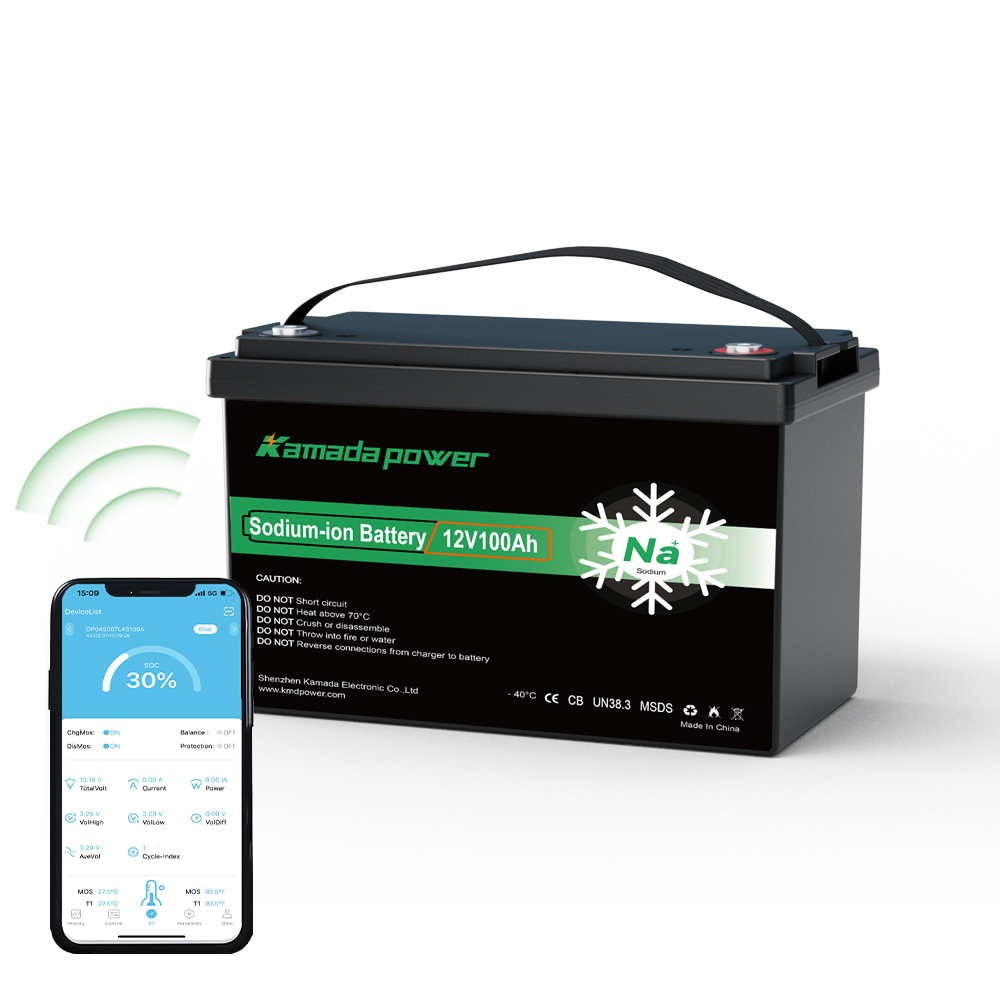
Kamada Power 12V 100Ah Sodium ion Battery
The High Cost of Heat: Why LFP Batteries Fail in Deserts
To understand why we are even talking about a new chemistry, we have to look at why LFP struggles in the heat. I’ve worked with plenty of engineers who assume that because LFP is safe, it’s invincible. It isn’t.
Thermal Degradation Mechanism of LiFePO4
Here is the technical reality: Lithium-ion batteries are like Goldilocks—they like it around 25°C. When you push an LFP cell consistently above 45°C, the chemical side reactions accelerate. Specifically, the Solid Electrolyte Interphase (SEI) layer on the anode starts to grow and thicken uncontrollably.
Think of the SEI layer like plaque in arteries. A little bit is necessary and normal. Too much restricts the flow of ions. As this layer thickens in high heat, internal resistance shoots up, and the capacity of the battery is permanently killed. We’ve seen LFP packs deployed in uncontrolled outdoor cabinets in Iraq lose 40% of their capacity in less than two years.
The “Cooling Penalty”: HVAC OPEX Drain
There is a brutal rule of thumb in battery chemistry: For every 10°C rise in operating temperature, the calendar life of the battery is cut in half.
To prevent this, telecom operators pay a “cooling penalty.” You aren’t just powering the radio equipment; you are powering a hungry HVAC unit to keep the batteries comfortable. In hot climates, cooling can account for 30% to 40% of the site’s total energy consumption.
From a procurement standpoint, this is a disaster. You are paying for electricity that doesn’t carry data; it just moves heat. And as mentioned in our opening scenario, if that AC unit fails, your network reliability fails with it.
Technical Analysis: Sodium-Ion Thermal Stability vs. LFP
So, how does Sodium-ion battery change this equation? It comes down to the electrolyte.
Electrolyte Stability at 60°C (140°F)
Sodium-ion chemistry utilizes different salts (typically NaPF6) and solvents that are inherently more stable at high temperatures than standard Lithium electrolytes.
While an LFP cell starts degrading rapidly at 45°C, many industrial-grade Sodium-ion cells are rated to operate continuously at 60°C (140°F) with minimal degradation. In lab testing, we’ve seen Na-ion packs run through hundreds of cycles at these temperatures while retaining over 90% of their capacity. They don’t just survive the heat; they are comfortable in it.
From Active Cooling to Passive Cooling
This is the “Lightbulb Moment” for site designers.
If your battery can safely operate at 55°C or 60°C, you do not need an air conditioner. You can switch from Active Cooling (HVAC) to Passive Cooling (simple fans or heat vents).
By removing the AC unit, you remove the single largest parasitic load on the site. You also remove a mechanical failure point. A fan is cheap, simple, and easy to replace. An HVAC compressor is expensive, power-hungry, and prone to breaking in dusty desert environments.
TCO Case Study: 5-Year Cost in a 40°C Climate
Let’s break this down into dollars and cents. I recently helped a client run a comparison for a deployment in a high-heat region. Here is what the numbers look like over a 5-year period.
CAPEX Comparison (Upfront Battery + System Cost)
Currently, Sodium-ion battery packs are priced similarly to, or slightly higher than, tier-1 LFP packs. The supply chain is still maturing, so we haven’t hit those “30% cheaper than lithium” targets just yet.
However, the System CAPEX for Sodium is lower. Why? Because you are buying a simple outdoor cabinet with fans, rather than a complex, insulated cabinet with an integrated HVAC unit. The savings on the enclosure often offset the battery cost.
OPEX Savings (Electricity & Maintenance)
This is where Sodium-ion wins the argument.
- Energy Bills: By cutting the AC, site energy consumption drops by roughly 35%. Over 5 years, that is thousands of dollars per site in electricity savings.
- Maintenance: No HVAC maintenance. No filters to clean. Fewer emergency site visits.
ROI Break-even Point
When we crunched the numbers, the Sodium-ion system (Passive Cooling) broke even against the LFP system (Active Cooling) in Year 2. By Year 5, the Sodium site had saved the operator nearly roughly 40% in Total Cost of Ownership.
The Hidden Value: Anti Theft Features
Here is a factor that doesn’t show up on a spec sheet but keeps operations managers awake at night: Theft.
In many developing regions, LFP batteries are stolen at alarming rates. Why? Because they are fantastic. They are lightweight, energy-dense, and widely compatible with 12V/24V home solar systems. A thief can steal a telecom LFP module and power their home or sell it on the black market easily.
Why Sodium-Ion is “Theft-Proof”
Sodium-ion offers a natural deterrent:
- Low Density (Bulk): Sodium-ion batteries are about 30% larger and heavier than LFP for the same capacity. They are awkward to carry and harder to smuggle down a tower.
- Voltage Incompatibility: This is the big one. Sodium-ion cells have a very wide voltage curve (more on this below). A 48V nominal Sodium pack might discharge down to 30V or charge up to 58V. Most standard home inverters and consumer electronics cannot handle this range—they will error out or fry.
Thieves are smart. Once word gets out that these “new blue batteries” don’t work with home inverters, theft rates tend to plummet. We call this “security through incompatibility.”
To make this easy for your procurement team to digest, here is the side-by-side breakdown:
| Metric | LFP (LiFePO4) | Sodium-Ion (Na-ion) |
|---|
| Optimal Temp Range | 15°C to 35°C | -20°C to 60°C |
| Cooling Requirement | Active Air Conditioning (High Cost) | Passive Fan Cooling (Low Cost) |
| Energy Density | High (Compact) | Moderate (Bulkier) |
| Cycle Life @ 45°C | Rapid Degradation | Stable |
| Theft Risk | High (High Resale Value) | Low (Hard to Repurpose) |
| TCO (Hot Climate) | High (Due to Energy Cost) | Lowest |
Implementation: Rectifiers and Voltage Compatibility
If you are an engineer reading this, you’re probably asking, “Okay, but can my rectifiers handle it?” This is the most critical implementation detail.
The Voltage Challenge (1.5V – 4.0V Range)
Sodium-ion cells have a steeper discharge curve than Lithium. A single cell discharges from roughly 4.0V down to 1.5V. When you stack these in series to make a 48V telecom battery, the operating voltage window is much wider than what legacy telecom equipment is used to.
Standard telecom rectifiers usually operate in a tight window (e.g., 42V to 54V). If a Sodium battery drops to 38V, the rectifier might disconnect it, assuming the battery is faulty, even though it still has 20% capacity left.
Before switching, you must verify your power system.
- Modern Systems: Major vendors like Huawei, ZTE, Vertiv, and Eltek are rolling out firmware updates or specific “wide-range” rectifier modules that support Sodium-ion voltage windows.
- Legacy Systems: You may need a bi-directional DC-DC converter to interface the battery with the DC bus, acting as a bridge to keep the bus voltage constant while the battery voltage fluctuates.
Do not skip this step. Putting a Sodium pack on a dumb, old lead-acid charger will result in poor performance or system errors.
When Should You Switch?
Sodium-ion isn’t the perfect solution for every site. It’s a specialized tool.
The “Green Light” Scenarios for Sodium-Ion
- High-Heat Regions: Sub-Saharan Africa, Middle East, Southeast Asia, Australian Outback, Southern USA.
- Remote/Off-Grid Sites: Where every watt of solar/diesel matters, and you want to eliminate the AC load.
- High-Theft Zones: Remote towers where security guards aren’t an option.
When to Stick with LFP
- Urban Rooftops: If you are renting space by the square foot in London or New York, you need the density of LFP. Sodium is too bulky.
- Climate Controlled Data Centers: If the room is already kept at 20°C for the servers, LFP is cheaper and more energy-dense.
- Small Cells: If the battery needs to fit inside a tiny pole-mounted box, Sodium likely won’t fit.
Conclusion
In the battle for base station power, there is no single winner—only the right tool for the job. If you are fighting for space in a crowded city, LFP wins on Density. But if you are fighting the sun in the desert, Sodium-ion battery wins on Resilience.
For procurement officers managing assets in hot climates, resilience is money. The ability to eliminate air conditioning, reduce theft, and extend battery life in extreme heat fundamentally changes the ROI calculation. We are moving away from fragile systems that need babysitting, toward robust systems that can sweat it out.
Contact us. Our kamada power sodium ion battery manfuacturers battery engineers will tailor a sodium ion battery solution specifically for you.
FAQ
Can I direct swap LFP with Sodium-ion battery?
Usually, no. While the physical connectors might look the same, the voltage range is different. You need to check if your rectifiers/power system can handle the wider voltage swing of Sodium-ion battery. If your equipment is less than 3 years old, it might just need a firmware update. If it’s older, you might need a DC-DC converter.
Is Sodium-ion battery safe for unattended sites?
Yes, extremely. Sodium-ion battery is actually safer than Lithium-ion in many regards. It has a higher thermal runaway temperature, meaning it takes much more heat to make it catch fire. Also, Sodium-ion batteries can be discharged to 0 Volts for transport, making them chemically inert during shipping. Lithium batteries always have to travel with a charge, which carries risk.
Does Sodium-ion battery support fast charging?
Yes. In fact, Sodium-ion battery excels here. Because the ions move faster chemically, many Sodium packs can charge from 0% to 80% in just 15-20 minutes. This is a massive advantage for hybrid diesel sites, as you can run the generator for a shorter time to top up the batteries, saving fuel.
What if the temperature drops below freezing?
Sodium-ion is a dual-threat. It handles heat well, but it is also fantastic in the cold. It can retain over 90% of its capacity at -20°C, whereas LFP loses significant power in the cold. It’s a great all-season chemistry.