How Long Will a 12V Battery Run a Light? When your LED light suddenly dies mid-dinner, leaving you fumbling in the dark, the urgent question becomes: How much runtime do I actually have? While theoretically based on Capacity (Ah) and Wattage (W), real-world limits like usable capacity, battery efficiency, and environmental factors often skew the math. Stop guessing; this guide provides the formulas, a runtime cheat sheet, and the truth about why LiFePO4 batteries keep the lights on twice as long as Lead-Acid.
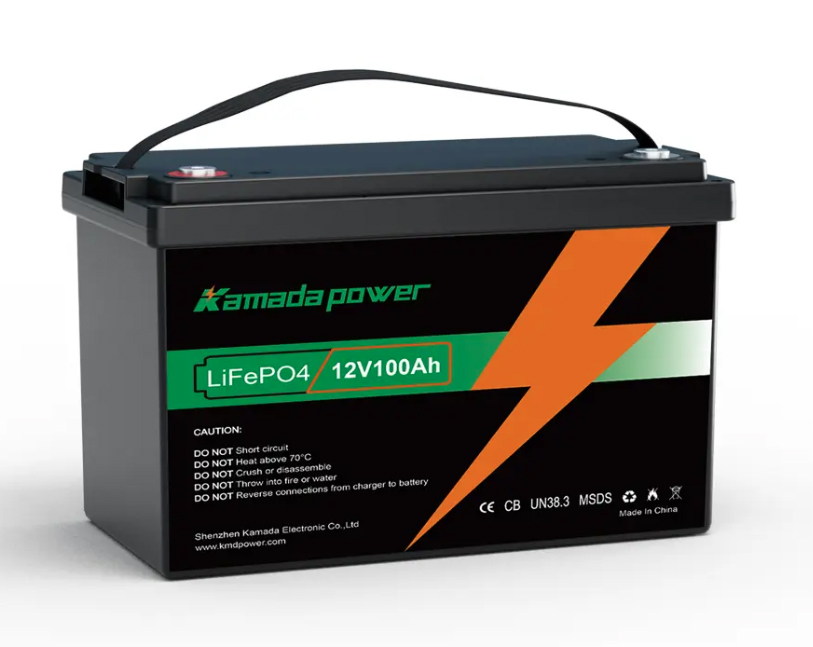
Kamada Power 12v 100ah Lifepo4 Battery
If you want to be precise, you can’t just guess. You need to do a little “napkin math.” Don’t worry, it’s simple.
Understanding Amp-Hours and Watt-Hours for 12V Batteries
Most people look at a battery and see “Amp-Hours” (Ah). The problem is that light bulbs are rated in Watts (W). To make them talk to each other, we need to convert the battery capacity into Watt-Hours (Wh). This gives us a “tank size” that is easy to work with.
Step-by-Step Runtime Calculation for 12V Lights
Step 1: Calculate Total Energy in the Battery
Multiply the battery’s Amp-Hours by its Voltage.
Watt-Hours (Wh) = Amp-Hours (Ah) × Voltage (V)
Step 2: Calculate Light Runtime
Divide the total energy by how much power the light consumes.
Runtime (Hours) = Total Wh ÷ Light Wattage (W)
Example:
Let’s say you have a standard 100Ah 12V battery and you want to run a bright 10W LED camp light.
- Total Energy: 100Ah × 12V = 1,200 Wh
- Runtime: 1,200 Wh ÷ 10W = 120 Hours (Theoretical)
Wait! Before you plan for 120 hours of light, read the next section. The “Theoretical” number is almost never what you get in the real world.
12V Battery Runtime: Depth of Discharge (DoD) and Limitations
Here is where most people get tripped up. You cannot drain every electron out of a battery—well, you can, but you might kill it in the process.
Why You Can’t Use 100% of a 12V Battery
Batteries have a “safe floor.” Draining a battery below this floor is called “Over-Discharging,” which causes chemical damage to the internal plates. This “safe floor” is defined as Depth of Discharge (DoD).
Lead-Acid 12V Battery Runtime (50% Usable Capacity)
If you are using a standard car battery, AGM, or Gel battery (Lead-Acid chemistry), the golden rule is never go below 50%.
If you drain a lead-acid battery to 0%, you might permanently ruin it in less than a month.
- The Reality Check: A 100Ah Lead-Acid battery only gives you 50Ah of actual usable power.
- Revised Example: (100Ah × 12V) × 0.5 (DoD) ÷ 10W = 60 Hours.
LiFePO4 12V Battery Full Runtime (100% Usable Capacity)
This is why everyone is switching to Lithium Iron Phosphate (LiFePO4). These batteries are designed to be drained almost completely without damage.
- The Reality Check: A 100Ah LiFePO4 battery gives you roughly 100Ah of usable power.
- Revised Example: (100Ah × 12V) × 1.0 (DoD) ÷ 10W = 120 Hours.
Same size battery, double the light.
12V Battery Runtime Table for LED, Camping & RV Lights (Cheat Sheet)
Don’t want to do the math? We’ve done it for you. Here is how long common lights will run on different battery types.
| Light Type | Wattage | 50Ah Lead-Acid (50% Usable) | 100Ah Lead-Acid (50% Usable) | 100Ah LiFePO4 (100% Usable) |
|---|
| Small LED Bulb | 5 Watts | 60 Hours | 120 Hours | 240 Hours |
| LED Strip (5m) | 20 Watts | 15 Hours | 30 Hours | 60 Hours |
| Camping Floodlight | 50 Watts | 6 Hours | 12 Hours | 24 Hours |
| Old Incandescent | 60 Watts | 5 Hours | 10 Hours | 20 Hours |
Inverter Loss: AC vs DC Lights on a 12V Battery
There is one more “hidden tax” on your battery life: The Inverter.
Using 12V DC LED or RV Lights Directly (Maximum Efficiency)
If your lights plug directly into a cigarette lighter socket or are hardwired to the battery (like in an RV), you are using DC (Direct Current). This is extremely efficient. You get nearly 99% of the power going straight to the bulb.
Using 110V/220V AC Household Lights via Inverter
If you are plugging a standard household lamp into an inverter (the box that turns 12V into wall power), you are losing energy. The inverter itself needs power to run fans and convert electricity. This creates an Efficiency Loss of about 15–20%.
The Impact:If your calculation says you have 120 hours of runtime, adding an inverter might drop that to ~100 hours. Pro Tip: Always stick to native 12V lights when camping to save power.
Battery Efficiency & Environmental Factors: How Real Conditions Affect Runtime
Even with correct formulas, real-world runtime can differ due to battery efficiency and environmental factors. Understanding these ensures more accurate planning.
1. Battery Age & Condition
- New Batteries: Deliver close to rated capacity.
- Aged Batteries: Internal resistance increases, capacity decreases. A 100Ah old LiFePO4 might effectively deliver only 90Ah.
2. Temperature
- Cold Temperatures (<0°C / 32°F): Battery capacity drops; chemical reactions slow down. Lead-Acid batteries may lose 20–30% runtime; LiFePO4 loses about 10–15%.
- High Temperatures (>40°C / 104°F): Self-discharge accelerates, battery ages faster, effective runtime decreases over time.
3. Self-Discharge
- LiFePO4 Batteries: Very low self-discharge (~3% per month).
- Lead-Acid Batteries: Higher self-discharge (~5–10% per month), further reducing usable runtime if stored.
4. Load Characteristics
- Stable Loads: LEDs provide consistent draw; formulas work well.
- Variable/Intermittent Loads: Motors or flashing lights may draw spikes of current, reducing effective runtime. Peak draws also stress battery, slightly reducing lifespan.
Tip: Multiply theoretical runtime by ~0.85–0.95 to account for real-world efficiency and environmental factors.
Step-by-Step 12V Battery Sizing Guide for LED, Camping & RV Lights
- Identify Light Wattage Check the label on the bulb or fixture. Let’s say you have a 10W camp light.
- Determine Required Runtime Be realistic. Maybe you need it for 5 hours a night for a 2-night weekend trip. Total Time = 5 hours × 2 nights = 10 hours.
- Calculate Required Wh 10W × 10 hours = 100Wh total energy needed.
- Select the Battery
- Option A (LiFePO4): 100Wh ÷ 12V ≈ 8.3Ah → buy 10–12Ah Lithium battery.
- Option B (Lead-Acid): Adjust for 50% usable capacity → 100Wh × 2 = 200Wh → buy 20Ah Lead-Acid battery.
- Account for Environmental & Efficiency Factors Apply ~15% buffer for inverter loss, temperature, and battery age.
Conclusion
Calculating runtime stops being a guess when you account for physics and environment. While Lead-Acid falters in cold temps and deep discharge scenarios, LiFePO4 provides superior resilience and double the effective runtime—ensuring you aren’t left in the dark.
Contact Kamada Power our battery engineering team to design a customized 12v lifepo4 battery Solution tailored to you.
FAQ
How long will a car battery run a 12V LED light?
A standard car battery usually has about 50Ah of capacity. Since it is a starter battery (not deep cycle), avoid deep discharge. A 10W LED light could safely run about 20–30 hours, depending on temperature and battery condition.
Can I connect a 12V LED or RV light directly to the battery?
Yes, if the light is rated for 12V DC. Most LED strips and RV fixtures are designed for this. Do not wire a standard 110V household bulb directly to a battery.
What happens if I drain a 12V Lead-Acid battery to zero?
Draining it completely causes “sulfation” on the lead plates. Even a single deep discharge can reduce capacity by 10–20%, and repeated full discharge can permanently ruin the battery.
How do temperature and battery age affect runtime?
Cold temperatures reduce runtime by slowing chemical reactions, especially in Lead-Acid batteries. Hot conditions increase self-discharge and aging. Older batteries have reduced effective capacity, decreasing runtime.