Scaling a Sodium‑ion battery system beyond 800Ah at 48V is no longer a laboratory exercise—it is a mission-critical engineering decision. For EPC contractors, ESS integrators, and telecom/data-center operators in high-standard markets like Germany, the priority is not just energy density, but system reliability, lifecycle cost, and regulatory compliance.
A common technical question:“Can I combine Sodium‑ion battery in series and parallel to build a 48V 800Ah Sodium ion battery system safely?”
This guide provides a vendor-neutral, engineering-focused analysis of series vs parallel architectures for high-capacity 48V Sodium‑ion Battery systems, and a field-proven reference architecture used in commercial deployments.
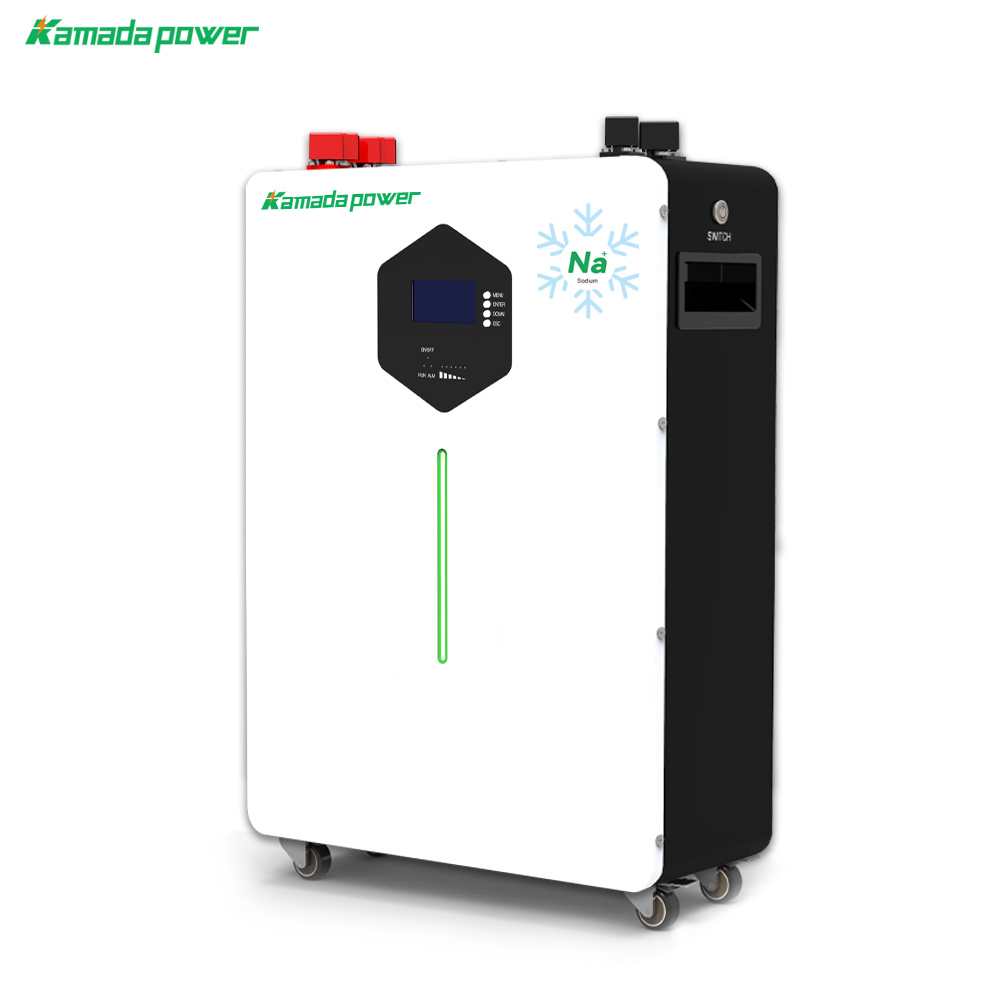
Kamada Power 48v 200Ah 10kWh Sodium ion Battery
1. Why 48V 800Ah is a Critical Threshold
At capacities below 200–300Ah, wiring topology is mostly a convenience choice. Beyond 800Ah, topology becomes a risk multiplier:
- Fault current: Short-circuit potential >10kA, requiring proper busbar sizing and fusing.
- BMS synchronization: Millisecond-level communication delays can trigger overvoltage or under-voltage trips.
- Thermal management: Series-connected strings create uneven heating, accelerating weakest-link failures.
- Lifecycle cost: Voltage drift and uneven cell aging directly impact replacement frequency and TCO.
48V 800Ah is where “works on paper” diverges from “works in the field.”
2. Series vs Parallel: Architecture, Not Chemistry
Two theoretical approaches exist to reach 48V 800Ah:
- Series-Parallel (S/P): String 12V or 24V packs in series, then parallel strings to increase capacity.
- Native 48V Parallel (P-only): Parallel multiple factory-matched 48V modules without series interconnects.
While both reach the same voltage/capacity nominally, failure modes differ fundamentally.
3. Why Series-Based Architectures Fail at High Capacity
Series connections are not inherently unsafe, but become fragile beyond small banks:
3.1 BMS Desynchronization Risk
- Each module’s BMS is calibrated to a fixed voltage window.
- Series connections accumulate State-of-Charge (SoC) drift, because balancing occurs inside modules, not between modules.
- During fast charge/discharge, communication delays amplify imbalances.
Engineering consequence:
One module hits overvoltage first → entire 800Ah system throttles or trips → downtime risk.
3.2 Weakest-Link Failure
- One failed module = open circuit in series string → full system shutdown.
- At 800Ah+, this is a single point of failure violating redundancy expectations in commercial ESS.
3.3 Voltage Drift & Capacity Fade
- Even identical modules age differently.
- Series strings may overcharge one module while undercharging others.
- Repeated micro-overstress accelerates degradation → higher lifecycle cost.
4. Native 48V Parallel: Industry Best Practice
For capacities ≥800Ah:
Maintain a single system voltage (48V) and scale by capacity only.
Advantages:
- Electrical symmetry: All modules share identical voltage.
- Graceful degradation: One module offline does not collapse the bank.
- Simplified protection: Module-level fusing & BMS fault isolation.
- Linear scalability: Add modules to increase capacity without inverter reconfiguration.
Field-proven applications: Telecom battery plants, data-center DC backup, utility-scale DC bus ESS.
5. Architecture Decision Matrix (Engineering View)
| System Capacity | Series (12V → 48V) | Native 48V Parallel | Risk Level | Notes |
|---|
| ≤200Ah Residential | Conditional | Optional | Low | Small home ESS |
| 300–600Ah Hybrid | Discouraged | Preferred | Medium | Industrial/Hybrid ESS |
| ≥800Ah Commercial | Not Recommended | Best Practice | High if Series | Commercial ESS, telecom, DC microgrid |
This matrix reflects real-world reliability, not just theoretical capability.
6. Reference Implementation: 48V 800Ah Sodium‑ion Battery
6.1 Base Module Selection
- Use 48V-native Sodium-ion modules, 200–210Ah class
- Ensure factory-matched cell grading for voltage/impedance uniformity
6.2 Parallel Expansion Strategy
- Connect all positives to a central busbar, all negatives to another
- Ensure identical cable lengths → minimizes voltage drop and current imbalance
- Each module retains independent protection/fusing
6.3 BMS Communication Layer
- RS485/CAN daisy-chain
- Master BMS presents one logical battery entity to inverter
- Enables SoC averaging, fault reporting, and early warning for module issues
6.4 Inverter Integration
- Configure Sodium-ion charge profiles
- Enforce conservative voltage limits
- Disable series-string assumptions in firmware
7. Why Sodium‑ion Excels in Northern European Deployments
- Cold resilience: >80% usable capacity at −20 °C
- No lithium plating risk during cold-weather charging
- High-rate discharge: Supports heat pumps, EV fast-charging
- Sustainability: Abundant, non-critical raw materials; aligns with EU regulations
These are system-level advantages, not marketing hype.
8. Mechanical & Thermal Design Considerations
- Advanced module form factors can:
- Improve airflow and heat dissipation
- Reduce cabinet dead space
- Design choices should be driven by installation constraints, not aesthetics.
Conclusion
Choosing between series and parallel isn’t just a technicality—it’s about de-risking your investment. While series-connecting packs might seem like a shortcut for small-scale projects, the physics of 800Ah+ systems demands a “Parallel-First” strategy.
For integrators targeting the European or North American markets, the transition to Native 48V Parallel architectures using Sodium-ion technology offers the most resilient path forward. It minimizes the “weakest-link” risk and ensures that your ESS remains operational even if a single module requires maintenance. In the high-stakes world of commercial energy storage, reliability is the only metric that truly matters. Contact us to customize your sodium-ion battery solution.
FAQ
What is the maximum number of modules I can parallel?
Our 48V Sodium-ion modules support up to 16 units in parallel (16P) within a single logical bank. This allows you to scale up to 3,360Ah (approx. 161kWh) without needing an external complex Master-BMS controller. For projects exceeding 161kWh, we recommend a multi-stack architecture using a high-voltage hub.
Can you safely build a 48V 800Ah system using series-connected 12V Sodium-ion batteries?
The short answer is: Not recommended for commercial use. While it works for small DIY setups, at 800Ah, series-connected strings suffer from BMS drift and synchronization lag. If one 12V module trips, your entire 800Ah system goes dark. For industrial reliability, always use Native 48V modules connected in parallel to ensure system uptime.
Why is “Native 48V Parallel” considered the industry best practice for ESS?
Native 48V Parallel architecture ensures electrical symmetry. Every module in the 800Ah bank operates at the exact same voltage. This prevents “voltage runaway” common in series strings and allows for graceful degradation—if one module fails, the rest of the system continues to power the load without interruption.
How does Sodium-ion Battery handle the high fault currents of an 800Ah bank?
A 48V 800Ah bank can deliver short-circuit currents exceeding 10kA. Sodium-ion modules designed for commercial use include internal fusing and high-speed BMS protection. When configured in parallel, the current is distributed across multiple busbars, making it easier to manage thermal loads compared to a single high-voltage series string.
Will Sodium-ion batteries lose capacity in cold climates like Northern Europe?
No, that is one of Sodium-ion battery greatest strengths. Unlike Lithium (LiFePO4) which struggles below 0°C, Sodium-ion maintains over 80% capacity at -20°C. It also eliminates the risk of “Lithium plating,” allowing for safe, high-rate charging in freezing conditions without the need for expensive heating elements.
Is it possible to expand an existing 800Ah Sodium-ion battery later?
Yes, but only if you use a parallel architecture. With a parallel setup, you can simply add more 48V modules to the central busbar. Because they share the same system voltage, you don’t need to worry about matching the “string age” as strictly as you would in a series configuration.