12V 100Ah Sodium-Ion Battery vs. Lead-Acid for Remote Monitoring Systems. That 7 AM alert is a familiar sound for any field engineer. You already know the cause: a lead-acid battery froze solid. Again. For years, the 12V 100Ah lead-acid has been the industry’s default “AA battery.” It’s cheap, it’s available, and it’s what we’ve always done. But here’s the problem: it’s often a terrible choice for the job. It’s incredibly heavy, it has zero tolerance for deep discharge, and it simply quits when the temperature drops.
A new contender is here: the 12V 100Ah sodium ion battery pack. It promises a lighter, longer-lasting, far more durable solution, but with a higher upfront cost. Which leads to the one question that matters: is the premium for sodium-ion actually worth it?
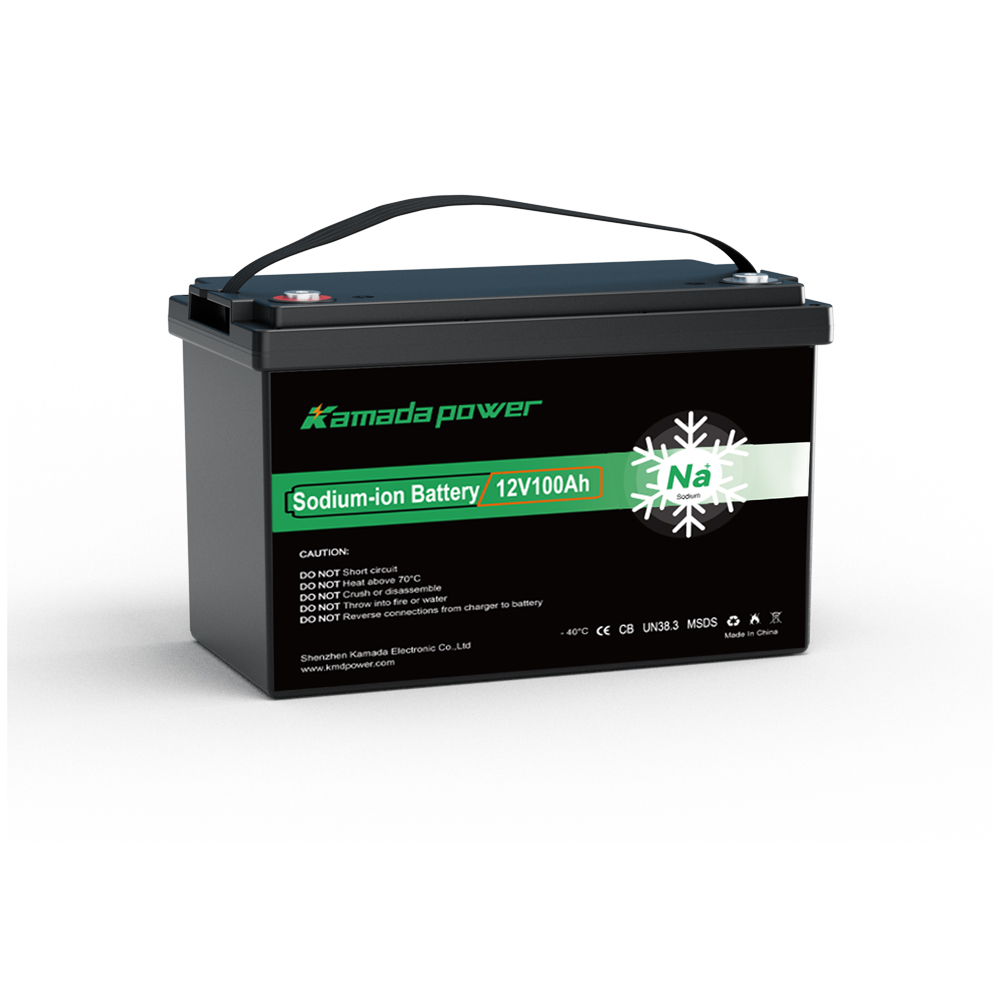
Kamada Power 12V 100Ah Sodium ion Battery
The “Usable Capacity” Myth: Why 100Ah ≠ 100Ah
We have to start with the biggest myth in batteries: usable capacity. This is where the low price of lead-acid becomes a false economy. The number on the label isn’t what you get to use.
Lead-Acid Reality (50% DoD Limit)
A lead-acid battery, AGM or Gel, has a critical weakness. It can’t handle deep discharge. If you regularly drain it below 50% of its capacity (its Depth of Discharge, or DoD), you are actively destroying the battery. Sulfation builds on the plates, capacity plummets, and you gut its service life.
The practical result? You can only use half the battery’s stated capacity if you want to protect your investment. Your new 100Ah battery gives you just 50Ah of usable energy.
Sodium-Ion Reality (100% DoD)
Sodium-ion chemistry is built differently. Its internal structure is designed for deep cycling, day after day, without the same rapid degradation. You can safely run a sodium-ion battery down to 0% if you have to, though most systems cut off around 10% to protect the connected equipment.
This fact changes everything. A 100Ah sodium-ion battery delivers a full 100Ah of real power. No fine print.
The 2-to-1 Replacement Ratio
Here is the one statistic that reframes the entire cost discussion: to get 100Ah of usable energy, you need TWO 100Ah lead-acid batteries for every ONE 100Ah sodium-ion battery.
Suddenly, that price premium doesn’t seem so steep. You’re not comparing one battery to another. You’re comparing one sodium-ion pack to two lead-acid blocks. That math levels the field, fast.
Weight & Installation: Saving Your Back (and Your Schedule)
Weight isn’t just a number on a spec sheet. For anyone who’s hauled a battery up a ladder, it’s a real-world headache that causes delays and creates safety risks.
The 30kg vs. 11kg Difference
Let’s put that in physical terms. A standard 12V 100Ah AGM is a 30 kg (66 lbs) block of lead. That’s an awkward, two-handed lift and a clear safety hazard.
A comparable 12V 100Ah sodium-ion battery weighs just ~11 kg (24 lbs).
A one-handed lift. That’s not just a number—it’s the difference between a one-person job and a two-person struggle. For teams managing dozens of sites, the savings in labor and reduced injury risk are massive.
Structural Safety for Pole Mounts
This weight reduction is fundamental for structural integrity. On a pole-mounted box, every pound matters. Hanging two 30kg batteries (a 60kg load) puts immense stress on mounts and poles, creating dangerous torque in high winds.
Switching to a single 11kg sodium-ion battery cuts that load by over 80%. This directly improves installation safety and gives you confidence your gear will actually be there after the next storm.
Winter is where batteries are truly tested, and it’s where lead-acid consistently fails. Its chemical reaction slows to a crawl and performance doesn’t just drop, it collapses. For any equipment in a climate with a real winter, this is a predictable point of failure.
Capacity at -20°C (40% vs. 90%)
The numbers tell the story. At -20°C (-4°F), a typical AGM battery loses up to 60% of its capacity. Your 100Ah battery, already only 50Ah usable, now performs like a 20Ah battery. No wonder they fail. It’s why engineers are forced to oversize lead-acid banks by 2x or 3x, adding more weight and cost.
Sodium-ion’s cold performance is a key advantage. At that same -20°C, it still delivers around 90% of its rated capacity. It simply works. You can size your battery for the real-world load, not a worst-case scenario.
Voltage Sag & Camera Cutoffs
It gets worse for lead-acid in the cold. Its internal resistance skyrockets. The moment your gear demands power, the battery’s voltage collapses. We call this “voltage sag.”
That sag is what triggers the low voltage cutoff on your electronics, forcing a shutdown even when the battery has a charge. It’s a deeply frustrating failure to diagnose. A sodium-ion pack’s stable chemistry and BMS maintain a flat voltage curve, delivering steady power and keeping your equipment online.
Lifespan and ROI: The Math Behind the Switch
An industrial battery is a long-term asset, not a disposable part. Focusing only on the upfront cost is a classic mistake. The real number is the Total Cost of Ownership (TCO).
Cycle Life Comparison (500 vs. 3,000)
If you treat an AGM perfectly (50% DoD max), you might get 500 cycles. For a solar application, that’s about two years before it becomes unreliable.
A quality sodium-ion battery gives you 2,000 to 4,000 cycles. For the same job, that’s a lifespan of 10+ years. A true “install and forget” component.
10-Year Total Cost of Ownership (TCO)
Look at two paths over ten years for a single site.
- The Lead-Acid Path: You replace the battery 3-4 times. Your cost is (4 x Battery Cost) + (4 x Truck Rolls & Labor).
- The Sodium-Ion Path: You buy one battery. Your cost is (1 x Sodium-Ion Battery Cost).
We see it all the time: the truck roll alone costs more than the battery. The sodium-ion option doesn’t just pay for itself; it saves you money. The reduction in labor costs alone justifies the switch.
Compatibility Check: Is It Truly a “Drop-In” Replacement?
So, it’s lighter, lasts longer, and handles the cold. But can you just swap it in? Mostly, yes. You just have to verify two key points.
Charging Voltage Settings
The good news is that most 12V sodium-ion packs are engineered for standard chargers. They work perfectly on the default “AGM” setting on most solar controllers (usually 14.4V – 14.6V).
This part, however, is non-negotiable: you must disable any “Desulfation” or “Equalization” mode. These modes send high-voltage pulses (>15V) for lead plates. The sodium-ion BMS will see this as a fault and shut down to protect the cells from damage.
Discharge Cutoff Voltage
Sodium-ion’s voltage profile is different. It holds steady longer, then drops faster at the end. While the BMS prevents over-discharge, you should set your equipment’s low-voltage cutoff to about 10.5V to use the full capacity. Most modern industrial gear is fine with this range.
Comparison: 12V 100Ah Sodium-Ion vs. 12V 100Ah Lead-Acid
| Feature | 12V 100Ah Lead-Acid (AGM) | 12V 100Ah Sodium-Ion |
|---|
| Usable Capacity | ~50Ah (to preserve lifespan) | 100Ah |
| Weight | ~30 kg (Heavy) | ~11 kg (Light) |
| Cycle Life | 300 – 500 cycles | 2,000 – 4,000 cycles |
| Cold Perf (-20°C) | Poor (<40% capacity, high sag) | Excellent (~90% capacity) |
| Maintenance | None (Sealed) | None |
| True Replacement Ratio | Need 2 for 100Ah usable energy | Need 1 |
| Lifetime Cost | High (due to frequent replacements) | Low |
Pros and Cons: A Quick Summary
Why Stick with Lead-Acid?
- The lowest possible initial purchase price.
- Universally available from any supplier.
- Compatible with old, basic, non-configurable chargers.
Why Switch to a Sodium-Ion Battery?
- Over 60% lighter, making installs faster and safer.
- Provides 100% of its rated capacity. An effective 2-for-1 replacement.
- Delivers reliable performance in freezing temperatures.
- A 10+ year lifespan means a much lower total cost of ownership.
Who Should Upgrade?
- Ideally Suited For: Any application where reliability is critical and site visits are expensive. Think telecom towers, pole-mounted security systems, off-grid SCADA, and solar lighting in places with actual winters.
- Not Suited For: Short-term projects (under a year) where the battery is disposable, or builds on a rock-bottom initial budget where long-term costs aren’t a factor.
Conclusion
The days of hauling heavy, unreliable lead-acid batteries up ladders are numbered. For too long, we’ve relied on a technology that delivers only half the capacity we pay for, fails when we need it most, and costs a fortune in maintenance. A 12V 100Ah sodium-ion battery isn’t a marginal improvement; it’s a fundamental shift in how we power remote equipment. It combines the longevity of an advanced chemistry with superior cold-weather performance that even lead-acid can’t touch, all within a package that’s far lighter and ultimately cheaper to own.
When making your decision, don’t just look at the price tag. Remember the “2-for-1” rule: you need two lead-acid batteries to do the job of one sodium-ion battery. When you factor in a decade of service life and no more trips for replacements, the choice becomes obvious.
Ready to lighten your load and reduce your service calls? Contact us,Explore our collection of 12V Sodium-Ion Batteries and find the perfect fit for your next demanding monitoring upgrade.
FAQ
Can I connect 12V sodium-ion batteries in series for 24V or 48V?
Yes. Most industrial-grade 12V packs are designed for it. You can typically connect up to four for 24V, 36V, or 48V systems. Just check the datasheet first, but it’s a standard feature for professional applications like large off-grid comms hubs.
Will a sodium-ion battery leak acid?
Not a chance. The name can be misleading, but these batteries are fully sealed with no free-flowing liquid acid. The electrolyte is a non-corrosive salt in an organic solvent. That means zero risk of leaks, no terminal corrosion, and no gassing. They’re far safer.
Is a 12V sodium-ion battery safer than a lithium (LiFePO4) battery?
Sodium-ion is considered one of the safest modern chemistries, on par with or even exceeding Lithium Iron Phosphate (LFP/LiFePO4) in safety. It has excellent thermal stability and is much less prone to thermal runaway from damage or overcharging. For an unattended remote site, that inherent stability provides critical peace of mind.