A mobile stretch wrapper may have a seemingly adequate battery rating and still stop before the last outbound pallets are secured. The missing variable is often the wrapping recipe: tall, unstable loads need different travel, carriage movement and film delivery from compact loads. For a packaging OEM or warehouse integrator considering sodium-ion battery, the question is whether an approved battery system can finish the required pallets, at the specified wrap quality, within the shift and charging schedule. Capacity beyond that constraint may add cost without adding accepted pallets. On a 24V-class machine, changing battery chemistry also requires the machine maker’s electrical and control approval.
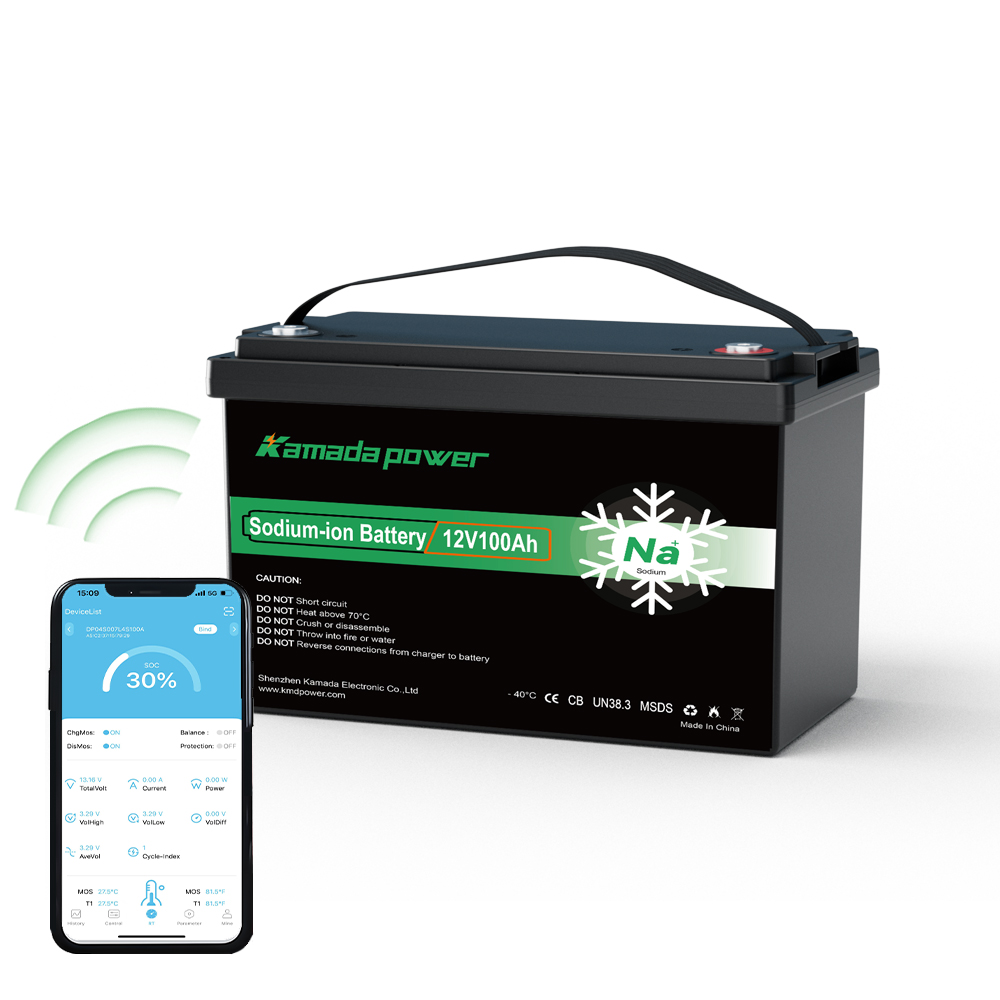
Kamada Power 12v Sodium ion Battery
Why Do Pallets per Charge Vary With the Wrapping Recipe?
A pallet is not a fixed unit of electrical work. The same 200 loads can impose different energy demands.
A short, rigid carton load and a tall, irregular load can require different top/bottom wraps, overlap, carriage passes and travel speed. Powered pre-stretch also changes motor behavior, but a higher stretch ratio does not necessarily increase electrical Wh or reduce it. Film savings and battery-energy savings are different measurements.
The Robopac Robot S7 technical table reports more than 250 pallets per charge with two 12V, 110Ah lead-acid batteries; optional 24V lithium configurations have different published counts. Its carriage options include mechanical tension control and powered pre-stretch. Those are manufacturer ratings for stated machine configurations, not Kamada Power Sodium-ion Battery tests or a guarantee for a buyer’s recipe.
Dividing nominal battery Wh by that advertised pallet count would also be misleading. The source does not report actual battery-terminal Wh delivered under the buyer’s pallet dimensions, wrap program, ambient temperature, travel pattern or low-voltage stopping point. Different chemistries’ Ah values do not establish equivalent deliverable Wh.
Hold pallet dimensions, film specification and wrapping settings constant. Assess containment force, load stability and load-to-pallet attachment where specified by the customer. Matching wrap counts alone do not establish equivalent packaging performance.
Tag every accepted pallet by recipe. A failed wrap or repeated pass still consumes battery energy, but does not become an additional accepted pallet. Otherwise a seemingly favorable pallets-per-charge figure can conceal rework.
Which Wrapping Operations Set the Battery’s Power and Energy Requirements?
The robot travels around a stationary pallet while the carriage rises and falls. Depending on its design, powered rollers pre-stretch the film; controls and sensors operate between cycles. Floor rolling resistance, wheel condition and repositioning also affect energy demand within approved operating conditions. Track waiting and between-pallet travel separately.
For battery selection, separate two quantities that are often confused:
Power (W) determines whether the pack and BMS can support simultaneous motor demand. Energy (Wh) determines how many cycles fit before the approved operating cutoff. Enough Wh cannot prevent a controller reset if motor acceleration exceeds the permitted current or causes excessive voltage sag.
Measure battery-terminal voltage and signed current together, rather than summing motor nameplate ratings:
E_recipe (Wh/pallet) = ∫ battery-terminal voltage × signed battery current dt during one completed wrap, with time in hours (divide by 3,600 if timestamps use seconds). Use positive current for discharge and negative current for energy returned to the pack. Never presume regenerative braking is available or that the battery can accept returned current under every operating condition.
Record drive travel, vertical carriage motion and film-feed demand on a synchronized trace. A short current peak matters for BMS limits; a small but prolonged control load matters to daily Wh. The same distinction applies to machine repositioning between pallets.
The Robot S7 illustrates the mechanical differences: P3GS uses selectable motorized pre-stretch ratios; PVS uses independent motors and adjustable pre-stretch. The manufacturer describes these drive systems but does not publish a universal Wh penalty for either setting. Carriage specifications.
Check the worst relevant combination of travel, carriage and film-feed demand. Record loaded controller voltage, sustained and peak pack current, BMS trip/recovery, connector ratings and any motor-controller current returned to the DC bus. Cell chemistry and series cell count set the pack voltage window. Under overlapping motor loads, voltage sag can trigger controller undervoltage shutdown before the cells reach their permitted discharge endpoint. Nominal 24V and Ah alone cannot establish compatibility.
The Robot S7 manual, revision 2, section 6.18, page 79 describes a low-charge sequence that finishes the current wrap, displays E9001 and permits travel only to the charging area. Coordinate machine low-charge management with pack protection to retain energy for that sequence. Abrupt BMS disconnection is not a normal operating endpoint. Verify charger voltage, current and temperature limits, controller firmware and SOC indication; a lead-acid voltage gauge may misreport sodium-ion SOC. Confirm safe restart without unintended motion.
How Many Pallets Can a Sodium-Ion Platform Support per Shift?
Start with measured battery-terminal Wh per accepted pallet for each recipe, then add travel and standby energy not already included. Compare that demand with verified deliverable pack Wh at the operating load and temperature, up to the machine’s approved cutoff. Do not convert the OEM’s lead-acid pallets-per-charge rating into a sodium-ion forecast.
Hypothetical illustration only—not a Robopac or Kamada Power test. Recipe A uses 8Wh per accepted pallet, B uses 12Wh, inclusive of their wrapping-cycle travel and carriage work. A 200-pallet shift also uses an assumed 200Wh of waiting and between-pallet travel. Reserve a further 15% of demonstrated usable battery energy.
| Accepted pallet mix in one shift | Wrapping energy calculation | Plus 200Wh shift overhead | Minimum demonstrated usable pack Wh with 15% reserve |
|---|
| 150 A + 50 B | (150 × 8) + (50 × 12) = 1,800Wh | 2,000Wh | 2,353Wh |
| 100 A + 100 B | (100 × 8) + (100 × 12) = 2,000Wh | 2,200Wh | 2,588Wh |
| 50 A + 150 B | (50 × 8) + (150 × 12) = 2,200Wh | 2,400Wh | 2,824Wh |
All figures are hypothetical; values are rounded. The 15% planning reserve is not a battery maker’s SOC limit.
Required usable Wh = shift demand Wh ÷ (1 − reserve fraction). For the 100-A/100-B mix: 2,200 ÷ 0.85 ≈ 2,588Wh. This is required deliverable, not nominal, pack energy.
The same 200 pallets require 2,000–2,400Wh. A hypothetical 2,700Wh deliverable pack meets the first two reserve-adjusted targets but not the B-heavy one.
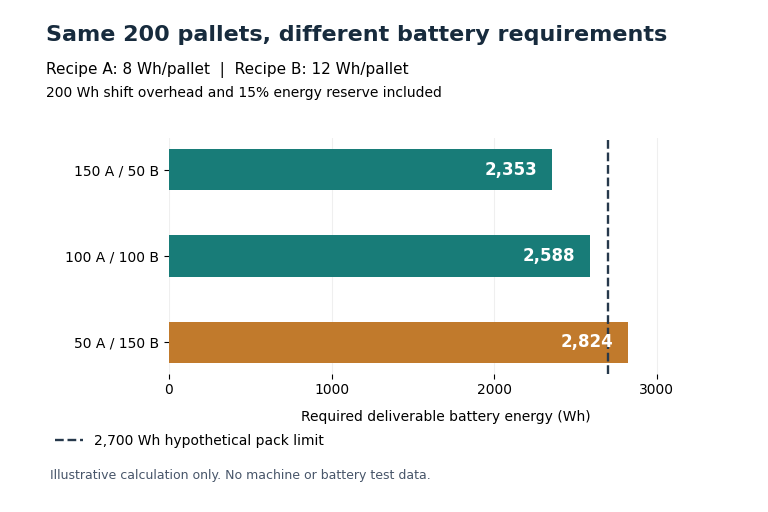
Figure 1. Hypothetical recipe-weighted energy requirements for 200 accepted pallets, including 200Wh of non-cycle demand and a 15% reserve of deliverable energy. A 2,700Wh pack meets the first two planning targets, but not the B-heavy target. No machine or Kamada Power Sodium ion battery pack test data.
The B-heavy shift leaves 300Wh, below the required 405Wh reserve. This is a planning shortfall, not proof of a mid-shift shutdown.
For a mixed schedule, calculate:
Shift energy (Wh) = Σ[accepted pallets in each recipe × measured Wh per accepted pallet] + measured non-cycle Wh + any rework energy not already included in the recipe averages.
Use consistent starting SOC, operating cutoff, temperature and load conditions. Verify deliverable Wh at the agreed aged-pack condition, not an emergency BMS cutoff.
Energy does not determine mechanical throughput. 200 pallets in eight hours requires 25 accepted pallets per hour, including handling, film changes and faults. A larger pack cannot speed up a slow wrapping cycle; it helps only when battery exhaustion or charging downtime is the binding constraint.
A 2026 Applied Energy study found chemistry- and temperature-dependent resistance and voltage–SOC behavior in commercial sodium-ion cells. That supports obtaining pack-specific Wh and BMS data; it is not a Kamada Power Sodium ion battery pack test or evidence of pallets-per-charge performance. Any 24V performance claim needs testing on the chosen production machine and battery configuration.
Can Battery Oversizing Increase the Cost per Wrapped Pallet?
Yes—when a smaller approved system already completes the required shift and additional battery capacity brings no extra accepted output, resilience or charging benefit. Higher Wh does not automatically mean lower cost per pallet.
Calculate battery-related cost per accepted, correctly wrapped pallet over a realistic evaluation period. Include installed battery and charger changes, electricity measured at the charger input, maintenance, replacements and attributable downtime. Hold film and labor assumptions equal when comparing just the battery options.
A practical calculation is:
Battery-system cost per accepted pallet = (allocated installed capital + grid electricity + battery service/replacement + attributable downtime cost) ÷ accepted pallets.
Electricity measured at the charger input already includes charging losses; do not add those losses again.
Consider two hypothetical 24V designs, assuming both satisfy OEM electrical, mechanical and safety approval requirements. Neither represents a Kamada Power quote or specification:
| Economic assumption | Concept X | Concept Y |
|---|
| Demonstrated usable Wh, hypothetical | 2,700Wh | 3,400Wh |
| Installed battery-system price, hypothetical | $1,800 | $2,400 |
| Normal 100-A/100-B shift requirement | Both meet 2,588Wh | Both meet 2,588Wh |
| Allocated capital over 150,000 accepted pallets, hypothetical | $0.012/pallet | $0.016/pallet |
| B-heavy 50-A/150-B requirement | Below 2,824Wh target | Above 2,824Wh target |
Illustrative prices, usable Wh and evaluation volume; not measured savings, lifetime forecasts or market quotations. Electricity, service and downtime are excluded from the capital-only comparison.
On normal shifts, Y adds $0.004 in capital per pallet with no extra output. On B-heavy shifts, X misses the reserve target; Y may justify its premium if it avoids a genuinely necessary charging break. At $30 of hypothetical avoidable cost per interruption, the $600 premium breaks even after 20 avoided interruptions, all else equal. Count only actual incremental labor, equipment or production losses; charging during an existing break is not automatically downtime. Robopac identifies continuous operation and limited overnight charging time as reasons for offering its lithium option. For sodium-ion, compare recoverable Wh during approved charging windows, not advertised charge current alone.
Sodium-ion does not guarantee a cheaper installed system; price, life and integration costs remain project-specific. Confirm that pack size, mounting and mass distribution preserve the machine’s approved stability and safeguards.
Kamada Power 12V 100Ah sodium-ion battery supports 2S2P (two in series and two in parallel) for 24V-class 200Ah systems and 2P–4P for 12V-class 200–400Ah systems. Confirm the exact model and revision. A 2S2P bank has 4,800Wh nominal energy with 12V modules, or 5,120Wh with 12.8V modules; neither figure establishes deliverable Wh.
For a 24V-class wrapper, 2S2P is a standard-battery option if the machine OEM approves the system voltage window, motor current, BMS coordination, charger, mounting and controls. Use matched modules and follow Kamada Power approved wiring, protection and balancing requirements. Verify branch current sharing and the effect of a module protection trip on the remaining bank. Compare this configuration with a custom 24V OEM finished pack when the standard bank is oversized or cannot meet integration requirements.
If the machine maker forbids the chemistry, or voltage, charging, mechanical, temperature or safety requirements cannot be met, reject a direct swap. An authorized OEM redesign is a separate project. Buy the configuration that completes the required accepted pallets at the lowest credible total cost without compromising wrap quality or machine safety.
FAQ
Does 110Ah mean 250 pallets on sodium-ion?
No. Robopac’s >250-pallet figure refers to its specified two-12V-battery, 110Ah lead-acid system. Ah does not prove usable Wh, identical recipes or equivalent cutoffs. A sodium-ion count requires testing of the approved 24V system, whether a 2S2P battery bank or a custom pack.
Does film pre-stretch affect energy?
Possibly. Powered rollers draw energy, and changes in tension, overlap or carriage motion alter the cycle. Measure Wh at the battery terminals under the same containment requirement; pre-stretch percentage alone cannot quantify savings.
Can the existing charger stay?
Only with machine-OEM and battery-maker approval for the exact pack. Check charging voltage and current, termination, temperature limits, protection coordination and restart. Matching connectors or a 24V label are insufficient.
Conclusion
Sodium-ion battery selection for mobile pallet wrapping machines should begin with accepted pallets per shift and recipe-weighted electrical energy at the required wrapping quality. Usable Wh, simultaneous motor demand, controller voltage limits, BMS protection coordination and approved charging behavior determine suitability. Approved 2S2P configurations may be considered for compatible 24V-class platforms, while standard 12V-class packs or 2P–4P parallel configurations serve compatible 12V applications. Other electrical, mechanical or capacity requirements may justify custom OEM battery designs. Unapproved legacy replacements remain outside this scope. Contact Kamada Power with pallet dimensions, wrapping recipes, film carriage type, target pallets per shift, machine electrical specifications and available charging intervals for application-specific OEM battery sizing.