A light pole may offer AC only at night. Its CCTV battery must power the daytime gap and recharge before sunrise. A 12V 100Ah sodium-ion battery pack is a candidate, not an automatic solution: AC hours, actual loads, charging, usable Wh and transfer behavior must all work. One successful day can hide a growing energy deficit.
Verify the authorized pole supply schedule. Then confirm usable battery Wh covers the longest AC-off period and nighttime charging restores enough deliverable energy before the next shutdown, with reserve. Prove video continuity during both power transfers. Nominal 100Ah cannot establish any of these results.
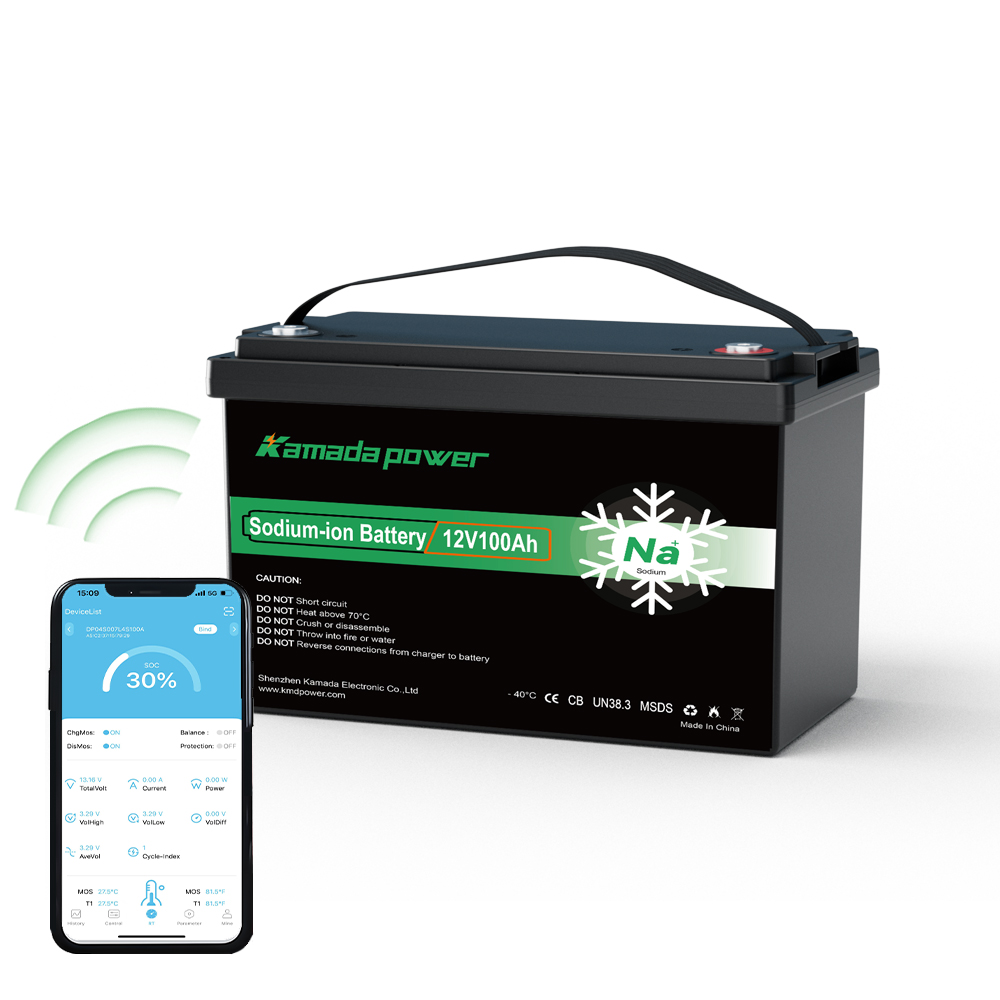
12V 100Ah Sodium-ion battery
When Is the Streetlight Circuit Actually Energized?
An unlit lamp does not prove that the pole lacks AC: switching may be upstream or within the luminaire. Have a qualified electrician verify the authorized connection point and actual AC-on/off schedule before selecting batteries.
A documented example appears in the U.S. Department of Transportation’s 2006 Public Education and Enforcement Research Study, Section 4.2: at certain sites, 12V 12Ah batteries charged from streetlight AC at night and powered cameras and transmitters by day. This proves the architecture existed, not Kamada Power compatibility. Verify local switching hours and seasons.
Obtain pole-owner approval and check local earthing, protection and dual-supply labeling. Access Canberra’s streetlight fact sheet addresses CCTV connections, but its rules are jurisdiction-specific.
First obtain a measured AC-on/AC-off timeline.
How Much Battery Energy Must the CCTV System Deliver While AC Is Off?
Measure daytime battery load and nighttime AC load separately: cameras, PoE conversion, router, recorder and controls. IR lighting, heaters and PTZ can increase nighttime demand. Axis’s power white paper distinguishes typical and peak camera watts. Record the full load curve.
For an initial constant-load estimate:
Battery energy during AC-off hours (Wh) ≈ DC equipment power (W) × AC-off hours ÷ measured battery-to-load efficiency.
For illustration, assume 30W continuous load, 90% battery-to-load efficiency, and 6 hours of AC. The battery supplies the other 18 hours: 30 × 18 ÷ 0.90 = 600Wh at the terminals, before reserve. This is not a field result; check peaks separately.
The supplied Kamada power 12V 100Ah sodium ion battery datasheet gives 1,200Wh nominal, 15.6V maximum charge and 8V discharge cutoff. These are not measured usable Wh or a guaranteed output range; the camera converter may shut down earlier. Measure usable terminal Wh at project load, temperature and the approved system cutoff, plus reserve. The 12v 100ah sodium ion battery describes a 12.8V model; do not merge unconfirmed revisions.
Can Nighttime Charging Replace the Energy Before the Lights Switch Off Again?
The supplied Kamada Power Sodium ion Battery datasheet specifies 15.6V CC/CV, with standard 0.2C (20A) charging followed by a 15.6V hold until 0.02C (2A), at 0–45°C. It lists 10A from -20 to -10°C and 20A from -10 to 0°C; higher-temperature rules and BMS recovery require confirmation. A lead-acid/LiFePO4 charger is not automatically compatible. Confirm voltage, termination and temperature control.
Measure net battery-branch charge Wh, not AC input or nameplate charger watts. Shared AC power also feeds the cameras. Integrate battery-terminal voltage × charge current; allow for storage losses and check repeated-cycle reserve.
A 30W example that exposes the hidden daily deficit
These are hypothetical planning values: 30W equipment load, 90% battery-to-load efficiency and 80W average net charging power at battery terminals during AC-on hours, after supplying nighttime cameras. Real charging may taper or be temperature-limited.
| AC available per night | Battery-powered hours | Battery energy required during AC-off hours | Maximum illustrative battery recharge opportunity | Initial engineering reading |
|---|
| 6 h | 18 h | 600 Wh | 480 Wh | At least 120Wh deficit before battery storage losses |
| 10 h | 14 h | 467 Wh | 800 Wh | Potentially sufficient; prove the charger actually restores the withdrawn energy |
| 14 h | 10 h | 333 Wh | 1,120 Wh | Opportunity exceeds the daily need; actual charge will stop or taper as appropriate |
Figure 1 — Daytime battery energy demand versus nighttime charging opportunity
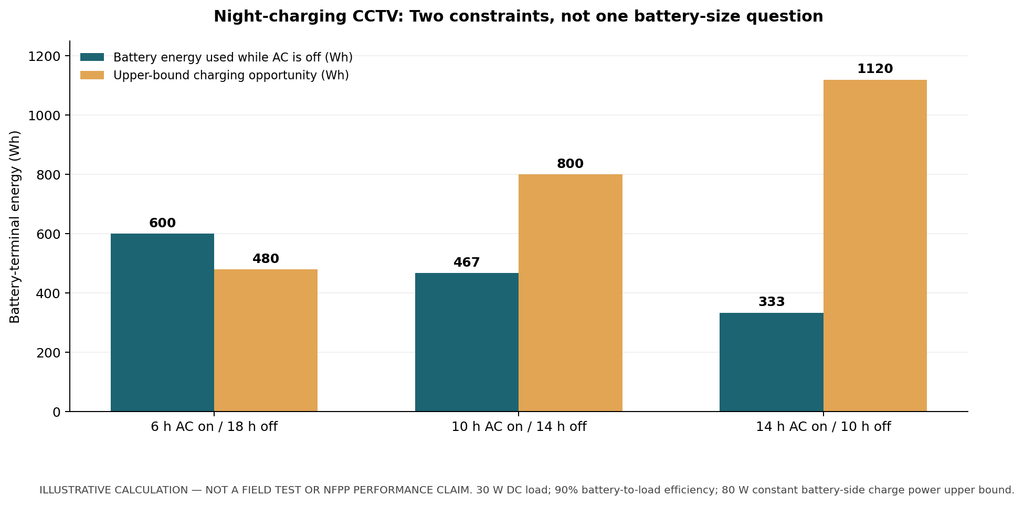
Calculated planning scenarios only. The 80W charging assumption is not a sodium-ion charger rating or measured charging performance. Theoretical available charging opportunity is not the energy a nearly full battery will actually accept.
At six AC-on hours, 600Wh is discharged and at most 480Wh reaches the battery terminals: at least 120Wh/day shortfall before storage losses. Battery reserve can fall each day despite passing a one-day test. More Ah delays failure; fix charger power, AC window or loads.
Is One 12V 100Ah Sodium-Ion Battery Pack Enough for the Actual Day–Night Cycle?
Two checks are mandatory: usable pack Wh covers AC-off demand plus reserve, and nighttime recharge restores that reserve. The pack’s 15.6V charging limit and 8V protective cutoff are not a verified continuous output curve. Check the actual voltages against converters, PoE and cameras. A converter may shut down before the BMS; an unregulated shared bus may expose equipment to charging voltage.
Use longest AC-off for endurance and shortest AC-on for recovery. Check winter separately: cold-charge limits and IR/heater load may outweigh longer night hours. Compare time-varying load and AC schedule.
The stated -20 to 70°C charging range does not permit identical current throughout; the standard CC/CV procedure covers 0–45°C. Confirm other temperature limits and BMS recovery before promising unattended operation.
Manufacturer-approved parallel packs add reserve, not AC hours, charging power or nominal voltage. Recalculate recharge time; do not assume series operation is permitted.
How Do You Keep Video Recording Through Every AC Power Transition?
The power path should be specified as explicitly as the battery. Conceptual power path:
             AUTHORIZED NIGHT-ONLY AC
                 /             \
       Protected AC/DC      Pack-approved charger
              |                    |
              |               Sodium-ion + BMS
              |                    |
              v                    v
       +------------------------------------+
       | QUALIFIED DUAL-INPUT POWER PATH    |
       | transfer, isolation and protection |
       +------------------------------------+
                        |
                Regulated CCTV/PoE bus
                        |
              Cameras / router / recorder
Functional concept only, not an approved wiring diagram. Qualified power-path equipment must prevent backfeed and unwanted interruption; do not directly parallel two supply outputs.
Qualify transitions into and out of AC at low battery reserve. Verify camera/PoE input limits, inrush, fusing, isolation and backfeed prevention. A battery and charger are not automatically a UPS; a reboot followed by recovery is not uninterrupted recording.
Time-align AC state, battery current/voltage, bus waveform and video logs. Test both transitions and cold starts; a multimeter can miss brief gaps.
When Should a Surveillance OEM Reject This Power Arrangement?
A workable design produces four decisions: standard pack eligible, approved larger parallel bank eligible, power-path/charger redesign required, or reject. Decisions require measurement.
| Qualification gate | What the OEM must verify | Reject or redesign when… |
|---|
| Pole AC schedule and permission | Approved connection, logged AC-on hours, switching behavior | Power access is unauthorized or the expected charging window is unavailable |
| Daytime battery endurance | Usable pack Wh at required temperature/load, required reserve | The AC-off duty exceeds approved usable energy |
| Nighttime recovery | 15.6V-approved charge profile, battery-branch Wh, BMS temperature/current limits | Deliverable reserve falls across repeated cycles |
| Voltage and transfer | Converter/PoE input range, bus waveform, camera and router logs | Voltage or recording limits fail at charging, discharge or transfer |
| Production repeatability | Pack revision, charger firmware, enclosure, wiring, annual volume | The configuration cannot be documented and reproduced safely |
Test multiple limiting cycles and measure reserve change under comparable conditions; voltage alone cannot show remaining usable energy.
What Should an OEM Send for a Light-Pole CCTV Battery Review?
Send logged AC hours, separate daytime/nighttime loads, charger settings, lowest temperature, power-path diagram, recording requirement, cabinet limits and annual quantity. These determine whether the Kamada Power 12V 100Ah Sodium ion Battery merits testing, not automatic approval.
For broader battery use in remote security, see Kamada power existing security application article. This article addresses AC that is available only while streetlights are energized, not ordinary solar sizing or dusk-to-dawn solar streetlighting.
FAQs
Can a camera use a streetlight pole’s electricity when the lamp is off?
Only if an authorized supply is actually present and the electrical design is approved. The lamp’s off state alone does not establish whether the pole conductors are energized. Verify the approved connection locally.
Is a 12V 100Ah sodium-ion battery enough for 18 hours without AC?
That depends on the measured load and the pack’s approved usable Wh, not nominal Ah alone. A hypothetical 30W load at 90% path efficiency needs 600Wh in 18 hours, before reserve.
Why can a system stop after several days if the battery runs the camera for one full day?
Because daily replenishment may be less than daily withdrawal. Even with a working 100Ah battery, usable reserve then declines across cycles. Log net charge Wh and recovered reserve, not voltage alone.
Can I use an existing lead-acid or LiFePO4 charger with a sodium-ion battery?
Not by chemistry label alone. The supplied pack uses a 15.6V CC/CV standard procedure with a 2A termination endpoint under specified conditions. Verify exact revision, limits, controller behavior and BMS permission; otherwise use an approved charger.
Will two parallel 100Ah batteries fix a short nighttime charging window?
Only with manufacturer-approved parallel packs. Reserve may increase, but AC hours and charger output do not; a daily deficit still needs a charging or load correction.
Conclusion
Authorized nighttime-only AC can support 24-hour CCTV only if usable battery Wh covers AC-off demand, approved night charging restores reserve, and a qualified transfer path preserves video. The Kamada Power Sodium ion Battery datasheet gives 1,200Wh nominal, 15.6V charge maximum and 8V protective cutoff—not proven usable Wh. Qualify repeated cycles, voltage limits and cold charging; extra Ah cannot fix chronic undercharging. Contact Kamada Power with pole schedules, day/night loads, charger, transfer design, temperatures and expected quantity for a revision-specific review.