A solar CCTV power cabinet faces afternoon sun while its MPPT charger, PoE switch and router generate heat inside. Even at 35°C (95°F) outdoors, the battery may operate at a very different temperature. The pack’s published temperature range alone cannot prove it will sustain the required load. An OEM needs cabinet and battery-sensor temperatures, actual currents, and revision-specific protection limits.
Qualify the installed pack, not ambient air. Test hot-weather charging, discharge, and camera availability separately. If a documented limit is reached, identify whether the battery, charger or PoE equipment acts first; then change the enclosure, power design or approved pack configuration. IP rating and Ah alone do not solve heat.
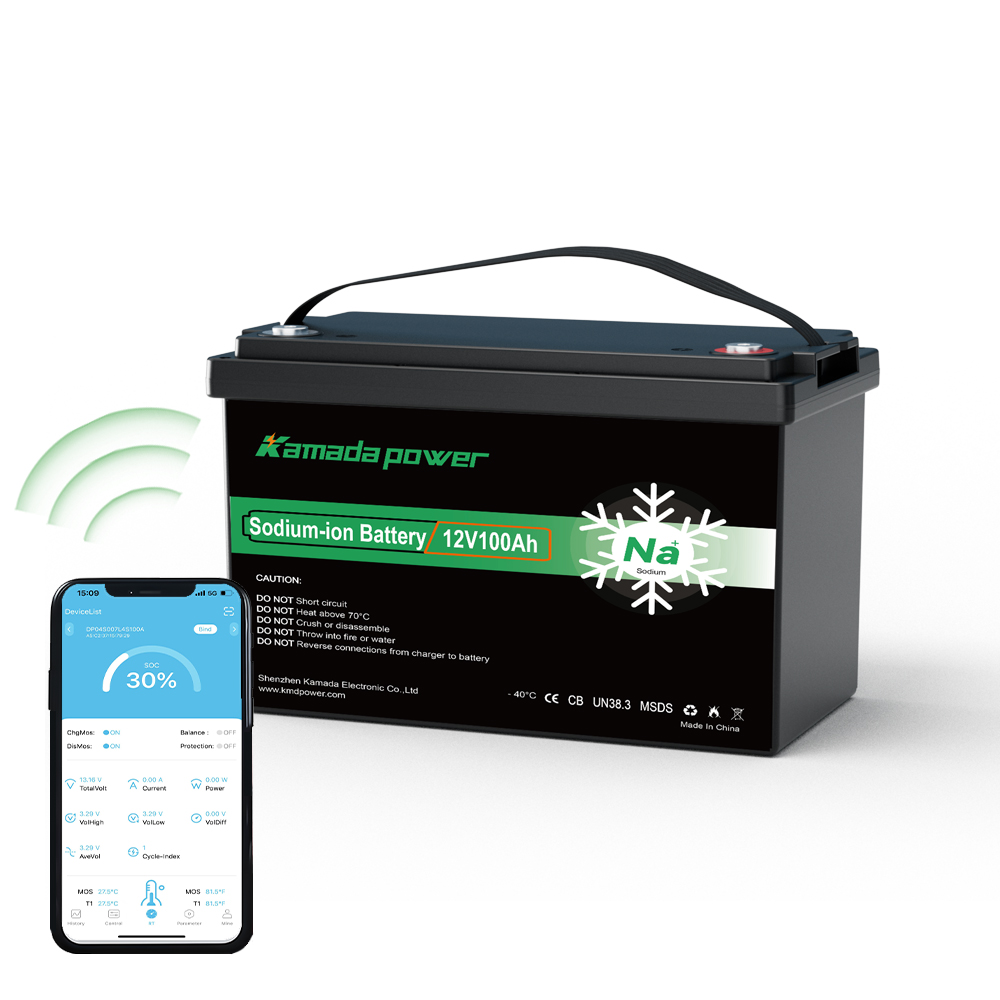
Kamada Power 12v 100Ah Sodium ion Battery
Why Can a Solar CCTV Cabinet Become Hotter Than the Outdoor Air?
Outdoor air is only one part of a cabinet’s heat balance. Sunlight warms exterior surfaces; heat moves into the enclosure while the MPPT charger, DC-DC converters, PoE switch, router and battery dissipate heat. A sealed housing may have limited ways to release that energy. Wind, shade, wall construction and thermal mass affect the result.
In its Outdoor Solutions guide, Rittal provides an illustrative large-enclosure calculation: 40°C ambient, assumed total radiation of 1,120W/m² and 500W internal heat loss. For an 800 × 1,600 × 800mm enclosure without active cooling, the example gives 85°C inside a single-wall design versus 70°C inside a double-wall design. These are large-enclosure calculations, not measurements of a small CCTV cabinet.
What Do Published Solar-Shielding Tests Actually Show?
nVent HOFFMAN’s solar-shielding white paper compares three non-vented NEMA Type 4 ComLine enclosures, each 600 × 500 × 200mm and finished in light-gray RAL 7035. One was unshielded, one had top shielding, and one had top-and-side shielding. Tests were run without an internal heater and again with a 100W heat source. Near peak daytime load, top shielding lowered internal temperature by approximately 5°F (2.8°C), and top-and-side shielding by around 10°F (5.6°C), compared with the unshielded enclosure.
The nVent technical catalog gives these rounded temperatures:
| Published enclosure condition | Approximate internal temperature | What the result supports |
|---|
| Unshielded | 119°F (48°C) | Solar exposure can raise internal temperature above ambient |
| Top shield only | 114°F (46°C) | Top shielding reduced solar heat gain in this comparison |
| Top and side shielding | 110°F (43°C) | Additional shielding further reduced temperature |
Figure 1 — Internal enclosure temperatures in nVent HOFFMAN’s published shielding comparison
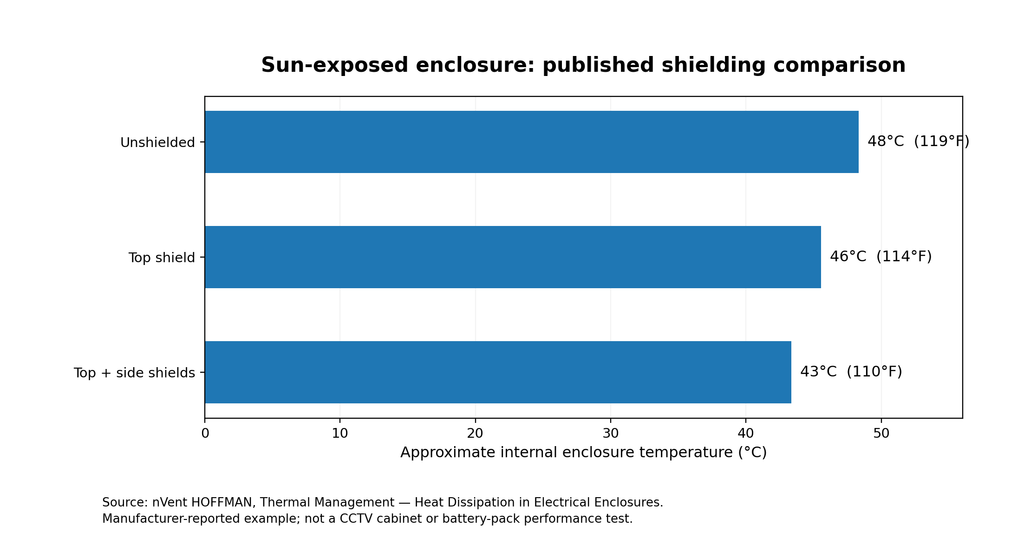
Source: nVent HOFFMAN. These are enclosure temperatures, not Kamada Power battery tests*. The catalog’s percentage reductions refer to temperature* rise above ambient*, not reductions in absolute temperature. Results cannot be assigned to another cabinet without testing.*
These results support investigating shielding; they do not promise a 5°F or 10°F reduction in battery temperature.
Which Temperature Determines Whether the Battery Can Charge or Discharge?
Ambient air, cabinet air, pack-case surface and BMS-reported temperature are different measurements. Internal cells may heat or cool more slowly than cabinet air; the BMS follows its configured sensors and thresholds.
The Kamada Power 12V 100Ah Sodium ion battery manufacturer datasheet supplied for this review specifies a -20 to 70°C charging range, -40 to 70°C discharge range and -20 to 45°C storage range. But its standard 15.6V CC/CV charging procedure is explicitly described for 0–45°C. The sheet also lists a 50A maximum continuous charge current above 0°C, without providing the allowable charging-current curve for 45–70°C. That 50A figure must not be interpreted as permission to charge continuously at 50A at 55°C or 70°C.
The datasheet does not supply BMS high-temperature cutoffs, recovery thresholds, internal sensor positions or hot-weather discharge derating. Obtain approved, revision-specific charge and discharge limits separately, including the charger and PoE equipment limits. Do not substitute the different 12V 100Ah Sodium ion battery for the supplied pack revision.
Illustrative screening arithmetic, not a field result: 42°C ambient + 12°C cabinet rise = 54°C cabinet air. Whether charging is permitted at that point cannot be decided from a 70°C advertised endpoint: actual battery-sensor temperature and the approved current at that temperature remain unknown.
Can the Pack Sustain the CCTV Load During Peak Heat?
An average camera wattage does not answer the question. The enclosure may be hottest at midday while solar power charges the pack; night-time IR lighting, PTZ movement or a heater can raise load later. Two distinct thermal failure paths need investigation:
- Charging restricted first: The charger or BMS reduces/stops battery charging while camera power may continue. Less energy enters storage, potentially creating a night-time deficit even if cameras stay online that afternoon.
- Discharge or equipment protection first: The BMS, PoE switch or DC-DC converter may interrupt the camera supply. Correlate the first protection event with battery voltage/current, component temperature and camera logs; an offline camera alone does not identify the culprit.
For a simple hypothetical night-time budget, a system drawing 30W at the battery terminals for 12 hours needs 360Wh. If the preceding daylight window replenishes only 250Wh, that is 110Wh less than the next night’s assumed demand. This is an energy-balance warning, not a prediction of outage: starting stored energy, earlier days’ balance, usable-Wh limits and other charging/discharging periods still determine uptime.
Heat generated inside the cabinet is not the cameras’ total delivered power. A converter supplying 40W at an assumed 90% efficiency draws about 44.4W and dissipates 4.4W locally. Battery resistive losses scale approximately with current² × effective resistance, but actual losses and BMS heating need pack-specific measurements. Log net battery-branch current, not only controller output, because PV power may feed both loads and storage. Whether charge can stop while discharge continues depends on BMS topology.
The result should identify which device reaches a limit first, the measured conditions and the effect on surveillance continuity and overnight energy reserve.
Can Shading or Cabinet Redesign Solve the Problem Without Changing Batteries?
Often the first investigation belongs to the enclosure, not battery chemistry. Consider moving the box out of direct afternoon sun, a spaced top/side shield, a suitable reflective finish, separation from hot power electronics or a validated double-wall design. The nVent tests and Rittal calculations justify evaluation, not an assumed temperature reduction at your site.
Ventilation changes dust, rain and condensation exposure; fans consume energy. Insulation may retain internally generated heat. A solar panel shades the cabinet only if its position and airflow gap actually reduce heat gain.
Ingress protection is not thermal certification. The supplied KMDPOWER datasheet says IP65 but also uses “splash-proof”; confirm the exact finished-pack rating and test record. An IP67 claim on a different online configuration must not be transferred to this pack. Altering a cabinet vent or gland may compromise its own environmental protection. The Rittal outdoor guide treats ingress protection and climate-control design separately.
If a modified enclosure keeps every component within its approved operating limits, a battery change may be unnecessary. If not, reassess cooling, equipment placement or a correctly documented alternative pack.
How Should a Solar Surveillance OEM Test Battery Performance in a Hot Cabinet?
Test a production-representative enclosure with the exact battery/BMS revision, controller, PoE switch, cables, fuses, camera load and installation orientation. Simulation cannot replace measurements of the finished assembly.
Time-align shaded ambient, upper cabinet air, battery-case hotspot, charger/PoE temperature and, where available, BMS sensor temperatures. Log battery terminal voltage, net battery charging/discharging current, PV input, protection events and camera uptime. Record sensor location and accuracy.
Cover morning charging, peak sun, afternoon heat soak, night-time peak loads and the next morning’s recovery. Repeat after cabinet redesign. Never defeat BMS or charger protection. Use an approved supervised test plan and check actual temperature-dependent current permissions.
| Qualification check | Required evidence | Decision criterion |
|---|
| Peak solar exposure | Ambient, cabinet, case and available BMS temperatures | All approved device limits met with defined uncertainty/margin |
| Battery charging at high temperature | Battery-branch current, voltage, temperature, BMS charge permission | Approved hot-weather current/voltage rules followed; unresolved 45–70°C limits mean hold |
| CCTV load continuity | PoE state, DC-bus voltage, camera uptime, pack discharge current | Identify whether charger/BMS or another device limits service first |
| Night-time energy recovery | Wh charged into battery, Wh drawn overnight, starting/ending stored-energy estimates | Required overnight reserve maintained across the duty cycle |
| Cabinet redesign | Comparable before/after thermal and electrical logs | Demonstrated improvement without loss of sealing or service access |
A room-temperature pass is insufficient. Record firmware and verify resets after cooling.
Should the OEM Change the Cabinet, Battery or CCTV Power Design?
The decision follows the measured failure mechanism.
Keep the proposed pack if the measured duty cycle and worst required temperatures meet approved charging, discharge, charger and PoE limits with appropriate margin.
Redesign the enclosure if solar gain or nearby electronics drive temperature toward a limit, and shading or thermal control measurably restores margin without compromising protection.
Reassess charging or energy capacity if high-temperature charging restrictions reduce recovered Wh below the required night-time budget. Do not assume that a larger Ah figure fixes a daily solar-energy deficit.
Reconsider the pack or supply architecture if the documented thermal/current envelope cannot support the loads. Manufacturer-approved parallel packs may share current but also change cabinet crowding and airflow; they do not raise permissible battery temperature.
Reject or hold the pairing when required operating conditions fall outside documented limits, or when BMS high-temperature behavior and the 45–70°C charging rules cannot be established.
For a Kamada Power 12V 100Ah Sodium-ion Battery review, provide cabinet photos, climate, camera/PoE loads, charge profile and planned volume. Kamada Power security-system article gives general application context; this article evaluates the heat-exposed cabinet-and-pack system, not generic battery benefits.
FAQs
Can the inside of a sealed CCTV cabinet be hotter than ambient air?
Yes. Solar gain and electronics losses can raise cabinet temperature. Wind, shade, wall design and load alter the rise; measure rather than assume a fixed offset.
Can a sodium-ion battery charge at 55°C if its published range extends to 70°C?
Not automatically. The supplied Kamada Power sheet lists a -20 to 70°C charging range, but its standard CC/CV procedure is specified only for 0–45°C. Obtain the approved current, BMS limits and recovery rules for 55°C before permitting charging there.
Does IP67 mean the battery is suitable for a sun-heated enclosure?
No. IP rating addresses dust/water ingress, not hot-weather current capability. The supplied pack sheet says IP65 and “splash-proof”; IP67 appears on a different public listing. Confirm the exact revision and qualify the full cabinet thermally.
Will adding another 100Ah battery prevent high-temperature shutdown?
Not necessarily. Approved parallel operation can change current sharing and reserve, but cannot remove solar heat gain or increase the pack’s approved temperature limits. Additional batteries may also crowd the cabinet.
Is a sun shield better than replacing the battery?
Possibly, if solar heat gain is the limiting factor. Published tests justify trying shielding, but an OEM should choose the remedy from measured battery, charger, PoE and overnight-energy results.
Conclusion
The real procurement test is whether the finished sodium-ion pack can power CCTV loads and accept approved charging current through the cabinet’s hot-weather duty cycle. The supplied KMDPOWER datasheet lists charge operation up to 70°C but does not establish permitted 45–70°C charging current or BMS recovery rules. Separate charging deficits from immediate protection trips, measure overnight Wh, and test shielding before replacing hardware. nVent and Rittal data support thermal investigation—not claims of Kamada Power pack-level performance. Contact Kamada Power with cabinet CAD/photos, climate, charger model, camera loads and expected volume for a revision-specific thermal compatibility review.