A procurement manager once told me, “We pulled a brand new battery pack from inventory—and it was already low.” In B2B, that kind of surprise quickly turns into DOA returns, commissioning delays, and truck rolls—because “lost charge while sitting” is often misdiagnosed. It can be true cell self-discharge, pack-level parasitic drain from the BMS/electronics, or calendar-aging capacity fade (permanent, not just low SOC today). This guide helps you separate the three fast, measure the right thing, and lock in storage + procurement controls so it doesn’t keep happening.
Battery self-discharge is the gradual loss of stored charge while a battery sits unused, driven by internal chemical reactions and leakage paths. It typically accelerates with temperature. It is not the same as parasitic drain (electronics drawing current), and it is not the same as calendar aging (permanent capacity loss).
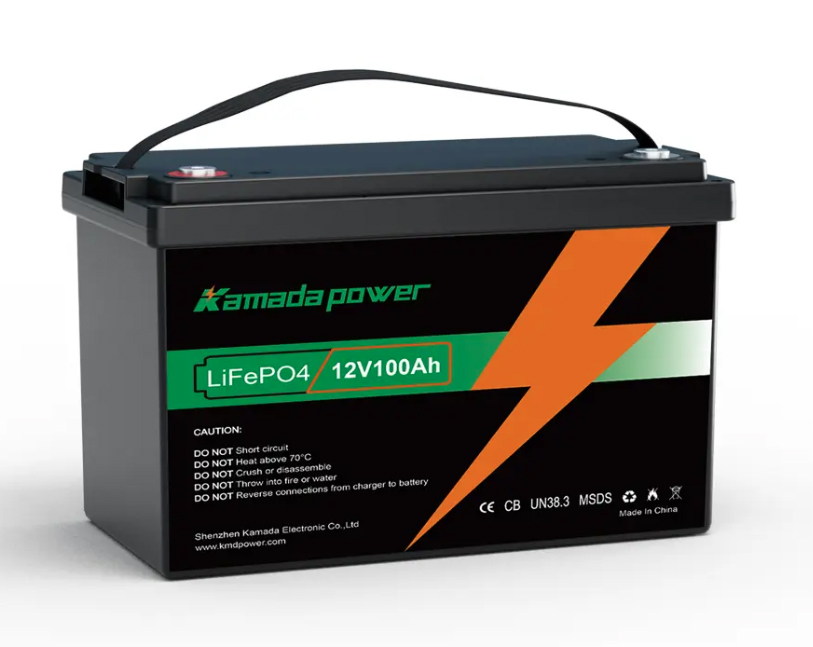
Kamada Power 12V 100Ah Lifepo4 Battery
Why Does Battery Self-Discharge Occur?
1. Side reactions (the battery isn’t a perfect container problem)
Even at rest, small reactions keep creeping forward.
- In the lithium-ion family (LFP/LiFePO₄, NMC, NCA, LCO), the electrodes/electrolyte aren’t perfectly inert. The SEI is normal and protective, but it still evolves slowly over time.
- In lead-acid, corrosion and other chemical processes dominate.
- In NiMH, chemistry-related mechanisms make self-discharge much more noticeable, especially right after charge.
Procurement reality: manufacturing quality produces a distribution, not a single number. Most units behave normally; a small “tail” can drop faster—and that’s exactly what triggers batch disputes.
2. Internal leakage paths and micro-shorts
Beyond normal chemistry, cells can leak through unwanted internal pathways:
- Separator imperfections
- Contamination (metal particles, residues)
- Micro-shorts that don’t cause immediate failure, but slowly drain the cell
A practical clue: if a pack drops fast over days and you’ve ruled out external loads, it’s often electronics drain—or a defect-driven leakage path.
3. Temperature and storage SOC (two multipliers, one warehouse problem)
If you remember one storage rule: temperature is the multiplier.
Warmer storage accelerates reaction rates, and that’s why hot warehouses and containers create “mystery” losses. For lithium-ion, the effect can be dramatic: self-discharge rates may be negligible at cold temperatures but can rise sharply at high temperatures, especially when combined with high SOC.
SOC matters too, but in a precise way:
- High SOC tends to matter most for calendar aging (permanent capacity loss).
- High SOC can also increase apparent loss at the pack level if balancing or electronics stay active near the top.
So high-SOC storage can be a double hit: more aging risk and sometimes more pack-level drain.
4. Cell vs pack (why users blame “self-discharge” when it’s not)
Many lithium cells have low intrinsic self-discharge. But real-world packs include:
- BMS quiescent current (sometimes with periodic wake-ups)
- Fuel gauge / comms (Bluetooth, CAN, etc.)
- Passive balancing bleed near top SOC
So what people experience as “self-discharge” is frequently pack parasitic drain on top of cell behavior. In many industrial designs, the protection circuitry and monitoring modules add meaningful extra loss beyond the cell itself.
SOC loss vs capacity loss (don’t mix them)
This mix-up causes expensive decisions:
- SOC loss (self-discharge or parasitic drain) means less energy today—often recoverable by recharge.
- Capacity fade (calendar aging) means less energy forever—you can charge to “100%,” but runtime won’t come back.
Also, voltage can lie. A pack can show decent OCV and still collapse under load if a weak cell limits a series string.
B2B cost translation
In industrial operations, “lost charge while sitting” turns into:
- higher return rates
- “mystery failures”
- commissioning margin loss
- more site visits and rework
it often gets blamed on “supplier quality” when the root cause is storage temperature + electronics behavior.
What Determines the Self-Discharge Rate?
1. Chemistry & cell design
Chemistry sets the baseline. Lead-acid, NiMH, Li-ion, and primary cells do not behave the same.
2. Age, stress, and tail risk
Self-discharge tends to increase with age and abuse. The painful part is “tail risk”: a small percentage of units can discharge abnormally fast.
3. Temperature profile
A pack stored cool and stable behaves very differently from one that spent weeks in a hot container. Treat “temperature history” as part of the product.
4. BMS quiescent current
If the pack includes a BMS, ask early:
- Quiescent current in shipping/storage mode
- Whether it truly disconnects loads (real ship mode) or just “sleeps”
- Whether it periodically wakes for comms/telemetry
It is critical to note that protection circuits can materially increase loss on top of the cell’s self-discharge.
Measurement note: many smart BMS units wake periodically, so a quick “spot reading” can miss the true average.
5. Storage SOC strategy and balancing behavior
Storing near full charge can trigger balancing bleed and keep electronics more active. For shipping and warehousing, SOC should be intentional, not accidental.
Typical Self-Discharge by Battery Type (Cell vs Pack Reality)
Important: numbers vary with temperature, SOC, age, and measurement method. Also, “first-day loss” can include post-charge relaxation effects and is often not the same thing as long-term monthly self-discharge.
| Battery type | Typical self-discharge (cell level) | What changes at pack level (real products) | Storage note |
|---|
| Lithium-ion (incl. LFP/NMC) | Often low long-term; typically ~1–2%/month after an initial post-charge loss in stable conditions | Protection/BMS can add additional loss; “sleep” vs “ship mode” is everything | Prefer cool storage; many guides target ~40–60% SOC for long storage to reduce aging stress |
| NiMH (standard) | High; expect large first-day loss after charge and continued monthly loss | Packs with monitoring add drain, but chemistry is already high | Consider LSD NiMH for stored spares |
| NiMH (LSD, e.g., Eneloop-type) | Much slower; product-specific | Depends heavily on brand/design | Panasonic claims ~70% remaining after 10 years for Eneloop under proper storage |
| Lead-acid | Often a few %/month at moderate temps; can rise significantly with higher temperature | Systems with parasitic loads drain faster | Trojan notes lead-acid can self-discharge ~5–15%/month depending on storage temperature; keep charged to avoid sulfation |
| Primary lithium (Li/FeS₂ AA/AAA) | Very low for shelf storage | No BMS drain | Energizer notes ~20+ year shelf life and ~95% capacity after 20+ years for LiFeS₂ under their definition |
Two procurement-grade takeaways
- If the pack has a BMS, you may be managing electronics drain, not cell chemistry.
- Temperature can turn “acceptable” into “problem” fast—especially at high SOC for lithium-ion.
How to Measure Self-Discharge Correctly (Without Fooling Yourself)
Method A — Controlled capacity test (most defensible)
- Fully charge using the correct profile
- Rest for a defined time (standardize it)
- Store for a set period at controlled temperature
- Discharge under a standardized load and measure Ah/Wh
Log: temperature, rest time, cutoff voltage, discharge current, duration. This is slow, but it’s the closest thing to “courtroom-grade” evidence.
Method B — OCV tracking (fast, easy to misread)
OCV depends on chemistry and temperature, and many batteries show relaxation/hysteresis effects.
Even Energizer warns that OCV can be misleading and can drop and recover depending on history and load. Use OCV for trend screening—not precise claims.
Method C — Measure parasitic drain (critical for packs)
Measure current in shipping/storage mode over time (especially if the BMS wakes periodically), then estimate monthly loss:
Monthly Ah loss ≈ quiescent current (A) × 24 × 30
Example: 10 mA = 0.01 A → 0.01 × 720 ≈ 7.2 Ah/month
Decision rule: If the observed loss matches the math, you’re not looking at “cell self-discharge”—you’re looking at electronics drain.
Common pitfalls (quick checklist)
- Measuring too soon after charge/discharge (relaxation effects)
- Temperature mismatch between measurements
- Balancing bleed near top SOC
- Smart BMS periodic wake-ups
- Confusing SOC loss with permanent capacity fade
The 1-Minute Triage (Decision Table)
| Symptom | Most likely causes | Fast next step |
|---|
| Drops fast in days | BMS awake / comms waking, ship mode missing, defect leakage path | Measure quiescent current over time; verify ship mode; isolate pack from loads |
| Drops slowly over weeks/months | Normal self-discharge + warm storage | Review temperature history + storage SOC strategy |
| Voltage OK but runtime collapsed | Capacity fade or weak cell in series | Controlled capacity test; check cell deltas/balance |
Why a New Battery Arrived Dead
When someone says “it arrived dead,” it’s usually one of these:
- Not fully charged before shipment
- BMS draining during storage (ship mode missing/not enabled)
- Heat exposure in transit/warehouse
- Weak cell triggering early cutoff in a series string
- Calendar aging reducing usable capacity
Practical Strategies to Minimize Self-Discharge (Storage + Operations)
1. Warehouse best practices for battery packs
- Store cool and stable; avoid heat spikes
- Disconnect external loads
- Use true ship mode / disconnect when available
- Label: date code + last-check date + storage SOC target
2. SOC targets by chemistry (operations-friendly)
- Lithium packs: often stored mid-SOC (commonly ~40–60%) to reduce aging stress; confirm with supplier guidance
- Lead-acid: avoid storing discharged; keep charged and top up periodically to reduce sulfation risk (and note temperature sensitivity)
3. A simple SOP that prevents repeat surprises
Incoming QC
- Record OCV/SOC, date code, ship-mode state, packaging condition
Periodic checks
- Fixed cadence (e.g., monthly/quarterly by product)
- Thresholds + recharge triggers
- Escalation rule for “tail risk” units that drop faster than expected
Inventory rotation
- FIFO
- Quarantine unusually fast droppers for deeper testing
4. Remote systems (UPS / IoT / solar CCTV)
Design for quiescent current, seasonal energy constraints, and long maintenance windows—because “small drain” becomes “big failure” over time.
Selecting Low Self-Discharge Battery Packs
What to ask suppliers (early, in writing)
- BMS quiescent current in ship mode and sleep mode
- How ship mode is enabled/verified
- Balancing behavior near top SOC
- Storage temperature limits and recommended storage SOC
Spec-sheet red flags
- No quiescent current spec
- Vague storage guidance (“store normally”)
- Missing date codes / traceability
- Warranty language that ignores inventory storage reality
A standard acceptance test you can scale
Define: storage condition + time window + measurement method (OCV trend + parasitic current math + capacity test for flagged units). Keep it consistent.
Conclusion
Battery self-discharge is real—but in modern industrial packs, most “self-discharge” complaints are really temperature exposure plus pack parasitic drain. Field data confirms that while lithium cells can be low-loss long term, pack protection and electronics can add meaningful drain, and heat can amplify losses sharply.
Separate SOC loss from capacity fade, measure the average drain (not a spot reading), and enforce a simple storage SOP. You’ll cut DOA returns, reduce truck rolls, and stop chasing the wrong root cause. Contact us for customized lithium battery solutions.
FAQ
What is the ideal storage condition to minimize self-discharge?
Cool, stable temperatures plus a chemistry-appropriate storage SOC. For lithium packs, mid-SOC storage is commonly used to reduce aging stress, and ship mode reduces pack drain.
How does self-discharge affect industrial battery packs?
It reduces commissioning margin, increases low-voltage trips, and drives returns—especially when one weak cell or electronics drain makes the whole pack look “dead.”
Can self-discharge damage batteries permanently?
SOC loss is usually reversible by recharging. Permanent damage is more often tied to heat exposure, long high-SOC storage for lithium-ion (aging), or lead-acid left discharged (sulfation risk). Trojan Battery explicitly ties long storage practices to charging cadence and temperature effects.
Why do lithium batteries lose charge in storage if self-discharge is low?
Because “low self-discharge” often refers to the cell. Pack electronics (BMS/protection, fuel gauge, comms, balancing) can draw power continuously or intermittently.
How can I tell if it’s self-discharge or BMS monitor drain?
Measure quiescent current over time in storage/ship mode and calculate monthly Ah loss. If the math matches the drop, it’s parasitic drain—not cell chemistry.