What is an AC-Coupled Battery in a Home Energy Management and Storage System? It’s a perfect solar day until the grid drops, and your panels frustratingly shut down due to mandatory anti-islanding safety protocols. For existing solar owners, the missing link isn’t generation but independence. An AC-coupled battery is often the most practical retrofit to add backup power without disrupting your current setup, and this guide explains how it delivers real energy resilience.
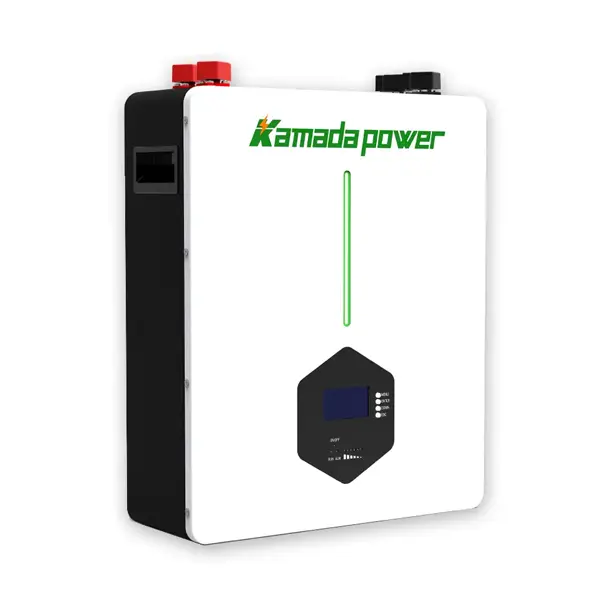
Kamada Power 10kWh Powerwall Home Battery
What is an AC-Coupled Battery System?
The Simple Definition
An AC-coupled battery system is a battery storage setup that connects to your home’s AC wiring (your main electrical panel), not directly to the solar panels. It has its own “brain”—a battery inverter (sometimes called a storage inverter)—that manages charging and discharging.
In plain English: your solar system stays your solar system, and the battery is added as a separate system that plugs into the house’s electrical “bus.”
Solar Panels (DC) → Solar Inverter (AC) → Main Panel (AC bus) → Battery Inverter (DC) → Battery (DC)
When the battery is discharging, the direction flips at the battery inverter, supplying AC power back into the panel.
Key Components
- The Battery Inverter (Storage Inverter): This is the gateway that converts AC ↔ DC. It takes surplus AC power from the home panel and converts it to DC for battery charging, then converts DC back to AC when the battery supplies the home.
- The Smart Switch / Gateway (Islanding Device): During an outage, this device disconnects your home from the grid (creates a safe “island”) so the battery and solar can keep running without backfeeding the utility lines. In different regions you’ll hear terms like backup gateway, automatic transfer switch (ATS), or grid isolation relay—same idea.
From our experience working with industrial clients who retrofit solar + storage onto small commercial sites (remote offices, clinics, service depots), this “separate brain” architecture is often what makes integration feasible without ripping out existing PV equipment.
How Does AC-Coupling Work? (Step-by-Step Flow)
- Solar Generation: Panels produce DC electricity; the solar inverter converts it to AC for use in the building.
- Usage & Surplus: The building uses power first. If there’s surplus, that AC power flows onto the main panel and becomes available for export to the grid—or for battery charging.
- The “Reverse” Conversion (Charging): The battery inverter takes that surplus AC and converts it back to DC to charge the battery.
- Discharging / Backup: At night or during an outage, the battery inverter converts DC back to AC to power critical loads (or whole-home loads, depending on design).
A quick analogy: DC-coupling is like plumbing directly from the well to the tank. AC-coupling is like filling the tank from a tap inside the house—slightly less efficient, but much easier to retrofit.
AC-Coupled vs. DC-Coupled: The Head-to-Head Comparison
Here’s the core decision most procurement teams and engineers face: efficiency vs. flexibility.
- DC-coupled systems connect solar and battery on the DC side (shared DC bus). They can be very efficient—but are typically best in new installs where you control the whole architecture.
- AC-coupled systems connect battery on the AC side. They’re usually best for retrofits where PV already exists.
Comparison Table (Essential for Scannability)
| Factor | AC-Coupled | DC-Coupled |
|---|
| Efficiency | Lower (extra conversions) | Higher (fewer conversions) |
| Installation Difficulty | Easier retrofit | More complex retrofit |
| Cost (Retrofit) | Often lower labor cost | Often higher due to rework |
| Cost (New Install) | Competitive, but extra inverter | Often best total efficiency/value |
| Scalability | Flexible; easier to expand | Can be tighter/brand-dependent |
If you’re specifying a system for an existing PV site, AC-coupling often wins on project risk alone. Less disruption. Fewer unknowns. And fewer “surprises” during commissioning.
Why Choose AC-Coupling? (The Strategic Benefits)
The “Plug-and-Play” Retrofit Advantage
For most existing solar owners, the biggest fear is: “Will adding a battery force me to replace my inverter—or mess with my warranty?” AC-coupling typically avoids that. You’re adding storage downstream of the PV system, not re-architecting the PV itself.
That’s a big deal for procurement. Less scope creep, lower integration risk, and fewer finger-pointing vendor calls.
Placement Flexibility
Because the battery ties into the AC panel, it can be installed far from the solar array. Roof PV, basement panel, garage battery—no problem. This is especially helpful in Europe where older homes have constrained routing options, and in the US where garage installs are common.
Energy Arbitrage (Money Saving)
With AC-coupled storage, you can charge the battery from the grid when rates are low and discharge during expensive peaks—classic Time-of-Use (TOU) shifting or energy arbitrage. Solar helps, but it’s not required for this benefit.
This matters in regions with strong TOU pricing or demand charges (especially for light commercial sites).
Redundancy
AC-coupling can create a practical form of redundancy: if the solar inverter fails, the battery can still charge from the grid and provide backup. If the battery inverter has an issue, the solar system may continue operating normally when the grid is up.
For critical users—home offices, clinics, remote comms—this separation is a feature, not a complication.
The Honest Drawbacks: What Salesmen Won’t Tell You
The Efficiency Penalty
AC-coupled systems often involve “triple conversion” during backup operation:
DC (PV) → AC (PV inverter) → DC (battery charging) → AC (battery inverter)
That adds losses. In real terms, compared with DC-coupling, you might see roughly 5–10% less efficiency, depending on inverter performance and operating conditions. It’s not catastrophic, but it’s real—and over years it affects economics.
Solar Clipping
If the solar array is large, the battery inverter may not be able to absorb all surplus power at peak production. The result can be clipping—solar output curtailed because there’s nowhere for excess power to go.
This is often solvable with better sizing (or export allowances), but it’s a design constraint procurement teams should confirm early.
Equipment Cost
You’re buying a second inverter and often a smart gateway. That increases hardware cost compared to a tightly integrated DC-coupled design.
The focused comparison here is simple:
- DC-coupled often wins on long-term efficiency and cleaner architecture (especially in new builds).
- AC-coupled often wins on retrofit cost, reduced labor, and lower project risk.
Decision Checklist: Is AC-Coupled Right for You?
| Decision Question (Scenario) | Recommended Path (If Answer is “Yes”) |
|---|
| Do you already have a solar system installed? | AC-Coupled |
| Are you happy with your current solar inverter? | AC-Coupled |
| Do you plan to expand your system or add an EV later? | AC-Coupled |
| Are you building a completely new off-grid cabin? | DC-Coupled |
If you’re retrofitting an existing grid-tied PV system, AC-coupling is very often the pragmatic choice. Not always the “perfect engineering choice,” but frequently the best real-world one.
Conclusion
AC coupling is the undisputed champion of retrofits, trading a sliver of efficiency for a clean integration path that doesn’t turn your electrical system upside down. Instead of guessing on compatibility, share your inverter model and load list with us—we’ll validate feasibility and help you lock down a defensible spec. Contact us for a customized home battery solution.
FAQ
Can I add an AC battery to any brand of solar inverter?
Mostly, yes. AC-coupled units tie into your main panel, so they ignore the solar inverter brand. The only snag is backup mode: your existing solar inverter must support frequency shifting to throttle down when the grid cuts out. If it’s too old, it simply shuts off.
Does an AC-coupled battery work if the grid is down?
No—unless you install a gateway (isolation switch). The system has to physically sever the grid connection to satisfy anti-islanding codes. Without that hardware, the battery stays dormant to protect utility workers. It won’t power anything, no matter how full it is.
How much efficiency do I really lose with AC coupling?
Plan on losing 5–10% vs. DC systems. It’s unavoidable thermodynamic loss from the “triple conversion” path (DC→AC→DC→AC). You basically trade that small efficiency hit for the ease of not rewiring your entire solar array.
Is the Tesla Powerwall AC or DC coupled?
Powerwall is the textbook definition of AC-coupled. It packs an internal inverter and sits on your home’s AC bus. Though the new Powerwall 3 adds DC solar inputs, for most existing homes, installers effectively treat it as an AC retrofit device.