How High-Rate vs. Standard Discharge Affects LiFePO4 Battery Life. “4000+ Cycles” is the standard promise, yet high-torque applications often face 30% degradation in just two years. The culprit is rarely quality but rather the Discharge Rate (C-Rate)—sizing for capacity (Ah) while ignoring power demand (Amps). This guide moves beyond the brochure to explain the physics of heat degradation and how to size your system to actually achieve that 4000-cycle target.
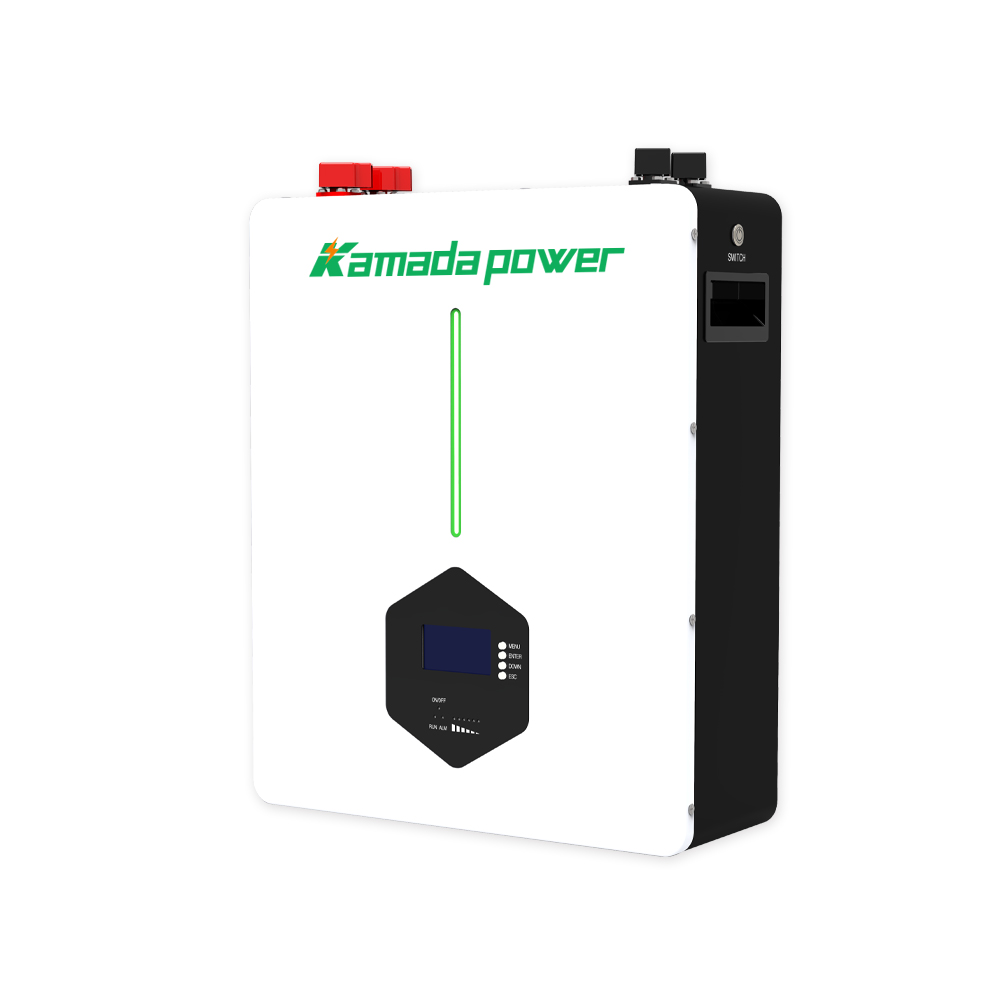
Kamada Power 10kWh Powerwall Battery
Standard vs. High-Rate Discharge
Before we get into the thermodynamics, we need to speak the same language. In the lab, battery performance is defined by “C-Rate.”
What is Standard Discharge? (The Sweet Spot)
Definition: Typically 0.2C to 0.5C.
Context: When a manufacturer tests a cell to determine its cycle life (e.g., the graph on the datasheet), they are almost always testing at this gentle rate. It represents the “Sweet Spot” where chemical reactions happen efficiently with minimal heat generation.
Definition: Typically 1C to 3C (continuous).
Use Cases: This is the real world. It’s the EV accelerating up a ramp, the microwave running off an RV battery, or the hydraulic pump kicking in.
- 1C: The battery empties in 1 hour.
- 2C: The battery empties in 30 minutes.
How to Calculate C-Rate
The formula is simple, but critical for sizing:
C-Rate = Current (Amps) ÷ Capacity (Amp-Hours)
Example:
If you have a 100Ah battery and your inverter draws 100 Amps:
100A ÷ 100Ah = 1C.
This is considered a moderate-to-high load.
The Physics: Why High-Rate Discharge Generates Heat
Why does running a battery harder shorten its life? It’s not magic; it’s physics. Specifically, the Joule Heating Law.
The Joule Heating Law (P = I²R)
Every battery has Internal Resistance (R). It might be small (milliohms), but it is the enemy. The heat generated inside the cell is governed by this formula:
P(heat) = I² × R(internal)
- P(heat): Power lost as heat (Watts)
- I: Discharge Current (Amps)
- R(internal): Internal Resistance (Ohms)
The “Square Law” Danger (The Math You Can’t Ignore)
Notice that Current (I) is squared (I²). This means heat doesn’t increase linearly with load; it explodes exponentially.
Let’s look at the difference between a Standard (0.5C) and High-Rate (2C) discharge on the same battery:
- Scenario A (Standard 0.5C): Let’s say the current is 1 unit.Heat is proportional to 0.5² = 0.25
- Scenario B (High Rate 2C): The current is 4 units (4x higher).Heat is proportional to 2² = 4
The Result: Going from 0.5C to 2C is a 4x increase in current, but a 16x increase in heat generation (4 ÷ 0.25 = 16).
Takeaway: This massive spike in internal temperature causes the electrolyte to degrade and the Solid Electrolyte Interphase (SEI) layer to thicken, permanently trapping lithium ions and reducing capacity.
Consequences: Polarization & Traffic Jams
At high rates, Lithium ions experience a “traffic jam” at the electrode surface. They can’t intercalate (enter) the anode structure fast enough. This causes Polarization, which manifests as an immediate voltage sag. It forces the battery to work harder to deliver the same energy, creating a feedback loop of heat and stress.
Data Analysis: Cycle Life Comparison Table
We compiled industry averages for Tier A LiFePO4 prismatic cells to show the real cost of speed.
Real-World Lifespan Scenarios
| Discharge Rate | Temperature | Heat Stress | Estimated Cycle Life (to 80% SOH) |
|---|
| 0.5C (Standard) | 25°C | Low | 4,000 – 5,000 |
| 1C (Moderate) | 25°C | Medium | 3,000 – 3,500 |
| 2C (High) | 25°C | High | 2,000 – 2,500 |
| 2C (High) | 45°C+ | Extreme | < 1,500 |
Note how the combination of High Rate AND High Ambient Temp (the bottom row) effectively destroys the battery in one-third the time.
Understanding Voltage Sag
High C-rates don’t just kill long-term life; they reduce usable capacity today.
Because of the internal resistance drop (V = I × R), a battery under a 2C load will hit its Low Voltage Cutoff (e.g., 10V) much earlier than a battery under a 0.5C load, even if there is chemically still energy left in the cells.
The Peukert Effect: LiFePO4 vs. Lead-Acid
If you are transitioning from Lead-Acid, you might be used to the “Peukert Effect” nightmare.
Why LiFePO4 Wins on Efficiency
- Lead-Acid: Suffers heavily from Peukert’s Law. If you discharge a lead-acid battery at 1C, you might only get 50% of its rated capacity. The rest is lost to heat and inefficiency.
- LiFePO4: Is incredibly efficient. Even at 1C, a quality Lithium battery will deliver ~95% of its rated capacity.
The Nuance: Lithium gives you the ability to run high power without massive capacity loss during the cycle, but as we proved above, the thermal cost is paid in the long-term cycle life.
Engineering Tips: How to Maximize Life in High-Power Systems
You don’t always have the luxury of running slow. If your application requires high power, here is how you engineer around the problem.
1. Oversize the Bank (The 0.5C Rule)
The cheapest way to cool a battery is to make it bigger.
Rule of Thumb: If your load pulls 200A, do not buy a 200Ah battery (which would be 1C). Instead, buy a 400Ah battery bank.
- Result: Your load is now 0.5C. You have cut heat generation by roughly 75% and doubled your expected cycle life.
2. Upgrade Interconnects
Heat doesn’t just come from the cells; it comes from the resistance in your busbars and cables.
For high-rate systems, use busbars rated for 1.25x the maximum continuous current. If your connections get hot, that heat conducts directly into the battery terminals and cells.
3. Active Cooling
If you are running at 2C+ continuously, passive cooling isn’t enough. Ensure there is a 2-3mm air gap between cells (don’t tape them tight together) and consider forced air cooling (fans) in the battery enclosure to strip away that I²R heat.
4. BMS Optimization
Configure your Battery Management System (BMS) with appropriate Over-Current Protection (OCP) delays. Don’t set the trigger too sensitive, or the BMS will shut down during motor inrush currents. But do set a “Temperature Cutoff” that is conservative (e.g., 55°C) to stop the system before thermal runaway risks increase.
Conclusion
Remember that “4000 Cycles” is a datasheet ideal, not a guarantee. While LiFePO4 handles high rates, the physics of I²R heating means pushing a battery twice as hard generates four times the heat—the primary driver of aging. For maximum ROI, design your system around a 0.5C continuous load; the slight increase in upfront capacity pays for itself by preventing premature replacement.
Not sure if your system can handle the load? Contact Kamada Power our battery engineering team for a free C-rate calculation and battery bank sizing recommendation.
FAQ
Is 1C discharge safe for LiFePO4?
Yes, absolutely. A quality LiFePO4 battery is chemically safe at 1C. It won’t catch fire or explode. However, running it at 1C continuously will result in fewer total cycles (e.g., 3000 instead of 5000) compared to running it at 0.5C. It is a trade-off between performance and longevity.
How does temperature affect high-rate discharge?
Heat plus High Rate is “Double Death.” If your ambient temp is 40°C and you run at 2C, the internal cell temp can easily exceed 60°C, which rapidly degrades the electrolyte. Always keep batteries below 45°C when discharging hard.
Does high discharge rate affect charging speed?
Indirectly, yes. A high discharge rate heats up the battery. If the battery gets too hot, the BMS temperature sensor may block you from recharging the battery immediately until it cools down to a safe range.