An outdoor surveillance cabinet may contain a 5V edge computer, a 12V camera and a 24V wireless bridge. One battery seems simpler than three, but a shared battery does not produce three regulated voltages. A بطارية كامادا باور 12 فولت 100 أمبير أيونات الصوديوم pack is a candidate only if all branches work through charging, startup and BMS events.
One 12V pack may power all three loads through properly selected DC-DC branches. Check input limits, cable drop, rail accuracy, peaks, derating and BMS recovery. The pack’s 8V discharge cutoff is not a normal operating target; an earlier system shutdown may be needed.
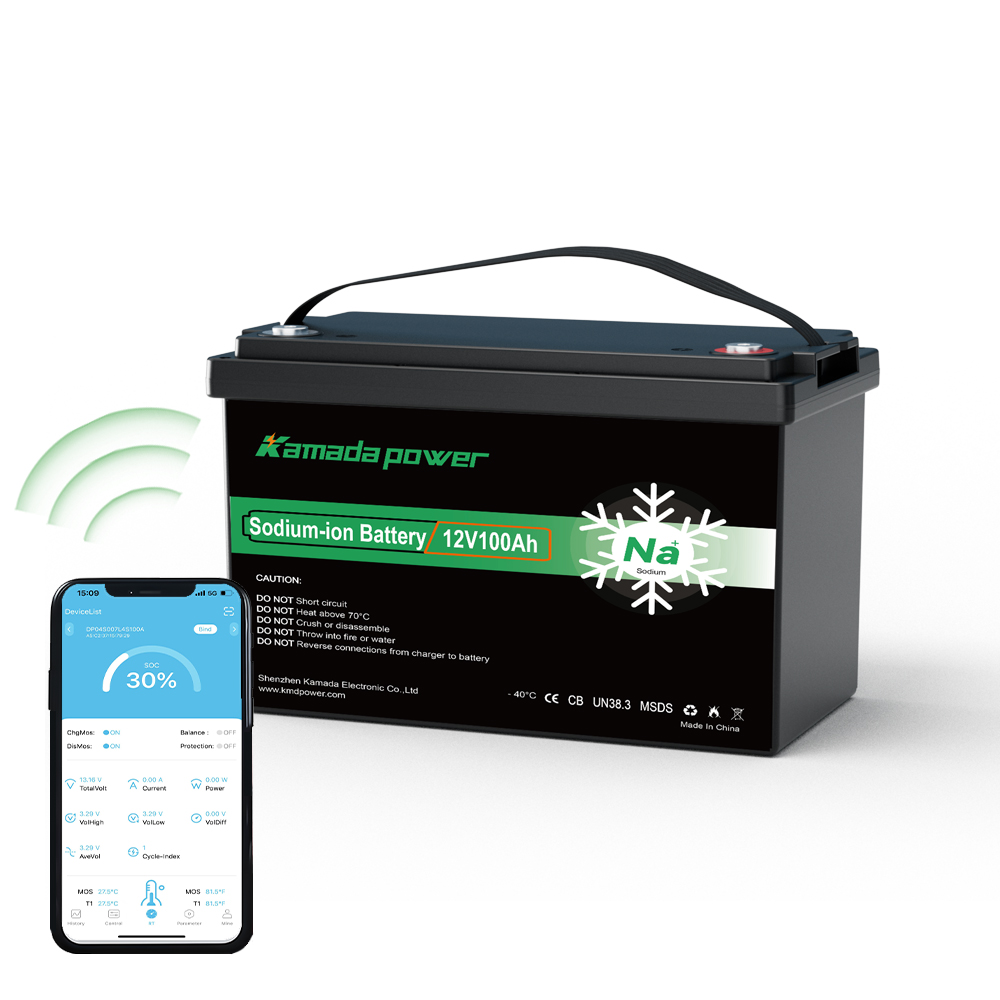
بطارية كامادا باور 12 فولت 100 أمبير أيونات الصوديوم
What Does the Surveillance Equipment BOM Actually Require?
Start with the device BOM, not battery Ah:
- 5V edge computing: Raspberry Pi 5 recommends a 5.1V, 5A-capable USB-C supply for full peripheral power; it does not constantly draw 25W. Without recognized 5A capability, USB peripherals may be limited to 600mA. A bare 5V DC-DC converter is not automatically a suitable USB-C source: verify source recognition, board-end voltage, peripherals and peaks. Raspberry Pi documentation.
- 12V camera or router rail: Some cameras require a narrow regulated 12V supply; others accept wider DC input. Check each device’s approved range, ripple, startup and peak load. A “12V” label is not a tolerance.
- 24V communications rail: Ubiquiti’s NanoBeam 5AC Gen2 specifies 20–27V DC, 8.5W maximumو 24V passive PoE on pairs 4/5 positive and 7/8 return. That supply method is not interchangeable with IEEE 802.3af/at active PoE. Official device specifications.
Teltonika’s RUT241 accepts 9–30V DC via its power connector or specified LAN1 passive PoE; LAN1 is not IEEE 802.3af/at compatible. Check charging voltage, wiring and supply-change behavior rather than assuming a seamless transfer. RUT241 power options.
For each device, record input range, maximum and measured W, startup, connector and uptime requirement.
Which Loads Need DC-DC Conversion Rather Than a Direct 12V Connection?
استخدم exact finished-pack specification. إن بطارية كامادا باور 12 فولت 100 أمبير أيونات الصوديوم datasheet supplied for this review specifies الجهد الاسمي 12 فولت، السعة 100 أمبير ساعة، الطاقة الاسمية 1,200 واط ساعة، الجهد الأقصى للشحن 15.6 فولت، وجهد قطع التيار عند التفريغ 8 فولت, with built-in BMS protection. These are not a discharge curve; service cutoff and BMS recovery remain undocumented. A separate بطارية كامادا باور 12 فولت 100 أمبير أيون الصوديوم bears a تسمية الطراز 12.8 فولت. Keep revisions separate.
A first-pass architecture:
APPROVED 12V SODIUM-ION PACK + BMS
                 |
          Protected DC bus
                 |
                 |-- 5V DC-DC --> qualified USB-C --> Edge computer
                 |-- 12V regulator -----------> 12V camera
                 `-- 24V DC-DC --> passive-PoE injector --> Wireless bridge
Concept only; validate the USB-C interface, branch protection and wiring for the actual BOM.
The Pi needs a compliant USB-C power interface, not just 5V output. The 24V bridge needs a rated converter and correctly wired passive-PoE injector; a narrow-range 12V camera may need buck-boost regulation. Check any direct connection against the full voltage range.
A converter specification can reveal a battery-range mismatch
MEAN WELL’s DDR-60G models give a useful published comparison:
| DC-DC model | Published input | Output / rated power | Typical efficiency* |
|---|
| DDR-60G-5 | 9–36V DC | 5V / 54W | 87.5% |
| DDR-60G-12 | 9–36V DC | 12V / 60W | 91% |
| DDR-60G-24 | 9–36V DC | 24V / 60W | 91% |
Reference ratings, not validated بطارية كامادا باور أيونات الصوديوم system choices. Typical efficiencies depend on test conditions. Source: MEAN WELL official DDR-60 datasheet.
For G-type units, MEAN WELL specifies power ON ≥9V و OFF ≤8.5V. At 9–18V input, the published derating curves show 75% rated load (DDR-60G-5) و 85% (DDR-60G-12/24)—about 40.5W و 51W, before additional high-temperature derating. Check the actual enclosure temperature.
The converters’ input rating includes 15.6V, but excludes the pack’s قطع التيار الوقائي عند 8 فولت. That need not rule them out if an approved system LVD/LVR keeps their terminals above the required operating and restart limits, with margin for cable drop and load peaks. 9V is not a recommended LVD setting; operation below the rated 9V input is unqualified. If lower-voltage operation is required, change the converter or architecture.
How Do Startup and Converter Idle Draw Affect a Shared DC Bus?
Average watts miss startup. Converter inrush and device boot can sag a shared bus, reset cameras or trigger BMS protection. Restart requires the 9V input condition, and a safe LVD/LVR should provide measured headroom above it.
Log pack current and each converter’s input voltage during simultaneous and staggered starts. Verify output rise, device reboots and unattended recovery.
Measure converter idle draw at the actual battery voltage; include it in the 24-hour energy budget. A common bus is ليس بالضرورة جهاز UPS. Define which loads must remain online and whether a reboot is acceptable.
How Much Power Must the Battery Deliver to Three DC Rails?
Hypothetical example: 12W at 5V, 18W at 12V and 8W at 24V, using published typical efficiencies. These are not tested loads. In particular, 8W is below the NanoBeam’s 8.5W maximum; design for the real device maximum, injector/cable losses and peaks.
| Branch | Assumed output load | Illustrative efficiency | Calculated battery-side power |
|---|
| 5V edge rail | 12W | 87.5% | 13.7W |
| 12V camera rail | 18W | 91% | 19.8W |
| 24V radio rail | 8W | 91% | 8.8W |
| الإجمالي | 38W | - | 42.3W |
Figure 1 — Illustrative delivered load vs. estimated battery input by DC rail
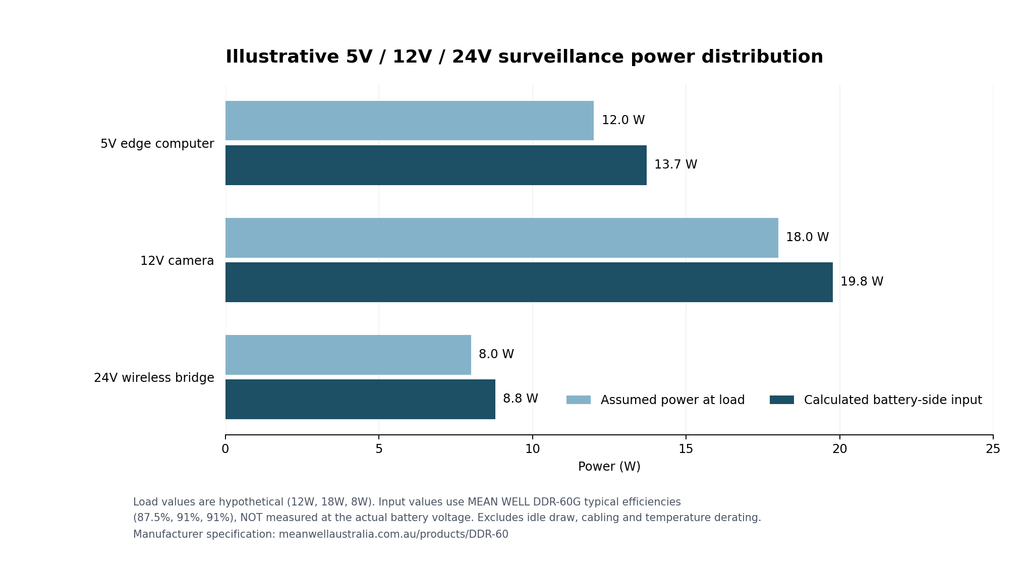
Illustrative output and calculated input power—not Kamada Power field measurements or actual NanoBeam peak consumption.
At an illustrative 12.0V bus, 42.3W draws about 3.5A; at 9V, about 4.7A if efficiency remained unchanged. Allow for cable drop; these converters are not rated below 9V.
The pack’s 1,200Wh nominal ÷ 42.3W ≈ 28.4 hours هو ideal arithmetic, not proven uptime. Actual runtime depends on usable Wh, approved cutoff, temperature and converter losses. For real loads use P_pack = Σ(P_rail / η_rail) + measured auxiliary draw, with measured efficiency at the expected operating point. See Kamada Power 12V/24V Sodium ion battery integration guide for the wider voltage-system topic.
What Failures Can One Shared 12V Bus Create Across the System?
A shared source creates common-mode risks, but a failure on one branch need not disable the others if protection and isolation work as designed.
| Fault observed | Possible result | ما الذي يجب التحقق منه |
|---|
| 5V branch or USB-C supply fault | Edge processor resets; cameras may still have power | Independent protection and Pi supply status |
| 12V camera branch fault | Camera loses power | Fuse/branch isolation and surviving bus voltage |
| 24V converter or passive-PoE fault | Wireless link drops | Injector polarity, output and branch protection |
| BMS discharge interruption or common-bus sag | All three rails may be lost or reboot | BMS event, bus waveform and unattended restart |
Provide properly rated branch protection; a converter’s own short-circuit function does not automatically replace wiring protection. Test fault isolation safely, without shorting wiring or bypassing the BMS.
The issue here is fault isolation among unequal-voltage loads, not generic 12V-versus-24V cable sizing.
When Is One 12V Pack Better Than a Different DC Architecture?
One shared pack may simplify inventory and packaging, but evaluate voltage overlap, protection, output derating, heat, continuity and charging before increasing capacity.
| Verified condition | Engineering and purchasing outcome |
|---|
| Every DC-DC input covers the planned service voltage, charger range and required restart conditions; all rail tests pass | Qualify that battery-bus design and hardware revision |
| Camera needs tightly regulated 12V; Raspberry Pi needs compatible USB-C power recognition | Use qualified regulated interfaces rather than direct nominal-voltage wiring |
| 24V radio needs an approved passive-PoE injector with correct pairs and adequate voltage at the device | Choose the correct converter/injector, not an arbitrary active-PoE source |
| Startup or low-input/temperature derating exceeds converter or BMS limits | Change power hardware or startup strategy; extra Ah alone is not proof of a fix |
| Voltage or BMS recovery is incompatible with the required service window | Change converter, shutdown policy or architecture; reject an unfixable pairing |
| Only runtime or per-pack current is insufficient and interfaces otherwise pass | Consider manufacturer-approved parallel expansion with measured current and Wh |
Approved parallel packs can increase reserve and sometimes reduce voltage sag, but do not create a 24V bank or cure an incompatible input threshold. Do not assume series approval. For high-power 24V loads, a different DC architecture may be more practical.
How Should an OEM Qualify the Complete Pack-to-DC-Distribution System?
اختبر الـ actual equipment BOM and exact pack revision:
- Voltage envelope: document 15.6V charging limit, 8V protective cutoff, approved LVD/LVR and BMS recovery. Measure voltage at each converter input, including cable drop and restart.
- Rail regulation: test USB-C source recognition, Pi input voltage and peripherals; 12V camera tolerance; 24V passive-PoE wiring and maximum device watts plus cable loss. Check ripple and voltage/temperature derating.
- Simultaneous power-up: capture current peaks, bus sag, 9V converter start requirement, BMS state and reboots; compare staggered startup.
- Branch interruption: use supported test controls to interrupt one branch and record whether other critical services remain available.
- Heat and recovery: measure enclosure temperature, converter derating, idle draw and automatic restart after approved low-voltage shutdown.
- Solar charging and energy balance: verify the pack-approved charger, BMS permissions and camera continuity. Over representative day/night cycles, log battery-terminal Wh charged and discharged, and confirm usable reserve does not decline across comparable cycles.
Pass only when all applicable battery, charger, converter and device requirements are documented and met. Log revisions and conditions. Redesign or reject a design that relies on bypassing protection or on unverified recovery.
What Should a Surveillance OEM Send for a Battery-Bus Review?
Send the 5V, 12V and 24V device BOM, measured/maximum watts, power interfaces and uptime priorities, plus converters, charger, schematic, operating temperatures, day/night Wh requirement and project volume.
Kamada Power 12V 100Ah sodium-ion Battery may be evaluated for a protected multi-voltage system. The 12V/24V sodium ion battery integration overview is general; here the issue is this pack, BMS and three-rail BOM.
الأسئلة الشائعة
Can one 12V battery directly supply 5V, 12V and 24V devices?
Not directly. Use appropriately regulated and connected DC-DC branches for devices requiring 5V, narrow-range 12V or 24V. Any direct connection must pass the full pack, charger and device voltage checks.
Can a 24V wireless bridge run on a 12V sodium-ion battery?
Potentially, through a properly rated boost converter and the bridge’s approved passive-PoE wiring. The NanoBeam example uses pairs 4/5 positive and 7/8 return; IEEE active PoE is not interchangeable.
Why might a 9–36V DC-DC converter stop before the battery reaches its lowest allowed voltage?
MEAN WELL specifies ON ≥9V و OFF ≤8.5V; operation below its rated 9V input is not assured. Kamada Power 8V is a protection cutoff, not a service target. Set an approved system LVD/LVR with cable-drop and restart margin, or change converters.
Will two parallel 100Ah packs solve a converter input-voltage problem?
No. Approved parallel operation increases possible reserve and changes load sharing, but not nominal bus voltage or a converter’s stated minimum input. Voltage sag may improve, yet input compatibility still needs testing.
الخاتمة
One Kamada Power 12V Sodium-ion Battery pack may power 5V computing, regulated 12V camera equipment and 24V passive-PoE communications through qualified DC-DC branches. The supplied 12V 100Ah sheet specifies 1,200Wh nominal, 15.6V maximum charging and 8V discharge cutoff; none alone establishes usable runtime or required service voltage. Check converter startup, derating, USB-C and PoE interfaces, branch protection and BMS recovery before ordering more Ah. للتواصل مع كامادا باور with your surveillance BOM, schematic, charger, operating temperatures and expected annual volume for a revision-specific compatibility review.